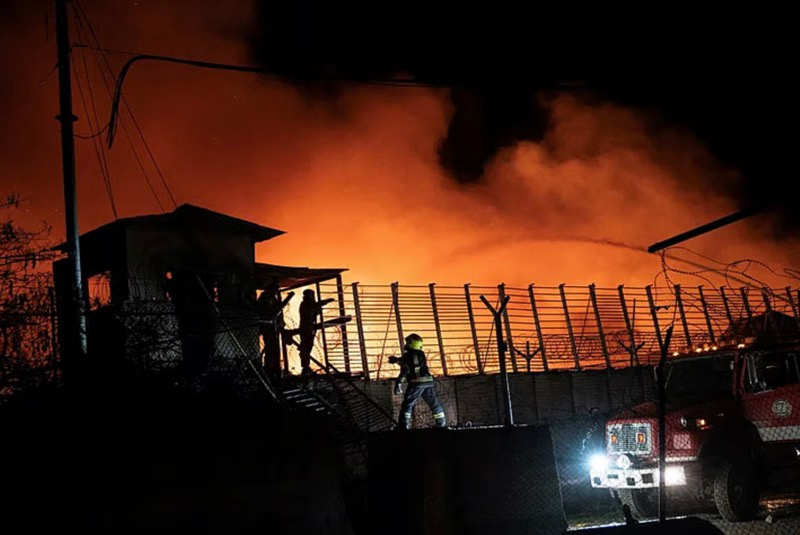
The barrage of missile strikes between Afghanistan-Pakistan border is no longer a skirmish or a manageable border dispute. Over four hundred people have died so far. More than two hundred and sixty people have been injured in the past few days. If this escalates further, it will have catastrophic consequences for the region and for the people of Afghanistan.
Pakistan’s Defence Minister Khawaja Asif declared in late February 2026 that the two countries are now in a state of “open war,” hours after the Taliban announced large-scale offensive operations along the border, also known as the Durand Line. The declaration was not surprising.
Pakistan had long considered itself to be the chief architect of the Taliban; the ISI chief, Lieutenant Genera Faiz Hameed, was caught on video sipping coffee at Kabul’s Serena Hotel after the takeover, smiling with a hint of mischief and muttering “Don’t worry. Everything will be Okay.”
But it wasn’t. Fissures erupted soon after. Tensions about sheltering Tehreek-e-Taliban Pakistan (TTP) in Afghanistan had been brewing beneath the surface between Pakistan and the Taliban for months, a scenario that analysts had been warning about for months.
The current conflict began in October 2025, when Pakistan carried out airstrikes in Kabul targeting the TTP leader, Noor Wali Mehsud, who survived the attack. Afghan forces carried out retaliatory operations that killed at least twenty three Pakistani soldiers.
Qatar mediated a ceasefire, but it was fragile. Subsequent talks in Turkey failed to produce a lasting agreement, and low-level skirmishes continued. By February 2026, with Pakistan striking targets in Kabul, Kandahar, and Paktika and Khost, the ceasefire was effectively dead.
Bilateral trade has collapsed—falling from $2.46 billion in 2024 to $1.77 billion in 2025—and Pakistan’s exports to Afghanistan fell by 56 per cent in early 2026. But the economic damage is a secondary story. The primary one is strategic, and it is darker than most public commentary acknowledge.
Those who follow Pakistan’s security establishment closely—and studied its long, tortured relationship with the Taliban and attempts to change the regime in Afghanistan—see a logic in what Islamabad is doing now that goes beyond retaliation for TTP attacks.
Pakistan’s first phase is aimed at degrading the Taliban’s military capacity: targeting ammunition depots, logistics infrastructure, and command nodes. This is punitive. Since 9 March 2026, Pakistan’s Air Force has attempted to destroy an ammunition depot in Kandahar (including attacking a suicide brigade in Paktika), Kabul and other provinces. These strikes have particular significance given the Taliban’s inability to easily resupply weapons under existing international sanctions.
Pakistani’s strategy is aimed at degrading the depots, constraining resupply, and diminishing the Taliban’s capacity to sustain a prolonged fight. However, credible sources who have closely studied ISI’s Afghanistan strategy suggest that Pakistan’s ambitions may not stop there. A second phase may involve targeting Taliban leadership directly, including the Supreme Leader Hibatullah Akhundzada.
Akhundzada, the Taliban’s reclusive Supreme Leader based in Kandahar, is the ideological head of the movement. His authority has sanctioned the total erasure of women from Afghan public life—from education, employment, and public spaces. His edicts are not merely administrative decisions. They are religious pronouncements that carry the force of a fatwa, making him Pakistan’s problem.
Unconfirmed reports suggest that some Taliban figures with historical ties to Pakistani intelligence have privately signalled to Islamabad and Washington that a post-Akhunzada Taliban would be more flexible. The logic, as reported in regional policy circles, is transactional: remove the ideological hardliner, and the movement’s more pragmatic factions might be willing to do business—including, reportedly, on the question of Bagram.
Trump has described Bagram as a strategic vantage point to monitor China, and has repeatedly said the Biden administration was “stupid” to leave the base. His administration has confirmed it is “trying to get it back.” Analysts have noted that while Taliban hardliners—especially the emir in Kandahar—are expected to resist any accommodation with Washington, other factions within the Taliban’s uneasy coalition may privately view a deal differently. Pakistani military officials have also reportedly signalled to Washington that they are willing to make this happen—clearing the path for the Americans to return to Bagram.
The Haqqani Network has historically been closely aligned with the ISI. Some have even described them as a “strategic asset” of Pakistani intelligence. Ergo, Sirajuddin Haqqani, currently interior minister, could emerge as the power broker in a post-Akhunzada dispensation, with Mullah Baradar providing political cover and Mullah Yaqoob—son of the movement’s founder and current minister of defence—lending religious and military legitimacy. This seems to align the ambitions of the Taliban pragmatists with ISI agenda.
However, Akhunzada’s religious authority cannot be underestimated. The Taliban’s recruitment base runs through the madrasas—tens of thousands of students on both sides of the Durand Line, whose ideological formation is inseparable from the authority of the Supreme Leader. Any move against him carries the risk of triggering not just internal fracture but mass mobilisation. Pakistan has already experienced what happens when madrasa networks are weaponised against the state—the TTP is itself partly a product of that blowback.
Islamabad’s strategy also involves mobilising the Afghan political opposition—figures currently based in Turkey, Tajikistan, and elsewhere in exile, possibly former President Karzai and former Chief Executive Dr Abdullah Abdullah. The intent, sources familiar with the planning say, appears less about genuine power-sharing than about lending a veneer of political legitimacy to a post-conflict arrangement that Pakistan would effectively shape from behind the scenes.
The opposition figures, for their part, may be too desperate for any opening to resist. That is a familiar trap in Afghan politics—being used rather than included, mobilised rather than empowered.
Pakistan has tried versions of this playbook before. It has cultivated, co-opted, and controlled Afghan political actors for decades—and the result has not been stability, but successive cycles of violence, displacement, and state collapse. The current military escalation, whatever its tactical logic, cannot yield a durable outcome.
The people of Afghanistan deserve to have a legitimate political leadership, not a reshuffle of the Taliban leadership with different ISI handlers. Creating a genuine political leadership requires constitutional mechanisms—a Loya Jirga with real representational legitimacy, not a choreographed assembly of co-opted elders. It requires a reform of the political system and meaningful decentralisation—a system in which communities, provinces, and regions hold real power, rather than one in which authority flows exclusively from Kabul or Kandahar. It requires the inclusion of women, minorities, and the full breadth of Afghan civil society—not as window dressing, but as decision-makers.
Armed warfare between Afghanistan and Pakistan would not favour Afghanistan, as it is ill-equipped to meet Pakistan head-on. But military asymmetry does not translate into political control. Afghanistan has defeated larger powers before—not through superior firepower, but by exhausting occupiers who underestimated the country’s internal complexity.
The Afghan people—women, ethnic minorities, people with disabilities, the communities that civil society has spent five years protecting and documenting—are not chess pieces in a Pakistan-Taliban negotiation. Any settlement that treats them as such will fail badly.
History is not short of examples. The question is whether anyone in Islamabad, Washington, or the halls of international diplomacy is paying attention.
Dr Timor Sharan is an Associate Fellow at the Centre on Armed Groups. He was previously a Visiting Fellow at the Pembroke Global Security Programme, University of Oxford, and Senior Analyst for Afghanistan at the International Crisis Group.
-30-
Copyright©Madras Courier, All Rights Reserved. You may share using our article tools. Please don't cut articles from madrascourier.com and redistribute by email, post to the web, mobile phone or social media.Please send in your feed back and comments to [email protected]