For decades, India’s missiles carried the faint imprint of foreign blueprints. It was a quiet indicator that the country’s defence ambitions were still tethered to outside hands. That changed only recently. Years ago, the chair of the Defence Research and Development Organisation announced, with measured pride, that India had achieved the long-pursued goal of producing its missile systems indigenously.
The statement was brief, technical, and understated. However, it represented the culmination of a journey set in motion four decades ago, when India’s place in the global technological order seemed uncertain. The transformation from that era to the present one, marked by self-confidence and the expansion of homegrown missile systems, traces a narrative of scientific tenacity, geopolitical anxiety, and a state’s quest to command the skies.
The origins of this trajectory lay in the 1980s, when India was still adjusting to the realities of a world, and where shifts in regional power dynamics had begun to unsettle policymakers in New Delhi. In 1983, the government launched the Integrated Guided Missile Development Program (IGMDP), an ambitious initiative to transform the country’s earliest missile families from fragile prototypes into operational weapons. The program was audacious, particularly for a nation that, at the time, struggled with access to critical components and navigated a maze of international restrictions designed to limit the spread of missile technology.
Nonetheless, researchers proceeded with a resolve that would later become characteristic of Indian defence science. The first fruit of this effort was the Agni project, whose maiden launch hinted at a future that seemed distant but not entirely out of reach: a medium-range, nuclear-capable missile developed under the country’s own roof.
If Agni represented the forward-looking aspirations of the IGMDP, Prithvi became its foundational workhorse. In 1988, after several years of testing and recalibration, India conducted the first successful launch of the Prithvi missile, a short-range, surface-to-surface system that was both technically modest and politically consequential. For a country still negotiating its technological adolescence, Prithvi provided proof that a guided missile, designed and assembled within the nation’s defence laboratories, could leave the Earth under its own power and land where it was instructed to land.
Over the decades that followed, the Prithvi line expanded into three variants—Prithvi I, Prithvi II, and Prithvi III—each responding to different operational needs and each adding a degree of maturity to India’s developing missile ecosystem. In 2015, a naval variant of the third model, named Dhanush, was test-launched from a ship, introducing the possibility that India’s missiles might one day lift not just from land but from sea.
However, even before Prithvi was completed, Agni had already established itself as the more symbolically potent sibling. The 1983 launch of Agni I marked not just the debut of a missile but the arrival of a national ambition: to develop a family of delivery systems that could reach farther, fly higher, and carry warheads of the magnitude reserved for situations one hopes never to encounter.
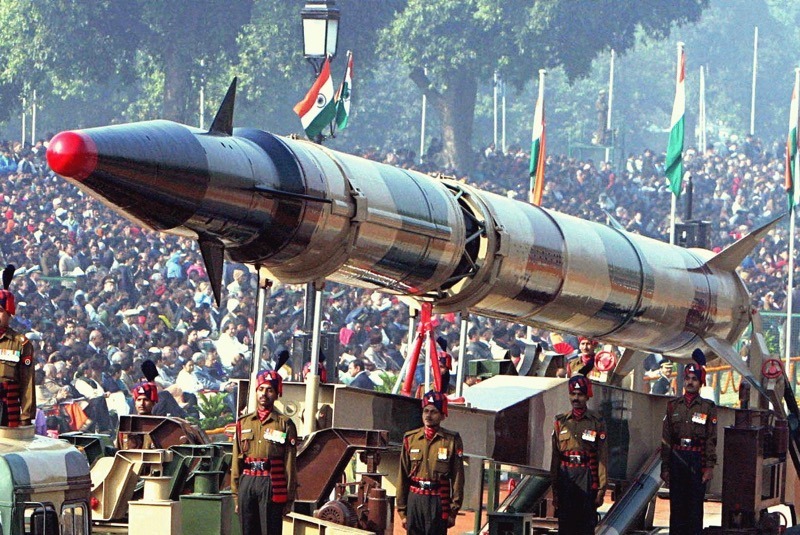
Over time, the Agni series grew into a seven-member lineage—Agni I through Agni V, the newer Agni-P, and the still-in-development Agni VI. Each model extended the reach of the one before it, in both range and sophistication. At the same time, the Agni-P introduced advanced materials and guidance systems, signalling India’s shift toward lighter, more manoeuvrable ballistic technologies. The Agni missiles came to function as strategic punctuation marks in India’s defence posture, visible reminders that thermonuclear capability had been grafted onto an indigenous technological framework.
After the Kargil War in 1999, the character of India’s missile efforts changed again. This time, it was shaped by the sobering realisation that its northern and western borders no longer afforded the luxury of technological complacency. The conflict, fought in the mountainous terrain of Kashmir, offered an unsettling glimpse of Pakistan’s developing missile capability, aided in part by China.
During this period, the DRDO formulated the Ballistic Missile Program, an umbrella effort intended to shield the nation from incoming missiles, including those carrying nuclear warheads. Where the IGMDP had been concerned primarily with building offensive capabilities, the new program carried a dual mandate: to enhance India’s defensive layers while integrating them with the offensive assets already under development.
The Ballistic Missile Program crystallised into two major subsystems: the Prithvi Air Defence, or PAD, and the Advanced Air Defence, or AAD. Combined, they formed a two-tier shield designed to intercept hostile ballistic missiles at different altitudes. The PAD system, which protects at high altitudes, is slated to be replaced by a more advanced interceptor known as the Pradyumna. The AAD, on the other hand, is meant to operate at lower altitudes, addressing threats that manage to slip past the upper layer of the defence grid.
Parallel to these systems were the operational Akash and Trishul missiles, each representing a distinct approach to air defence. Akash, a surface-to-air missile with a range of up to 30 kilometres, offered a domestically made alternative to imported air defence systems. Trishul, smaller and more versatile, was designed for use across the army, navy, and air force. Together, these systems gave India a defensive vocabulary that it had previously lacked, one composed not merely of deterrence but of interception.
The country’s evolving missile repertoire did not end at the shoreline. As India’s naval ambitions broadened and its submarine fleet modernised, the prospect of a sea-based deterrent—protected by the invisibility of ocean depths—became essential. This shift found expression in the K-15 Sagarika, a submarine-launched ballistic missile tested in 2008. With a range of roughly 750 kilometres, the K-15 introduced the possibility of a second-strike capability anchored in Indian waters, a development with profound implications for regional deterrence.
The presence of an SLBM signalled a quiet but unmistakable assertion: India’s nuclear capabilities were no longer constrained to land. Dhanush, the ship-launched variant of Prithvi III, complemented this effort by providing a short-range option for naval platforms operating closer to shore. Though its reach was modest, at 350 kilometres, its significance lay in the diversification of India’s launch modes, extending the logic of self-reliance into maritime space.
The expanding constellation of India’s ballistic missiles—Agni III and Agni V with their long-range capacities, and Shaurya, whose canister-based design provided rapid-launch flexibility—formed a system that had grown not only in breadth but in maturity. Many of these missiles were explicitly engineered to neutralise or deter nuclear threats, arriving not as symbols of aggression but as insurance policies in a region where miscalculation has historically hovered too close to the surface. Their development occurred within a geopolitical neighbourhood that rarely afforded India the luxury of time; yet it was precisely the sustained passage of time and the disciplined refinement it allowed that enabled the country to assemble the technologically complete missile ecosystem it now claims.
By the time India was producing most components of its missiles domestically, the achievement felt less like a surprise than the final line of a long-anticipated chapter. It represented more than an inventory of indigenous parts; it marked the culmination of a national arc in which science, strategy, and sovereignty converged.
The story of India’s missiles, once defined by external constraints and incremental progress, has evolved into something more assured. It reflects a country that has learned to translate insecurity into innovation, setbacks into institutions, and ambition into the silent trajectories of objects that rise from launch pads, curve across the sky, and descend with a precision that suggests mastery rather than mere aspiration. The story is not yet complete—no story involving national defence ever is—but it now belongs unequivocally to India.
-30-
Copyright©Madras Courier, All Rights Reserved. You may share using our article tools. Please don't cut articles from madrascourier.com and redistribute by email, post to the web, mobile phone or social media.Please send in your feed back and comments to [email protected]