
In October of 2025, Ethiopia’s foreign minister, Gedion Timothewos, dispatched an urgent letter to the United Nations. Eritrean troops, he wrote, were advancing into contested areas, moving through Tigray, entrenching themselves where they did not belong. He alleged coordination between Asmara and the Tigray People’s Liberation Front, and accused Eritrea of bankrolling armed movements in Ethiopia’s Amhara region, where militias known as Fano had turned their guns on the federal state.
Eritrea’s government dismissed the charges as an invention. But in the Horn of Africa, denials have rarely been sufficient to calm the tremor that precedes a storm. By early 2026, the atmosphere between Addis Ababa and Asmara had grown brittle.
Ethiopian officials formally demanded the withdrawal of Eritrean forces from what they described as sovereign territory. Eritrea replied with indignation, rejecting the premise of the accusation.
The exchange was ritualistic—statement and counterstatement, grievance and rebuttal—but it carried the unmistakable scent of escalation. The region, already destabilised by the protracted war in neighbouring Sudan, seemed to hover at the edge of another armed confrontation. The question was no longer whether mistrust existed; it was whether mistrust had hardened into inevitability.
At the centre of the dispute lies an issue that appears deceptively simple: access to the sea. Ethiopia, a nation of well over one hundred million people, has been landlocked since Eritrea’s formal independence in 1993. The loss of coastline along the Red Sea was not merely geographic; it was psychological.
Ports are apertures to the world, conduits of commerce and imagination. Without them, a country must negotiate its passage through the goodwill of others. Ethiopia’s economy depends heavily on Djibouti’s ports, a reliance that rankles many in Addis Ababa. In speeches over the past several years, Prime Minister Abiy Ahmed has invoked what he calls Ethiopia’s historical relationship to the sea, suggesting that the port of Assab—just sixty kilometres from the Ethiopian border—occupies a special place in the nation’s memory. For Eritrea, such rhetoric sounds less like nostalgia than encroachment.
Yet maritime ambition alone does not explain the present chill. The deeper fissure formed in the aftermath of the Tigray war, which began in November 2020 and officially concluded two years later. Eritrea had entered that conflict on the side of Ethiopia’s federal government. For President Isaias Afwerki, the Tigray People’s Liberation Front (T.P.L.F) was not merely a domestic Ethiopian rival; it was a historic adversary.
The T.P.L.F. had once been a close ally of Eritrea’s ruling party during the long struggle against the Derg regime, but alliances forged in revolution often curdle in victory. When the border war of 1998 erupted, Ethiopia was governed by a coalition dominated by the T.P.L.F., and Eritrea found itself fighting the partners with whom it had once shared trenches. The resentment lingered long after the guns fell silent.
The Tigray war reopened that wound. Eritrean troops were widely reported to have played a decisive and brutal role in the fighting, and allegations of atrocities proliferated. When the conflict ended with a peace agreement between the Ethiopian government and Tigrayan authorities, Eritrea was conspicuously absent from the negotiating table.
In Asmara, this omission was read as a slight, even a betrayal. If Eritrean soldiers had bled to defeat the T.P.L.F., why was Eritrea excluded from the architecture of peace? From that grievance emerged a consequential shift. Ethiopian officials now claim that Eritrea has begun cultivating ties with its former enemy, extending support—covert or otherwise—to Tigrayan elements and other insurgent groups within Ethiopia.
To understand how such reversals become possible, one must return to 2018, a year that briefly promised a different trajectory. When Abiy Ahmed assumed office as Ethiopia’s prime minister in April of that year, he moved swiftly to mend relations with Eritrea. The border between the two countries had been sealed for nearly two decades, a frozen scar left by a war that killed tens of thousands.
The Algiers Agreement of 2000 established a ceasefire and created a boundary commission to delimit the frontier, but the demarcation remained contested, and the border remained heavily militarised. Abiy’s overtures culminated in a dramatic thaw. Flights resumed. Families separated by years of hostility reunited. The international community celebrated the rapprochement as a triumph of pragmatism over pride, and Abiy was awarded the Nobel Peace Prize.
The embrace, however, proved less a reconciliation than a truce born of convenience. Abiy’s ascent marked the end of nearly three decades of rule by the Ethiopian People’s Revolutionary Democratic Front, a coalition dominated by the T.P.L.F. For Eritrea’s leadership, this political transformation in Addis Ababa was an opportunity.
Peace with Ethiopia under Abiy also meant the marginalisation of an old foe within Ethiopia’s power structure. But when conflict later erupted between Abiy’s government and Tigrayan forces, the alignment hardened into a wartime alliance. Eritrea’s participation in the Tigray war deepened its entanglement in Ethiopia’s internal politics, making the subsequent exclusion from peace talks all the more galling.
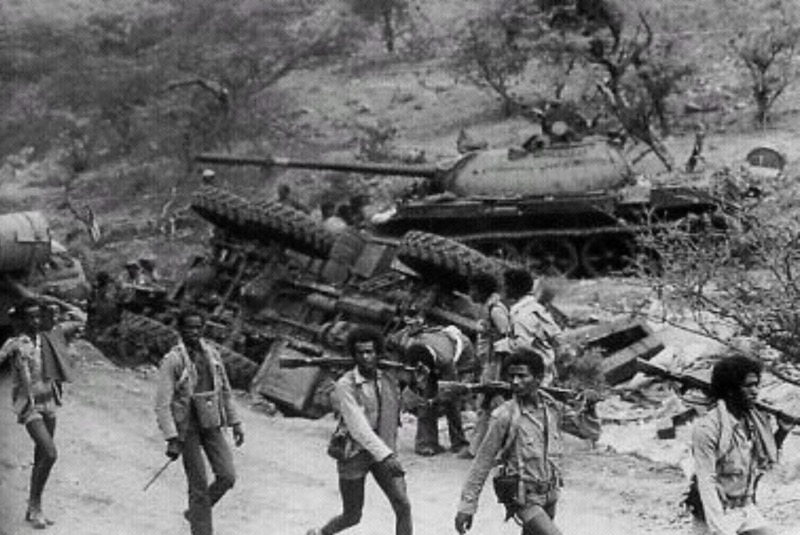
Ironically, the two nations have always been entwined in ways that defy easy separation. Eritrea was federated with Ethiopia in 1952 and annexed a decade later, a move that sparked an armed struggle for independence beginning in 1961. That war lasted three decades, ending in 1991 when Eritrean forces captured Asmara, and a referendum in 1993 confirmed independence.
For many Eritreans, sovereignty is the hard-won prize of generational sacrifice. For many Ethiopians, the separation remains a source of quiet sorrow, a historical amputation that severed not just territory but identity. These parallel narratives—liberation on one side, loss on the other—continue to shape political imagination.
The border war that erupted in 1998 over the small town of Badme revealed how combustible those narratives could be. What began as a localised dispute escalated into one of Africa’s deadliest interstate conflicts in recent memory. Trenches carved into the earth evoked the battlefields of an earlier century.
The Algiers Agreement halted the fighting, but it did not extinguish suspicion. A heavily militarised frontier, punctuated by a buffer zone, became the physical manifestation of unresolved grievance. Peacekeepers could monitor silence; they could not manufacture trust.
Today, the Horn of Africa is again at an inflexion point. Ethiopia signals that it remains open to dialogue, even suggesting that maritime access and broader security concerns could be addressed through negotiation. Eritrea, for its part, insists that accusations of interference are baseless.
The African Union, headquartered in Addis Ababa, occupies an awkward vantage point: both host and potential mediator. The region’s recent history offers ample warning of how quickly rhetorical skirmishes can metastasise into armed confrontation.
Whether war is inevitable depends less on troop movements than on political imagination. Leaders on both sides face domestic constituencies attuned to sovereignty and pride. In Ethiopia, the call for dependable sea access resonates as a matter of national destiny. In Eritrea, vigilance against perceived encroachment is woven into the state’s founding myth.
Each government interprets the other’s gestures through a historical lens, shaped by decades of conflict. A request for negotiation can sound like a prelude to coercion; a defensive deployment can resemble preparation for invasion.
And yet, their shared history may offer a counterargument to fatalism. Nations that have fought together and against each other, that have alternately embraced and estranged, possess an intimate understanding of the costs of miscalculation. The memory of the 1998–2000 war, of the Tigray conflict, of families divided by closed borders, remains fresh.
The Horn of Africa does not require another proving ground for grievances. Instead, it requires a recalibration of ambition and fear—a recognition that geography need not dictate destiny, and that even the most entangled histories can, with sufficient restraint, avoid repeating themselves.
-30-
Copyright©Madras Courier, All Rights Reserved. You may share using our article tools. Please don't cut articles from madrascourier.com and redistribute by email, post to the web, mobile phone or social media.Please send in your feed back and comments to [email protected]