Constitution Day: Celebrating the Preamble or the Politics of Symbolism?

preamble_to_the_constitution_of_india_madras_courier
Representational Image. Public domain
Events like the Samvidhaan Diwas— Constitution Day—do not carry much substance as far as the Constitution is concerned,

November 26 is observed as Constitution Day—also known as Samvidhan Diwas— since 2015. This is an initiative of the NDA regime. For some strange reason, November 26, which is of great significance in our national life, went unnoticed till then. But what does it signify? It was on this day, in 1949, that the Constituent Assembly enacted and adopted the Constitution of India on behalf of ‘We the people of India’. We never had a constitution till then.

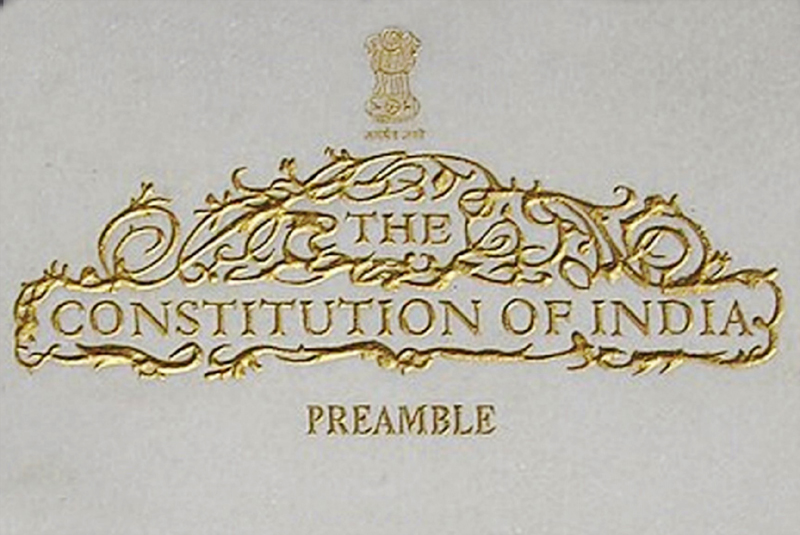
The Preamble to the Constitution of India solemnly states: WE, THE PEOPLE OF INDIA, having solemnly resolved to constitute India into a SOVEREIGN SOCIALIST SECULAR DEMOCRATIC REPUBLIC and to secure to all its citizens: JUSTICE, social, economic and political; LIBERTY of thought, expression, belief, faith and worship; EQUALITY of status and of opportunity; and to promote among them all FRATERNITY assuring the dignity of the individual and the unity and integrity of the Nation; IN OUR CONSTITUENT ASSEMBLY this twentysixth day of November, 1949, do HEREBY ADOPT, ENACT AND GIVE TO OURSELVES THIS CONSTITUTION.

The Constituent Assembly held its first sitting on the 9th of December 1946. After spending 1083 days in discussion and deliberation to draft a constitution for independent India, it wrapped up its work on the 26th of November 1949. The Constituent Assembly was a part of the Cabinet Mission plan. Responding to the growing demand for independence, the British Government realised it was time to wind up shop in India and, as a step in that direction, sent the Cabinet Mission consisting of three cabinet ministers—Pethick Lawrence, Stafford Cripps and AV Alexander—to India.

It had two issues on its agenda: setting up a Constituent Assembly to draft a constitution for independent India and to institute an Interim Government from the Constituent Assembly. While many of the Mission’s proposals did not receive a favourable response from the leaders of the freedom movement, its two principal ideas fructified, and a Constituent Assembly was set up with Rajendra Prasad as its President, and an Interim Government headed by Jawaharlal Nehru, which was sworn in on 2 September 1946. The Constituent Assembly functioned from 9 December 1946 to 26 November 1949. Subsequently, it became the provisional Parliament until a new Parliament was constituted by holding the first general elections based on universal adult suffrage in independent India, a heady experience, the first of its kind in our 5000-year history.

The Constituent Assembly consisted of elected members as well as nominated members representing various shades of opinion. Many eminent freedom fighters found a place in the Assembly, who considerably influenced and enriched its proceedings and proposals. While several subcommittees addressed specific issues, a drafting committee headed by BR Ambedkar oversaw the drafting of the Constitution. It was the Drafting Committee which processed the proposals received from the sub-committees and codified them into a legal framework.

The provisions thus codified were intensely discussed and debated by members; several amendments were carried out, eventually leading to the emergence of a draft Constitution that was enacted and adopted on 26 November 1949. The draft Constitution came into force on 26 January 1950, which is known as the Republic Day. It did not occur to any bigwig in the Government to have a Constitution Day to commemorate 26 November, the day the draft Constitution was enacted and adopted.

This idea was conceived by the NDA Government in 2015. Since then, Constitution Day, also known as Samvidhaan Diwas, is observed every year on 26 November. It is a good initiative. However, curiously, the event is handled by the Ministry of Social Justice, while the Constitution of India comes under the purview of the Ministry of Justice. The intention behind the move is obviously to please the Dalits rather than to demonstrate respect for the Constitution. Otherwise, this event should have been handled by the Ministry of Justice, which is the custodian of the Constitution of India. What would it look like if the Ministry of Textiles, Agriculture, or the Ministry of Civil Aviation is roped in for this occasion? 

Irrespective of which Ministry handles the event, there is no denying that the Constitution comes into focus on this day. In schools and colleges across the country, the Constitution and its salient features, such as the Preamble, Fundamental Rights, Directive Principles, and Fundamental Duties, are discussed to foster awareness and understanding of the nation’s principal document. But, is it enough to set aside just a day in educational institutions to reflect on the Constitution? Does this gesture foster respect for the Constitution, let alone raise awareness of it? When do we come out of the obsession with symbolism? When do we learn to pay attention to substance?

The Constitution of India should be made part of the curriculum in higher education, such as engineering, medicine, and management, rather than just a lesson for tenth-grade students who are not mature enough to understand its importance. But no such move is on the anvil, though it is the Union Government that controls the curriculum of higher education in the country. At the school level, teachers are not equipped to explain the Constitution’s salient features, nor are students mature enough to understand its significance. This is not just like another lesson.

The Constitution of India deserves better than what it is getting from we the people. The Constitution is not just a legal document; it is a doctrine of faith reflecting the hopes, aspirations, and even the fears and frustrations of the people. It was crafted by some of the best minds of the time, who were genuinely fired by a zeal to build a brave new nation by making the Constitution an instrument to that end. They drew inspiration from some of the leading constitutions of the world. That is how it has features, making it an engine capable of ushering in a just social order.

In one stroke, it wiped out the infirmities suffered by we the people based on caste, creed, gender and estate since time immemorial. The rule of law is the abiding principle of the principal parchment of the soil. It declared all citizens as equals and seeks to give credit to achieved status than acquired status. Our Constitution has the potential to become a rallying point to promote the unity and integrity of the nation, if we care to teach its values to our youngsters.

What prevents the state from making the Preamble part of the prayer in every school across the country? Why can’t every student seeking entry to engineering, medicine and management read out the Preamble of the Constitution at the time of admission? We hardly see any parents buying a copy of the Constitution as a birthday gift for their children, even though the Constitution is not expensive. It costs much less than a movie ticket in a multiplex! Unfortunately, we think of the Constitution only when our rights are infringed and not otherwise. How many educated people are aware of the chapter on fundamental duties enshrined in the Constitution?

Of course, it would be straining credulity to exhort young minds to develop scientific temper, humanism, and the spirit of inquiry and reform when the prima donna of the ruling dispensation indulges in ritualistic fanfare at state events, such as building inauguration and foundation stone laying ceremonies. It is equally incredulous to exhort young minds to safeguard public property and abjure violence when elected representatives who take an oath in the name of the Constitution resort to destruction of public property to express their protest over public policy which, in their view, is detrimental to public interest.

Today, we often see the sorry spectacle of ministers proclaiming their allegiance to Sanatan Dharma, which is in direct conflict with our constitutional values of liberty, equality, fraternity, justice, secularism, and scientific temper. Thus, it remains a symbolic gesture, an image-building exercise for the biggies in the Government. It is an undeniable fact that the Constitution has been reduced to a pawn by the political parties. When the institutions of the Constitution are effeminate, what suffers is good governance, the welfare of the people, and nation-building.

We often blame the Constitution for all our ills; but the Constitution is not a person. It is a doctrine, and its efficacy depends to a large extent on the way we work it. So, it is not the Constitution that failed us; it is we who failed the Constitution. It is not that the Constitution is not without its foibles. The Fundamental Rights are the cornerstone of the Constitution. While these rights are available to all citizens, in reality they are accessible to the educated, employed and entrepreneurial sections of society.

The rickshaw puller, the street vendor, the slum dweller, the domestic worker and the farm labourer hardly have any use of these rights. How do we make the Constitution relevant to them, who constitute a vast majority of the teeming millions of the masses in this country and hardly use these rights? Many people find it difficult to travel to the district headquarters; that being so, can we imagine them to knock on the doors of the High Court, much less the Supreme Court if the State infringes their rights? They hardly know they have rights in the first place. Existence precedes essence. When livelihood is still a big deal for millions of people, liberty is not relevant to them.

In many cases, the Supreme Court judge and a junior civil judge have the same qualifications. Not even a district judge can touch the Constitution; the same judge can decide issues involving the Constitution when elevated to the High Court. Why can’t the district courts tackle constitutional matters? At least, cases relating to fundamental rights can be dealt with by the Sessions Courts. But that is not the case, and nobody is thinking on these lines. Why is it so?  

Therefore, it is important to understand that events like the Samvidhaan Diwas are more of a symbolic gesture that does not carry much substance as far as the Constitution is concerned, for another reason. Today, there are many people in the country who believe that the Constitution and the institutions created by the Constitution are increasingly coming under stress and strain due to the policies of the Union Government.

Institutions under the Constitution, such as the Parliament and the Election Commission, are losing their autonomy and becoming handmaids of the Executive. The Election Commission is the worst victim in the process. There is the Opposition in Parliament to raise its voice, however feeble it may be, to corner the Executive for its acts of commission and omission, though the Executive hardly pays any attention to the views of the Opposition.

The Opposition thinks that it must oppose the Executive all the time and the Executive thinks that it need not pay any heed to what the Opposition says. When everything is perceived as politically motivated, how do the Constitution and consensus figure into our public discourse? Politicians do politics, what else do they do? We blame the politicians for all our plagues. And, what do we the people do? Fall an easy prey to political machinations! Isn’t selling the vote an unpardonable sin? How can you sensitise people in this context? How do we tackle the menace of money power and muscle power in elections, which make our democracy a mockery of sorts?

And, what is the role of the media in this sordid drama? The media has lost its vibrancy as the principal agent of vigilance. Leading media organisations are owned by industrial houses that use their publications and channels as platforms to advance their business interests rather than to highlight public issues.

Today, people feel they need freedom from the press than freedom of the press. Such is the biased nature of reporting events and analysing issues by the mainstream media, people are turning to social media for a better perspective and greater clarity on public issues, not that social media is free from bias. But at least one can air one’s views on social media about matters of interest. 

Finally, the court has become a mute witness to the current absurd drama. It is under these unedifying circumstances that we observe the Constitution Day. Is it an occasion to celebrate or to reflect on where we went wrong? The good thing about this event is that it is not a public holiday to be spent in cinema halls or at picnic spots. It is a working day. One can choose to reflect rather than relax!

-30-

Copyright©Madras Courier, All Rights Reserved. You may share using our article tools. Please don't cut articles from madrascourier.com and redistribute by email, post to the web, mobile phone or social media.
Please send in your feed back and comments to [email protected]
0 replies on “Constitution Day: Celebrating the Preamble or the Politics of Symbolism?”