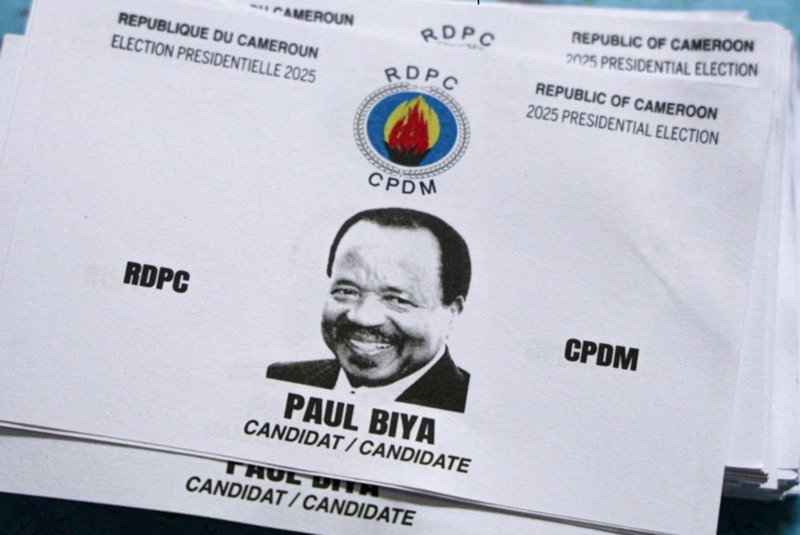
Paul Biya, who has held power in Cameroon for over forty years, is an increasingly anachronistic figure, a ruler who has long outlived any legitimate claim to political vitality. Now 92 years old, he has become not just a symbol of Africa’s lingering autocratic tendencies, but of the extraordinary lengths to which power can be retained through deceit, manipulation, and coercion.
At a time when the political landscape in much of the world is evolving—where younger, more dynamic leaders are coming to power—Biya remains obstinately ensconced in his palace in Yaoundé, resolute in his refusal to relinquish control. His rule, like the frail body of the man himself, seems frozen in time, sustained only by a perverse system of electoral fraud, state-sponsored violence, and a patronage network that binds the country’s elite to his continued dominance.
When Biya first came to power in 1982, after the sudden resignation of his predecessor, Ahmadou Ahidjo, it was under the guise of a peaceful transition. A former prime minister, Biya was heralded as a moderniser, a break from the authoritarian regime that had defined Cameroon since independence.
In the early years of his presidency, he cultivated an image of reform and engagement with the outside world, promising democratic change and economic stability. Yet, like many autocrats before him, he quickly understood that power, once seized, was best kept through deception rather than reform.
Cameroon’s electoral history is a litany of rigged elections, from the first contested presidential race in 1992, in which Biya narrowly defeated opposition leader John Fru Ndi despite widespread allegations of fraud, to the more recent election, where his victory was again contested, with accusations of voter suppression, ballot-box stuffing, and the systematic disempowerment of the opposition. Each time Biya is declared the winner, it is as if the country collectively exhales, and then forgets—until the next farcical poll.
The manipulation of elections is not merely a symptom of a corrupt system. It is its lifeblood. The Cameroonian electoral process is a carefully crafted sham, where outcomes are determined before a single ballot is cast. The country’s elections are dominated by a cadre of Biya loyalists, from the judiciary to the military, who ensure that the system remains firmly in his control.
The opposition, though not entirely without a voice, is silenced or bought off; their candidates and campaigns are either neutralised or compromised by the pervasive influence of state power. Biya, knowing full well that his grip on power rests on the ability to bend the electoral process to his will, has ensured that the government remains the sole arbiter of legitimacy. As the years pass, the absurdity of these exercises in democracy becomes increasingly apparent. Biya’s face, weathered with age but ever-present on billboards and state-controlled media, serves as a reminder that in Cameroon, democracy is little more than a formality.
In many ways, the longevity of Biya’s rule reflects the broader structural shortcomings of the African political landscape. Where one leader fails to relinquish power, the country itself becomes trapped in a cycle of stagnation. The ruling elite, unable or unwilling to challenge him, benefits from the status quo.
Those who might otherwise rise to challenge the president, either through political reform or by offering an alternative vision of governance, are either co-opted or crushed. Biya’s patrons in the military and in business remain loyal because they know that, as long as he remains president, they remain in control of the state’s resources. This patronage system, far from being a side effect of autocracy, is the foundation upon which it rests. No one has an interest in toppling the system; they merely wish to maintain their share of the spoils.
The toll of Biya’s extended rule has been felt most acutely by the country’s youth, whose aspirations have been consistently thwarted. A generation of Cameroonians has grown up under the shadow of a leader who, despite his advanced age, shows no sign of abdicating or yielding to popular pressure. The youth, who are politically engaged and increasingly vocal in their demands for change, find themselves facing an iron-clad government that controls both the means of repression and the mechanisms of electoral legitimacy.
The government’s response to calls for reform has been one of indifference and brutality. Protests are crushed with force. Opposition leaders are detained or silenced. Attempts at meaningful dialogue are obstructed. In the rare moments when Biya does make an appearance—often from his guarded residence, appearing frail and distant—he offers little more than platitudes about national unity, which, in practice, is only ever enforced through state violence.
One of the most glaring examples of Biya’s commitment to power at all costs is his handling of the Anglophone crisis. Beginning as a peaceful protest over the marginalisation of the country’s English-speaking regions, the conflict has evolved into a full-blown insurgency, with thousands dead and over a million displaced.
The government’s response has been one of overwhelming military force, and Biya, for his part, has shown little interest in engaging in meaningful dialogue. In his mind, the Anglophone crisis is a mere challenge to his authority, to be dealt with through brute force rather than political concession.
The crisis has brought international condemnation, but Biya, secure in his relationship with France, the United States, and other Western powers, remains unshaken. His ties to international diplomacy, primarily because of Cameroon’s role in the region’s fight against terrorism, allow him to continue with impunity.
No external power has done enough to challenge his rule decisively. At most, they issue statements, but they are never followed by concrete actions that would force him to relinquish control.
There is a grim irony in the fact that Biya, in his waning years, remains steadfast in his refusal to loosen his grip on the country. His health, once described as fragile, has only seemed to exacerbate the perception of a man whose reign is held together by sheer will and sheer force of habit.
Biya, a man who has spent decades navigating the intricacies of political survival, now faces a new challenge: the fact that his very longevity has become his most effective weapon. The longer he remains in power, the weaker his opposition becomes, the more his grip on the country solidifies. What began as a career of political manipulation has evolved into an almost pathological refusal to let go, a man who will not relinquish his perch even as the world moves on without him.
There are moments, however, when Biya’s regime seems to be showing cracks. The country’s younger generation, increasingly connected and mobilised, is more attuned to the need for change. The international community, too, is slowly beginning to recognise that the status quo is no longer sustainable.
However, these moments, fleeting as they may be, are quickly dismissed by a regime that has weathered decades of criticism. Biya’s Cameroon is a place where the forces of repression, indifference, and coercion have created a political system where the past, present, and future are indistinguishable; where the idea of change is a mere abstraction, ever distant, forever postponed.
In the end, Paul Biya may prove to be one of history’s most enduring—and tragic—figures: a man whose reign, sustained through fraud and manipulation, has left Cameroon adrift. His grip on power is a reminder of the dangers of unchecked authoritarianism and the lengths to which those in power will go to preserve their rule.
As the world watches, one can only wonder how much longer Cameroon will have to wait for its long-overdue political transformation.
-30-
Copyright©Madras Courier, All Rights Reserved. You may share using our article tools. Please don't cut articles from madrascourier.com and redistribute by email, post to the web, mobile phone or social media.Please send in your feed back and comments to [email protected]