The Shahbazgarhi Edicts & A Buddhist Past That Predates Pakistan

shahbazgarhi-buddhism-madras-courier
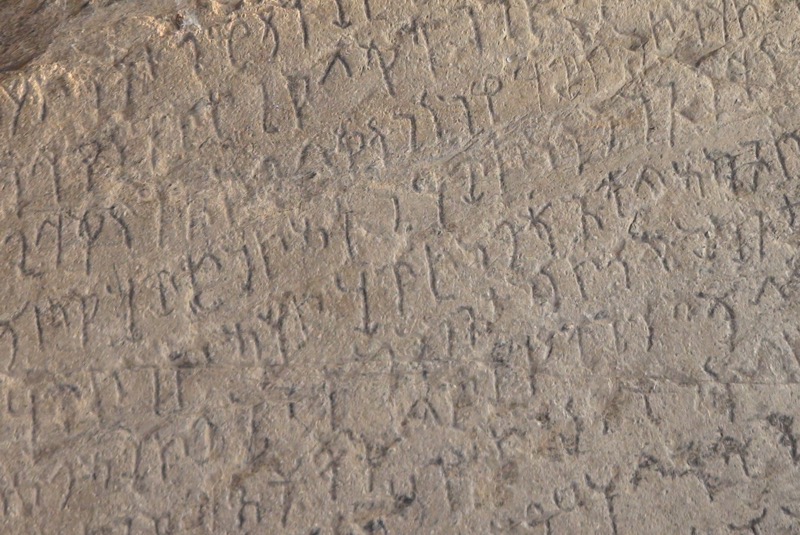
Representational Image: Public domain/Wikimedia
The Shahbazgarhi inscriptions remind us that the subcontinent’s history has always been shared, even when its futures were not.

Long before the cartographic lines that now divide South Asia were drawn, before passports, border posts and the anxious vocabulary of partition, there reigned on the subcontinent a king whose afterlife would be longer and stranger than most empires. Ashoka Maurya, who ruled in the third century BCE, sits uneasily in the modern imagination: at once an ancient conqueror and an apostle of restraint, a figure claimed with equal confidence by India’s secular republic and by Buddhist traditions that stretch far beyond it.

In contemporary India, his presence is ceremonial but unmistakable—the national emblem is adapted from the lion capital of the Ashoka pillar at Sarnath, and the wheel at the centre of the tricolour flag is the Ashoka Chakra. Ashoka’s empire once covered territory that now lies in India, Pakistan, and Bangladesh. The physical traces of his rule remind us that history has a way of disregarding the borders we insist upon. It is, therefore, inevitable that some of the most revealing evidence of Ashoka’s moral and political imagination survives in what is now Pakistan.

Among the most significant of these are the rock edicts at Shahbazgarhi, near present-day Mardan in Khyber Pakhtunkhwa. Carved into stone in the Prakrit language and written in the Kharosthi script, these inscriptions belong to the set known as the Major Rock Edicts, fourteen proclamations distributed across the Mauryan realm.

They are not laws in the narrow sense, nor are they theological treatises. Instead, they are personal and, for an ancient king, unusual: public meditations on power, remorse, and ethical conduct. Several edicts allude to Ashoka’s embrace of what he called Dhamma—a moral law indebted to Buddhism but articulated in a vocabulary meant to be legible across religious communities.

One edict, echoed in others across the subcontinent, refers obliquely to the king’s transformation after the Kalinga War, fought roughly eight years into his reign. The carnage of that campaign, which brought a resistant region on the eastern coast under Mauryan control, is described in stark terms elsewhere: hundreds of thousands killed, or otherwise ruined. The shock of that violence, Ashoka tells us, altered him irrevocably.

The king who emerges from these inscriptions is a figure who seeks to be remembered for stepping back from conquest without relinquishing authority. After Kalinga, Ashoka renounced the royal hunt and replaced it with pilgrimages; he spoke less of victory in battle and more of victory over the self. The language he used was pointedly ethical rather than doctrinal.

While Buddhist concepts clearly inform his vision—nonviolence, compassion, restraint—he avoids explicit discussion of Buddhist metaphysics or ritual. This reticence appears deliberate. Ashoka governed a vast, pluralistic empire, populated by Brahmanas, Sramanas, householders, traders, and communities whose beliefs we can only partially reconstruct. His Dhamma was meant to travel across these differences, a moral Esperanto rather than a sectarian creed.

The Shahbazgarhi edicts, weathered and fragmentary, can be frustratingly opaque, but even their ambiguities are revealing. In one passage, Ashoka observes, “There is no country where these two classes, the Brahmanas and the Sramanas, do not exist, except among the Yonas.” The Brahmanas were the custodians of Vedic ritual; the Sramanas were renunciant ascetics, a category that included Buddhists, Jains, and other wandering seekers. The Yonas—generally understood to mean Greeks—are singled out as an exception.

In the northwestern reaches of Ashoka’s empire, Greek communities still lingered in the wake of Alexander the Great’s campaigns, and Ashoka’s remark suggests both an awareness of cultural difference and an assumption that the presence of renunciant orders marked moral civilisation. The line is brief, but it hints at a world knitted together by conquest, trade, and uneasy coexistence, in which an Indian emperor could casually compare the religious landscapes of his realm and its neighbours.

Another verse from Shahbazgarhi reads, in translation, “This is meritorious. This practice should be observed until the desired object is attained. After it is attained, I shall observe this again.” The object remains unnamed, the practice unspecified, but the cadence suggests a disciplined repetition familiar from Buddhist ethical training. Ashoka’s voice here is not that of a distant lawgiver but of a participant, someone who submits himself to the moral regimen he urges upon others. The effect is subtle but powerful: kingship is reframed not as exemption from restraint but as its most visible test.

Throughout the edicts, Ashoka refers to himself by a title that is grand and curiously intimate: Devanampriya Priyadarsin Raja. Devanampriya means “Beloved of the Gods,” while Priyadarsin can be rendered as “He Who Looks with Favour” or “Of Gracious Appearance.” Taken together, the title suggests a ruler who stands in a special relationship to the divine while also extending benevolence downward to his subjects.

Variations of this honorific appear in inscriptions across the Mauryan world, and other ancient Indian kings later adopted it. Its resonance with Buddhist ideals of compassionate authority is unmistakable, but it also participates in a broader ancient language of sacral kingship.

The very formula with which many of the rock edicts begin—“Thus speaks the Beloved of the Gods, King Priyadarsin”—has drawn scholarly attention for its resemblance to the proclamatory style of the Achaemenid Persian kings. Inscriptions of rulers such as Darius and Xerxes often open with a comparable declaration, establishing authorship and authority before proceeding to content.

This is more than a stylistic curiosity. There is substantial evidence that Ashoka’s dominion extended into what is now eastern Afghanistan, regions that had previously been under Persian control. Administrative practices, modes of inscription, and even political vocabulary could have travelled along these imperial palimpsests. In Shahbazgarhi, the echo of Persia is not merely theoretical; it is etched into the stone.

Perhaps the most intriguing hint of this cross-cultural exchange lies in a single word found in the Shahbazgarhi inscriptions: nipista. The phrase in which it appears can be roughly transliterated as stating that “this rescript on morality has been nipista here.” Early interpreters, noting that the language of the edicts is Prakrit, attempted to derive the word from Sanskrit roots, proposing a connection to nispis, meaning “to crush.”

The fit was awkward, and the sense implausible. Attention then shifted westward. In Old Persian, the verb nipišta- means “written” or “inscribed,” a term commonly used in royal proclamations. Read in this light, nipista neatly resolves into “has been written.” The sentence becomes a straightforward declaration of authorship and location: this moral rescript has been written here, at Shahbazgarhi.

If this reading is correct, it is a telling sign that Ashoka’s scribes were comfortable borrowing administrative language from Persian models and adapting it to an Indian ethical project.

What emerges from the Shahbazgarhi edicts, then, is not a simple story of a king who converted to Buddhism and abandoned the world, but a more intricate portrait of a ruler negotiating multiple inheritances. Ashoka was shaped by the violence that secured his throne, by the ascetic critique that challenged the moral legitimacy of such violence, and by the imperial precedents—Indian and Persian alike—that offered templates for ruling a diverse population.

His solution was not to retreat into silence but to speak, repeatedly and publicly, about restraint, empathy, and responsibility. That he chose to do so in stone, in languages and scripts accessible to different audiences, suggests an acute awareness of the performative dimension of power.

In Pakistan today, the Shahbazgarhi edicts stand as quiet witnesses to this past. They are often treated as archaeological artefacts, valuable but inert, or as footnotes to a history presumed to belong elsewhere. Yet their presence complicates any attempt to confine Ashoka to a single national narrative.

The moral vocabulary he carved into rock travelled across regions that would later be sundered by religion and politics. His vision of Dhamma, deliberately nonsectarian yet unmistakably shaped by Buddhist ethics, addressed a world already plural and interconnected.

To read the Shahbazgarhi inscriptions with care is to encounter an ancient voice speaking across borders—geographical, cultural, and temporal—reminding us that the subcontinent’s histories have always been shared, even when its futures were not.

-30-

Copyright©Madras Courier, All Rights Reserved. You may share using our article tools. Please don't cut articles from madrascourier.com and redistribute by email, post to the web, mobile phone or social media.
Please send in your feed back and comments to [email protected]

0 replies on “The Shahbazgarhi Edicts & A Buddhist Past That Predates Pakistan”