The Taj Mahal, a masterpiece of grandeur and symmetry, is a monument that captivates visitors from across the globe. Its pristine white marble structure, set against a serene reflecting pool, has become synonymous with eternal love. Yet, what often holds the gaze of those who walk through its marble halls and gardens are the intricate gemstones inlaid into the stone. The craftsmanship of these inlays—known as Parchin Kari—raises the Taj Mahal from merely magnificent to otherworldly. This delicate art of embedding gemstones into marble was, in the time of Shah Jahan, a mark of luxury, sophistication, and a devotion so deep it transcended the bounds of life and death.
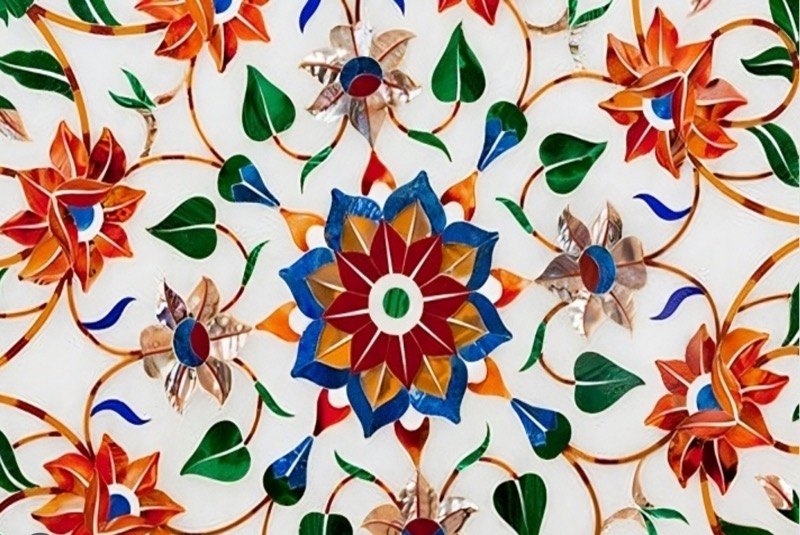
Shah Jahan’s devotion to his wife, Mumtaz Mahal, is woven into every facet of the Taj Mahal. The emperor, who ruled the Mughal Empire in the seventeenth century, spared no expense in building the mausoleum, ensuring that no detail was too small to escape the touch of perfection. At the heart of this monumental endeavour were the gemstones that formed part of the architectural narrative. Parchin Kari was the crowning achievement of this aesthetic. The term refers to the delicate art of inlaying precious stones such as turquoise, lapis lazuli, and carnelian into the marble surface of a building, creating intricate patterns that resemble delicate floral motifs and geometric designs. This laborious art was not only a visual feast but also a testament to the Mughal penchant for perfection and their fascination with precious materials.
Shah Jahan’s desire to create the perfect resting place for Mumtaz Mahal—a monument to both her memory and the bond they shared—was rooted in a deep and almost mystical love. Their love story began when she was just a fifteen-year-old girl, and the two first met in 1607. It was an instant connection, and Shah Jahan, struck by her beauty and grace, immediately sought her hand in marriage. But they had to wait for five years before they could wed, and even then, their marriage was subject to the approval of family and political alliances. Once united, their bond became unshakeable. Over the next fourteen years, Mumtaz bore Shah Jahan fourteen children, and the strain of these pregnancies took a toll on her health. In 1631, during the birth of their fourteenth child, Mumtaz passed away.
Her death shattered Shah Jahan. His grief was so profound that it led him to vow that he would build the most magnificent mausoleum the world had ever seen. Mumtaz was initially buried in a temporary grave in Zainabad, while Shah Jahan’s grand vision took shape. The Taj Mahal was to be not just a tomb, but a symbol of paradise—a paradise built from marble and precious stones. Every stone, carving, and inlay was chosen to ensure that the mausoleum would stand as an eternal testament to Mumtaz’s beauty and the emperor’s undying affection.
The gemstones embedded in the Taj Mahal’s marble were more than just decorative flourishes; they were imbued with meaning. Gems in the Mughal era were seen as symbols of power, wealth, and spiritual significance. Shah Jahan himself was known for his extravagant love of gemstones, which he incorporated into his own clothing, and the artisans he employed were highly skilled, many of them Europeans. Perhaps it was this connection to European craftsmanship that brought Parchin Kari to the Taj Mahal.
While the technique’s roots can be traced back to ancient Rome, where it was known as opus sectile, it was perfected during the Italian Renaissance and spread across Europe and beyond. In the sixteenth century, the art evolved into what came to be known as Pietra Dura—“hard stone”—a method of embedding semiprecious stones into marble to create intricate, durable designs.
In 1588, the Grand Duke of Tuscany, Ferdinando I, established the Galleria de’ Lavori in Pietre Dure in Florence, a workshop dedicated to training artisans in this precise art. By the time Shah Jahan ascended the Mughal throne, Pietra Dura had found its way into Mughal architecture, and the technique became a hallmark of Mughal luxury. Under Shah Jahan’s patronage, this art reached its zenith. The artisans employed at the Taj Mahal were highly trained in the meticulous work of carving marble and setting gemstones. The process itself was incredibly time-consuming, requiring precision and patience. The artisans would first sketch the design in henna on the marble surface, then use chisels and other specialised tools to carve the intricate patterns. Once the design was complete, they would fit the gemstones—each piece chosen for its colour, brilliance, and symbolic meaning—into the carved grooves.
The Taj Mahal’s Parchin Kari inlays are a study in contrast: the white marble, glowing under the sun’s rays, forms a perfect canvas for the vibrant gemstones. The most common motifs include flowers, leaves, and vines, reflecting the paradise garden that the Taj Mahal was intended to represent. It is said that some of the stones chosen for the Taj Mahal’s inlays carried specific meanings: jade, for healing; carnelian, for fulfilling desires; turquoise, for protection; and lapis lazuli, for wisdom. This symbolism imbued the monument with a spiritual dimension, as though each gemstone carried with it a blessing to ensure the peace and serenity of the soul who would rest there.
While the Taj Mahal remains the most famous example of Parchin Kari, the technique was not confined to this one structure. Parchin Kari inlays can also be found in other Mughal-era buildings, such as the Jagmandir temple, Buland Darwaza, the Jahangir Mahal, and the tomb of Itmad-ud-Daula. The craft extended beyond the Mughal Empire as well, influencing architecture in Rajasthan, where it continues to be practised to this day. In the lanes of Delhi, one can find artisans who still practice this ancient craft, creating intricate tabletops, marble fountains, and inlaid gemstone flooring. These artisans continue to uphold the centuries-old tradition, although the designs have evolved to meet modern tastes.
The legacy of Parchin Kari is not just in the monuments it adorned, but in the stories it tells. It is the language of stone and gemstone, a way of expressing devotion, beauty, and permanence. And while the techniques and materials used in Parchin Kari may have evolved, the fundamental principle remains the same: detail and craftsmanship are the essence of great design. The Taj Mahal, with its breathtaking marble inlays, is a testament not only to the love of a husband for his wife, but to the enduring power of artistry and the way in which the finest craftsmanship can transcend time. The Taj Mahal is, after all, a monument of beauty and love, and in the glowing gems embedded in its walls, we see a symbol of eternal connection—one that endures far beyond the mortal world.
-30-
Copyright©Madras Courier, All Rights Reserved. You may share using our article tools. Please don't cut articles from madrascourier.com and redistribute by email, post to the web, mobile phone or social media.Please send in your feed back and comments to [email protected]