How A Last-Minute Deal With Bob Dylan Rewrote Rock History At The Isle Of Wight Festival

Bob-Dylan-Madras-Courier
Representational image: Public domain.
The Foulk brothers — Ray, Ronnie & Bill — convinced Bob Dylan to perform in the Isle of Wight Festival of Music. Together, they rewrote the history of rock music.

That the 1970 Isle of Wight Festival of Music became the most iconic British rock festival of its era – and laid the foundation for the UK’s now-ubiquitous festival scene – is primarily thanks to the decision of a single artist: Bob Dylan. In 1969, Dylan was at the peak of his fame as the world’s most sought-after music star. He hadn’t given a concert in over three years, and fans – including the Beatles, the Rolling Stones, and others – wondered if they would ever see him on stage again. Dylan was not only the voice of the 1960s counterculture in America and beyond, but also the pioneering force behind a new genre in music – what became known as “Rock” (electric music with meaningful content, transforming rock-n-roll into a serious art form – beyond just entertainment, but as an issue-based medium for personal, socio-political and cultural expression).

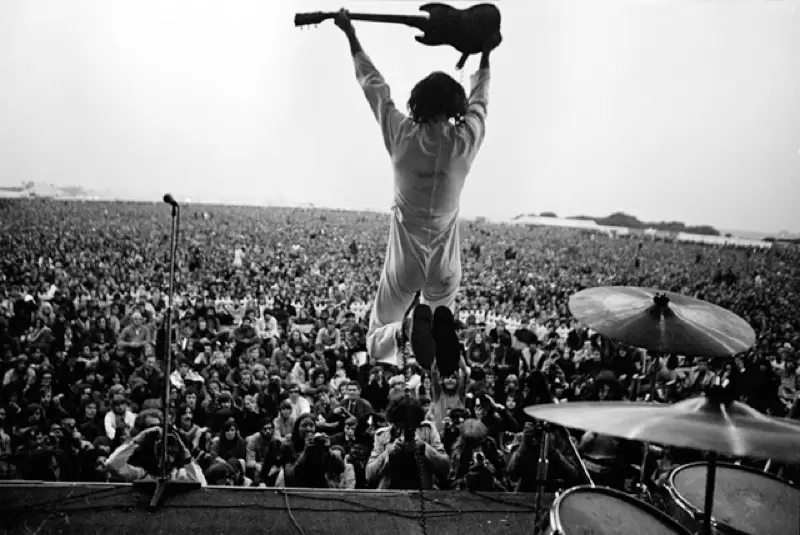
For us organisers, the Foulk brothers (Ronnie, 24, Ray, 23, and Bill, 21), securing Dylan for our 1969 festival was like winning the lottery, described in the music business as the coup of the sixties. The result was a European festival of unprecedented scale, drawing an estimated 150,000, just two weeks after the Woodstock Festival in the United States at double that figure – an event about which the Isle of Wight shares a significant slice of rock history. More on that later.

Bob_dylan-Aerial Picture-Madras-Courier
An aerial picture of a mass of some 150,000 fans gathered for the Isle of Wight festival.

Our first Festival had taken place a year earlier, in August 1968. It was a one-day (or rather, one-night) event originally planned by my brother, Ronnie, as a fundraiser for an indoor swimming pool – something the Island lacked. However, when the pool charity grew uneasy about a potential influx of hippies, they withdrew their support, leaving us to carry on alone. The event, headlined by American band Jefferson Airplane and featuring The Crazy World of Arthur Brown, Fairport Convention, and Tyrannosaurus Rex, went ahead successfully, drawing around 10,000. There was no trouble, and financially, it just about broke even. But it quickly became clear that to turn a profit, we’d need a bigger name – an exclusive major act not available to see at a mainland venue – to attract a much larger audience from across the water. Such an act would need to be in the “superstar” class, of which at that time we recognised just three possible names: Elvis Presley (not a festival act), the Beatles (no longer a viable live act and in the process of breaking up), and Bob Dylan.

This one possible superstar had last given a concert in 1966 (in London’s Royal Albert Hall). Two months later, back in America, in Woodstock where he lived as a recluse, to the dismay of his worldwide followers, he had a motorcycle accident. Despite rumours of a broken neck, and possibly worse, new highly acclaimed Dylan albums continued to be released. As to whether Bob Dylan would ever appear again live on stage remained a perennial question in the music world, right up to early 1969 when we first started our approaches to his management for him to headline our August festival.

My brother’s initial phone call to his manager, Albert Grossman, in New York yielded little success – but the door wasn’t entirely slammed shut. I followed up with several calls to Grossman’s partner, Bert Block, and over the next three months, a glimmer of hope emerged through our conversations. I began to receive requests for more information about our background, the festival, and the Isle of Wight itself.

Bob-Dylan_telegram-Madras-Courier
Telegram from Bert Block confirming Bob Dylan. Image: Author provided.

We made an unconventional move: we offered Dylan and his family an all-expenses-paid holiday in a manor house on the “culturally historic” Island, complete with a chauffeur-driven limousine and a governess to help with the children. Later, when we learned that the newly launched QE2 was sailing from New York two weeks before the festival, we added first-class passage aboard the luxury liner to our proposal. We also produced a professionally printed booklet about the event – which would have appeared impressive by the standards of the time.

Foulk-brothers-madras-courier
Ray, Ronnie & Bill Foulk: Image: Author provided.

Our efforts paid off. Six weeks before the festival, we received a telegram confirming that Bob Dylan had accepted. That moment of triumph quickly turned into a race against time: we now had just five days to secure financial backing – equivalent to three-quarters of a million pounds in today’s money. Despite having no capital of our own, the sheer draw of Bob Dylan proved powerful enough to meet the challenge. The following week, with no experience of international travel, I flew to New York to finalise and sign the contracts and meet Bob Dylan.

Bob-Dylan-1969-festival-madras-courier
Image: Author provided.

The public announcement that he would perform at the Isle of Wight sent shockwaves through the music world. Demand for tickets and travel to the Island surged almost immediately. Media coverage extended well beyond Britain, drawing fans from across Europe and as far afield as Australia and New Zealand. The three-day festival took place over the August Bank Holiday weekend, featuring a stellar supporting lineup including The Who, The Moody Blues, Richie Havens, Joe Cocker, The Bonzo Dog Band, and The Nice – delivering some 36 hours of live music. Thanks to the lessons learned from the previous year, logistical planning and site organisation were much improved, though there was still plenty to learn for the future. Indeed, the backlash from the Island establishment and conservative elements of the community was so intense that it sparked a twelve-month battle against us to prevent a repetition of the event.

Bob-Dylan-1969- Madras-Courier
1969 Bob Dylan, Robbie Robertson and Rick Danko; Image: Author Provided.

While the Woodstock Festival took place as we were still completing construction on our own site, it wasn’t until six months later, when Warner Bros.’ blockbuster documentary hit cinemas, that the event achieved worldwide fame. Only later did the full story of behind-the-scenes intrigue in the small upstate New York town begin to emerge.

Dylan, his manager Albert Grossman, and the festival’s organiser, Michael Lang, all lived in Woodstock. According to Dylan’s close confidant, Al Aronowitz, “The choice of Woodstock as the site was itself a tribute to Bob Dylan … in essence, the Woodstock Festival was nothing but a call to Bob to come out and play.” Grossman wanted Dylan to perform, just as he had added his other major acts to the festival lineup – Janis Joplin, The Band, and Richie Havens. But at the time, Dylan and Grossman were embroiled in a legal dispute and not even on speaking terms. As a result, it fell to Grossman’s partner, Bert Block, to maintain communication with their biggest star – and it was Block who had been negotiating with me in England. Both managers wanted Dylan back on stage, but Block also understood how much Dylan resented having the festival placed in his own backyard, shattering for ever the quiet of his artistic retreat. Afterwards he and his family never went back to Woodstock.

Bob-Dylan-Ray-Foulk-Madras-Courier
1969 Bob Dylan & Ray Foulk at at IOW Fest Press conference: Image: Author provided.

For us brothers we were well established to aim for an even more successful festival in the following year, assisted in no small measure, by Bert Block becoming our North America talent booking agent.

*Stealing Dylan from Woodstock, Ray Foulk, with Caroline Foulk, Medina Publishing, 2015.
Stealing Dylan From Woodstock | Medina Publishing LTD

-30-

Copyright©Madras Courier, All Rights Reserved. You may share using our article tools. Please don't cut articles from madrascourier.com and redistribute by email, post to the web, mobile phone or social media.
Please send in your feed back and comments to [email protected]
0 replies on “How A Last-Minute Deal With Bob Dylan Rewrote Rock History At The Isle Of Wight Festival”