Dylan, Hendrix & The Island that Almost Killed Rock ‘n’ Roll

Isle-of-Wight-Hendrix-Madras-Courier
Image: Author provided.
Despite local outrage and a hostile press, the Isle of Wight Festival of 1970 became a defining moment in rock history: here’s how.

In 1969, my brothers and I organised a Bob Dylan event in the Isle of Wight. The next day, we were euphoric about the festival’s success. The show had been outstanding, with no sign of trouble, and we’d made a solid profit. The upper room of our mother’s house, which had served as our headquarters, buzzed with celebration as the team gathered to reflect and ask: “What next?”

Our sense of triumph was short-lived. The following weekend, the island’s principal newspaper – having previously ignored the event entirely – published its next edition filled with scathing criticism across its editorial, news, and letters pages. This monopoly publication, which had boycotted coverage of both the festival and Bob Dylan’s historic comeback, was now in full-blown outrage. Leading the charge was the Island’s Conservative MP vowing to prevent any reoccurrence.

It was against this new and more hostile backdrop that the giant 1970 festival was planned. In contrast, the 1969 event had gone entirely unchallenged – everything happened so quickly that potential opposition had no time to mobilise. We now realised that the ease with which we had staged the event, with virtually no opposition, could not be repeated. The situation had changed dramatically.

But we were determined to move forward, balancing two major challenges: managing the local backlash and grappling with how to match, or surpass, the success of landing Bob Dylan. An ambitious pitch for the Beatles came to nothing, and the truth was, no other act existed in quite the same league. We decided instead to rely on what we called a “raft” of top-tier artists just below superstar status.

At the time, we hadn’t fully appreciated how legendary the festival had already become, thanks to Dylan’s appearance. In hindsight, we likely overcompensated for the absence of a singular headline act by enlisting an excessive number of well-known performers. The upcoming festival and our strategy for artists were announced in the music press that January. While this delighted fans it reignited furious local opposition.

1970-festival -poster-madras-courier

The 1970 event evolved into a far more professional operation. It began with the establishment of a dedicated headquarters with a departmental structure, staffed by up to 40 people at its peak. My own responsibilities included negotiating with local authorities and addressing mounting pressure from the community critics.

Aside from these concerns, two major challenges dominated the early stages: securing the artist lineup and finding a suitable festival site. While the former came together with relative ease, the latter dragged on into a full-blown crisis – right up to one month before event. Opponents used every tactic imaginable to block us: targeting landowners (mostly farmers), High Court injunctions, and even threats and intimidation. We were forced into a desperate cat-and-mouse chase across the Island, as the festival hovered on the brink of collapse.

Opposition to the festival, led by retired military officers ranging from brigadiers to admirals, reached its peak in July with large-scale public meetings held on the organisers’ home turf in Freshwater. Supporters clashed with opponents, but the latter were decisively outnumbered and out-argued, establishing that local public sentiment was after all firmly on the side of the festival.

A last-minute deed of agreement with the local authorities and the acquisition of a secure, uncontested site, owned by a fearless gentleman farmer, on the more rural side of the Island, enabled us to get up and running. It was now the final week of July, leaving just four weeks to construct the festival “city” on the expansive, prairie-like fields at the foot of Afton Down.

The councils had imposed strict and demanding conditions: especially sanitation, security, health and hygiene, water supply, and post-event site clearance. My brother Bill took on the role of site and stage designer, while the site director, engineer Ron Turner Smith – drawing on experience of the previous two years – oversaw construction with unbelievable speed and efficiency.

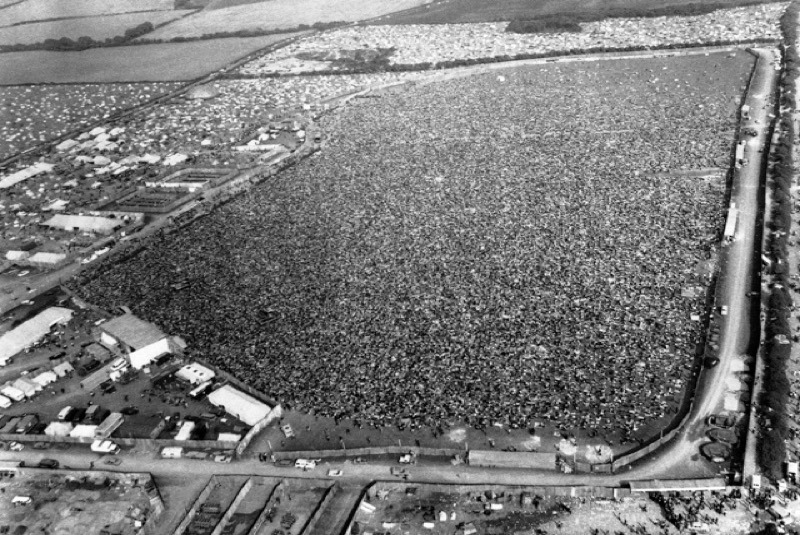
Extended to five days, the festival was scheduled to start on Wednesday 26 August, and was ready on time. Many early arrivals had been on site during the preceding weeks, making site work difficult at times. Construction included two miles of walling around the double walled arena, with a further mile required around the overlooking Afton Down, to protect National Trust land and to prevent non-payers from enjoying a free grandstand. However, the hilltop walling proved impossible to complete. Radical free festival advocates sabotaged the construction nightly, tearing down sections as fast as they were built. Although the arena’s walls held firm, the ongoing vandalism became a flashpoint – and a source of great confusion and controversy in subsequent media and film coverage.

Artist bookings had progressed well from early in the year and through the summer. Ronnie handled the British acts, while I was responsible for those from the U.S. and Canada – although it was my brother who negotiated directly with the London agents representing Jimi Hendrix and The Doors. Publicity, headed by Peter Harrigan, was a major department. An extensive, high intensity campaign helped attract the unprecedented audience.

Once the music began, the festivities ran almost continuously for five days and nights, interrupted by few serious hiccups. The audience peeked at some 300,000 (widely claimed to be twice that with the hillside populated with non-payers). And we duly entered the Guiness Book of Records. Performances, many of which would go down as some of the most iconic live sets of the era, helped cement the event’s place in music history. The lineup read like a who’s who of the time: Jimi Hendrix, Joan Baez, The Doors, The Who, Miles Davis, Jethro Tull, Melanie, Sly & the Family Stone, Richie Havens, Joni Mitchell, Leonard Cohen, Tiny Tim, Donovan, Procol Harum, Emerson Lake & Palmer, The Moody Blues, John Sebastian, Family, Free, Supertramp, Chicago, Kris Kristofferson, and Ten Years After.

1970-Joni-Mitchell-Madras-Courier
Joni Mitchell performing at the concert. Image: Author provided.

On Sunday afternoon, as the festival approached its final stretch, we made a misjudgement: we declared, somewhat whimsically, the remainder of the event free. Attendance through the turnstiles had already slowed to a trickle, and the gesture was intended as an olive branch to the small minority on the hillside agitating for free music. However, there were unintended consequences. Sections of the wall near the entrance were torn down (from the inside) to repurpose as makeshift shelters as cooler weather set in. The materials were costly, and the damage provided convenient images for elements of the media eager to misrepresent and sensationalise any sign of disorder.

In all, the festival was an amazing experience for the audience and performers alike, with most acts returning for encores. Many who attended still speak of it as life-changing and several acts as a career turning point. Tragically, the most famous among them, Jimi Hendrix, was lost to a drug-overdose 18 days later. The Isle of Wight was his last UK performance.

Jimi_hendrix_Madras_Courier
Jimi Hendrix, The Legend. Image: Author provided.

The aftermath was marked by media sensationalism, with disproportionate focus on a relatively small number of troublesome incidents. This narrative was later exacerbated by a distorted documentary-style film released 25 years after the event, which further fuelled controversy.

Remarkably, 32 years later, the festival was revived – this time by the Isle of Wight Council itself – as part of the celebrations for Her Majesty the Queen’s Golden Jubilee in 2002. The event was soon handed over to London music agent John Giddings of Solo, under whose stewardship it has flourished for more than two decades, and on a more manageable scale, entertaining a maximum of just 65,000.

Ray Foulk, with Caroline Foulk, The Last Great Event (revised, Paperback), Medina Publishing, 2025
The Last Great Event by Ray Foulk | Medina Publishing LTD

-30-

Copyright©Madras Courier, All Rights Reserved. You may share using our article tools. Please don't cut articles from madrascourier.com and redistribute by email, post to the web, mobile phone or social media.
Please send in your feed back and comments to [email protected]

0 replies on “Dylan, Hendrix & The Island that Almost Killed Rock ‘n’ Roll”