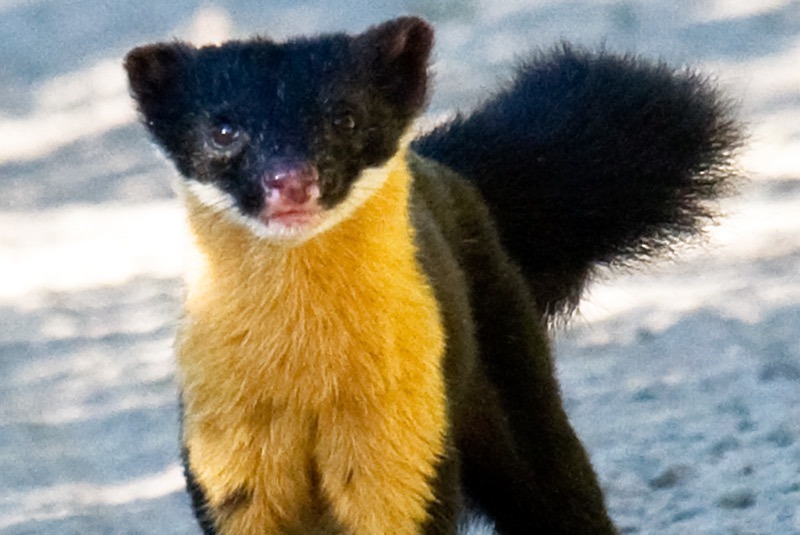
The Western Ghats in India, a mountain range that runs parallel to the western coast, have long been a sanctuary for rare wildlife, some of which remain shrouded in mystery. Among these is the Nilgiri Marten, a small, elusive creature that inhabits the dense, misty forests. Its fur is a rich, dark brown, almost black, with a striking yellow patch that runs from its throat down to its belly.
It is a species that few people have ever seen, even fewer have studied, and even fewer still can claim to understand. Yet, despite its mystery, the Nilgiri Marten is a symbol of the fragility of the ecosystems that support it, and it is rapidly becoming a symbol of something else: the tragic, slow erasure of a species.
The Nilgiri Marten is not just rare; it is becoming endangered, yet little is known about its precise habits or even its numbers. Scientists believe its population numbers barely a thousand individuals. But the lack of concrete data does not make the threats it faces any less real.
The Nilgiri Marten’s habitat, nestled within the humid, high-altitude forests of the Western Ghats, is increasingly under siege. As the world’s biodiversity crisis deepens, the Nilgiri Marten becomes emblematic of a larger, global problem: the loss of species we may never know we had, until it is too late.
To understand why the Nilgiri Marten is so challenging to study, one must imagine the environment it inhabits. Dense forests, often shrouded in mist, are home to towering trees and thick undergrowth, making any form of observation a challenge.
The animal’s secretive nature compounds these conditions. The Nilgiri Marten is a nocturnal and solitary creature, and though it occasionally forms small groups, these gatherings are fleeting. For years, scientists believed the species to be strictly solitary, a nocturnal hunter whose territory extended across the dense undergrowth of the Western Ghats.
However, in a groundbreaking study, a team of researchers led by conservationists from the Wildlife Institute of India found something surprising: the Nilgiri Marten did not prefer solitude, as had been assumed. Instead, it was often observed in small groups of two to three individuals, challenging what had long been considered the defining characteristic of this elusive species.
This discovery was more than a footnote in a scientific paper; it was a revelation that reshaped the way researchers thought about the animal and, by extension, the ecosystems it relies on. It suggested that the Nilgiri Marten might not just be a solitary carnivore, but a species with social and perhaps even cooperative behaviours that could be crucial for its survival.
Yet, despite the growing body of knowledge, much remains unknown about the species. Scientists have a limited understanding of its mating habits, its complete dietary preferences, or how it interacts with its environment in ways that might support the larger ecosystem.
What we do know is that the Nilgiri Marten plays a crucial role in the ecological web of the Western Ghats. Like many members of the mustelid family, the marten is an opportunistic feeder. It eats small birds, insects, and mammals, but also feeds on fruits and seeds. The latter is perhaps the most ecologically important part of its diet. By dispersing seeds across the forest floor through its faeces, the Nilgiri Marten indirectly contributes to the regeneration of the forest. In this sense, it is a quiet gardener of the forest, ensuring that the rich biodiversity of the Western Ghats persists. Yet as its habitat shrinks and is fragmented, this ecological service is at risk.
The pressures on the Nilgiri Marten are many, and they are growing. One of the greatest threats is the destruction of its habitat. In the 1980s, the black wattle tree, an invasive species from Australia, was introduced to the Western Ghats in an effort to control soil erosion. But the plant, with its thick canopy and aggressive growth, quickly displaced native vegetation. This change in the landscape had a profound impact on the entire ecosystem.
As the wattle tree spread across the region, it altered the composition of the forest, disrupting the delicate balance that species like the Nilgiri Marten depend on. What had once been a rich and varied habitat became a sort of monoculture, offering fewer resources for the animals that lived there.
Another, perhaps more immediate threat, is the rise of ecotourism in the region. The Western Ghats, with their breathtaking views and unparalleled biodiversity, have become a major draw for tourists, particularly nature lovers and wildlife enthusiasts. However, unregulated tourism puts immense pressure on the region’s delicate ecosystems.
The influx of visitors can cause habitat destruction, disturb animal behaviour, and even contribute to the spread of invasive species. In the case of the Nilgiri Marten, the increasing human presence in the parks and reserves where it resides could disrupt its natural behaviours and further fragment its already limited habitat.
Conservationists have called for improved management of these tourist sites, urging a balance to be struck between economic gain and ecological preservation. But such efforts often face stiff resistance, and the challenge remains unresolved.
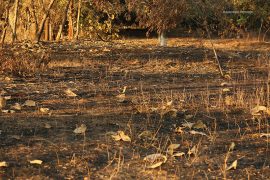
Perhaps most terrifying of all, however, are the fires that periodically ravage the region. In 2018, the Neelakurinji Sanctuary, located within the heart of the Nilgiri Marten’s range, was struck by a devastating forest fire. The blaze spread rapidly across the sanctuary, consuming large tracts of land and devastating the flora and fauna that depended on it. Although the fire was ultimately contained, it had a lasting impact on the region’s wildlife.
The Nilgiri Marten, which spends a significant portion of its time in the trees, is particularly vulnerable to such disasters. During a fire, it has nowhere to go. In addition to fires, the region has also suffered from devastating floods in recent years, which have been caused by heavy rains and exacerbated by climate change. The destruction of trees, landslides, and flooding pose a direct threat to the marten’s survival.
The Nilgiri Marten, like many species, faces a future fraught with uncertainty. While it is currently classified as “vulnerable” on the International Union for Conservation of Nature (IUCN) Red List, its classification is subject to change. With a population of around a thousand individuals and the continued pressures of habitat loss, climate change, and human interference, it could easily slide toward extinction.
And yet, the world seems to remain unaware of the quiet tragedy unfolding in the forests of the Western Ghats. There is no loud public outcry, no media frenzy to alert the world to the marten’s plight. Its extinction, if it were to occur, would likely be a slow, quiet affair—an animal disappearing in the fog, its role in the ecosystem slowly fading until it is gone.
Conservation efforts are underway, but they remain underfunded and fragmented. National parks, such as Pampadum Shola in Kerala, where the Nilgiri Marten is most commonly found, are designed to protect the species, but they are often understaffed and overburdened by both natural and human pressures.
The ongoing struggle to protect the Nilgiri Marten is part of a broader conservation movement in India, one that seeks to preserve the region’s unparalleled biodiversity. Yet, without sustained efforts, both in terms of research and conservation, the Nilgiri Marten faces a future that is as uncertain as the mist that shrouds the forests it calls home.
The loss of the Nilgiri Marten would be a blow not just to India’s natural heritage, but to the world. It is a reminder of the fragile connections that bind life together, the quiet work of animals like the Nilgiri Marten that, though small, play an outsized role in maintaining the ecological balance. Ultimately, the story of the Nilgiri Marten is not just about a rare species on the brink of extinction. It is about all of us—and the ecosystems we share, and so often take for granted.
-30-
Copyright©Madras Courier, All Rights Reserved. You may share using our article tools. Please don't cut articles from madrascourier.com and redistribute by email, post to the web, mobile phone or social media.Please send in your feed back and comments to [email protected]