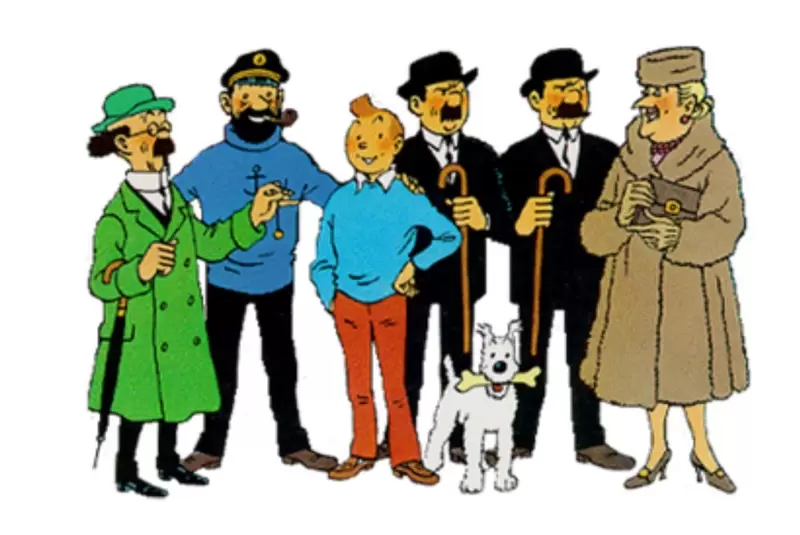
As a child growing up, I, like countless others, encountered Hergé’s Tintin and quickly fell under its spell. The series offered a tantalising glimpse into a world of adventure, where a plucky, quiffed young reporter and his cast of quirky companions — the irascible, liquor-loving Captain Haddock, the loyal dog Snowy, and the eternally befuddled Thompson and Thomson — faced off against criminals, tyrants, and countless cultural oddities.
For me, as for millions of readers before and since, Tintin was a doorway into the mysteries of distant lands and the rigours of friendship. But as I grew older, my fascination with these stories expanded into something more complex: an exploration of how Hergé’s own history, his evolving political views, and his meticulous attention to detail, made Tintin’s universe a reflection of the world around him.
When Hergé began his work on Tintin in 1929, the world was in turmoil, shaped by the aftermath of the Great War, the rise of totalitarianism, and the colonial ambitions that still defined European powers. The Cigars of the Pharaoh, Tintin’s fourth adventure, epitomises this complexity. Set in a vaguely exoticised India, it brims with racial stereotypes, orientalist caricatures, and a rather clumsy portrayal of the local culture.
Here, Thompson and Thomson — the two bumbling detectives — unwittingly impersonate Hindu gods, while a snake gyrates to a gramophone record titled “The Snake Charmer.” Such moments seem more fitting in the colonial fantasies of the time, and one could hardly argue that they don’t reveal something darker about the lens through which Europe viewed the world. These were stories of the period, and they reflected Hergé’s own immersion in the prevailing colonial mindset, one that assumed the superiority of the European worldview and framed ‘the other’ in crude, exaggerated terms.
Yet, in Tintin’s early works, there is also an underlying tension — a seed of discomfort — as Hergé himself began to reconsider his perspectives. By the time he completed Tintin and the Picaros in 1976, the change in his attitude was profound. This final volume depicts Tintin aiding left-wing guerrillas in South America, using non-violent means to topple an oppressive regime. The evolution was striking.
Hergé, who had once created anti-Soviet propaganda in Tintin in the Land of the Soviets (1930), had gradually come to sympathise with the struggles of the oppressed. His views had shifted considerably from the days of The Cigars of the Pharaoh, and that arc mirrored the changes in his own society and in the world around him.
But it wasn’t just the themes of Hergé’s work that interested me as I grew older; it was his devotion to detail, his commitment to crafting a world that, though fantastical, had a firm grounding in the real. The accuracy of the settings, the authenticity of the props, the painstaking research that went into the creation of each new location — all of this became more fascinating to me the more I revisited the series. For example, Hergé famously consulted experts on aviation, architecture, and even oceanography to ensure that his depictions of the world were as close to reality as possible, given the constraints of the medium.
But it wasn’t just the real world that Hergé faithfully recreated; he also drew upon the characters in his life, re-imagining them as larger-than-life figures in the pages of Tintin. Among the many inspirations for his characters, one stands out for its eerie similarity to Tintin’s most memorable sidekick, Captain Haddock.
As I pondered this connection, I began to draw parallels that seemed too coincidental to ignore. Captain Haddock, with his short temper, frequent brawls, and endless supply of whisky, bears a striking resemblance to a man from a different time — a historical figure whose story had been largely forgotten.
The link, I believe, begins in Kolkata, where Tintin continues to be hugely popular to this day. Bengali was the first Indian language into which the series was translated, and the franchise has become deeply embedded in Bengali popular culture. The books, revered by many, are considered a rite of passage for children here, and references to Tintin’s adventures can be found throughout the city — in bookstores, in homes, and even in the work of some of Bengal’s finest artists and filmmakers, including the great Satyajit Ray.
It’s in Kolkata that I discovered something peculiar: the first appearance of Captain Haddock in the series occurred in Tintin in Tibet (volume 20), when he grudgingly accompanies Tintin on a quest to find his long-lost friend, Chang. The setting of the story, as well as Haddock’s interactions with the locals, made me think of another figure from Kolkata’s colonial past — one who, curiously enough, shares a name with Tintin’s fiery companion.
Job Charnock, an Englishman who played a key role in the establishment of the British settlement in Bengal, was an ambitious and controversial figure. In the late 1680s, he fought a near-constant battle to secure land on the Hooghly River for the East India Company. Charnock’s efforts eventually led to the founding of Calcutta, which, over time, grew into a major British colonial hub.
But what caught my attention was the name of one of Charnock’s contemporaries: Joseph Haddock, an officer in the East India Company’s army. Haddock, like Charnock, had a pivotal role in the company’s expansion into Bengal. In 1689, he was appointed to reinforce the English fortifications in Sutanuti, a settlement that would later merge with two others to form Kolkata. His contributions are recorded in a letter he wrote to his brother while onboard the ship Princess of Denmark, recounting his mission to assist in securing British interests on the Hooghly River.
The name, of course, was not lost on me. Haddock — a common surname, to be sure — was also the name of Tintin’s beloved, yet often inebriated, seafaring companion. However, the resemblance between the historical Haddock and Hergé’s creation didn’t end there.
Haddock was not only a man of action but also a complex figure. His brother, Sir Richard Haddock, was a decorated naval officer, famous for his feats in the Anglo-Dutch wars. Sir Richard commanded several ships, including the HMS Unicorn, a second-rate warship that had a storied history in the British navy.
This connection, though faint, begins to form a fascinating link between the man and the myth. As Hergé’s biographers note, the Tintin creator often drew inspiration from real-life figures, and it’s easy to imagine that Joseph Haddock, with his maritime background, could have been one of those early inspirations for the character who would become the indomitable Captain Haddock.
Moreover, there’s the curious coincidence that Captain Haddock’s first name, “Archibald,” was not revealed until the final book, Tintin and the Picaros. This late reveal adds to the sense that Hergé was carefully constructing his characters, keeping them shrouded in mystery and complexity. And the more I learned about the historical figure of Joseph Haddock, the more it seemed that Hergé had created a fictional doppelgänger, one who both mirrored and exaggerated certain traits of the original.
Yet, as much as I revelled in this discovery, it also served as a reminder of how history and fiction often overlap in unexpected ways. Captain Haddock, with his gruff exterior, his love of alcohol, and his occasional flashes of wisdom, is as much a product of Hergé’s imagination as he is a reflection of the historical figures that inspired him. In this way, Tintin becomes a fascinating lens through which we can examine both the past and the way we shape our stories.
Ultimately, the appeal of Tintin lies in its ability to straddle the line between the real and the imagined. Hergé’s work is not merely a collection of colourful adventures but a detailed map of the world as it was seen through the eyes of a man living in a complex, changing time.
His characters, from the idealistic Tintin to the blustering Haddock, serve as vehicles for the values and contradictions of the era. And as I look back on my own journey with Tintin, I can’t help but appreciate the subtleties in Hergé’s work — the way he wove together real history and fictional narrative to create a world that still resonates with readers today.
-30-
Copyright©Madras Courier, All Rights Reserved. You may share using our article tools. Please don't cut articles from madrascourier.com and redistribute by email, post to the web, mobile phone or social media.Please send in your feed back and comments to [email protected]