Fardunji Murzban: The Runaway Boy Who Founded India’s Oldest Newspaper

Mumbai-Samachar-Madras-Courier
Representational Image: Public domain
Fardunji Murzban transformed his passion for learning into a publishing revolution. His Gujarati newspaper, Mumbai Samachar, created a new public sphere, leaving a legacy that has endured for over two centuries.

Few lives illustrate the making of modern India as vividly as that of Fardunji Murzban. Long before newspapers became instruments of political movements or commercial empires, they were fragile ventures sustained by little more than conviction and curiosity.

Murzban’s story began in the quieter lanes of Surat, where an ambitious boy once fled his family home with little more than a bundle of clothes and a handful of books. Barely twelve years old, he walked for hours beyond the city limits, driven by a determination that defied convention.

His father, an orthodox Parsi priest, had resolved that the boy should inherit the family’s religious vocation. Fardunji had other ambitions; he had a hunger for learning, not religion and ritual. Although he was found and brought home, the episode foreshadowed a life spent resisting the boundaries others sought to impose upon him.

Born in Surat in 1787, Fardunji belonged to a respected Zoroastrian priestly family whose expectations were shaped by tradition. His early education reflected that world. He learned Persian and Gujarati before his father directed him to study Zoroastrian scriptures and ceremonial practices. Yet scholarship proved difficult to contain within religious instruction alone.

Under the guidance of the noted teacher Fazel-ulma-Mofti Jahiroddin, he deepened his knowledge of Persian while also studying Sanskrit, experimenting with other languages and acquainting himself with the rudiments of medicine. Every new subject widened his intellectual horizons. The more he learned, the more convinced he became that education was not a destination but an endless pursuit.

That conviction soon brought him into conflict with his father. Bombay, still emerging as the commercial heart of western India, offered opportunities unavailable in Surat, and Fardunji repeatedly sought permission to continue his studies there. His father refused. To Murzbanji, preserving the hereditary priesthood mattered more than the uncertain promise of secular learning.

Family disagreements escalated until Fardunji attempted to escape again. When he was returned home, his father reportedly confined him for three days in an underground room as punishment. The experience did not extinguish his resolve. Instead, it reinforced a lesson that would define his life: knowledge was worth personal sacrifice.

At the age of eighteen, in 1805, Fardunji finally reached Bombay. The city he encountered bore little resemblance to the metropolis it would become. Under the East India Company’s administration, Bombay was rapidly expanding as a port where merchants, sailors, administrators and artisans from across Asia converged. It was also a city where ideas travelled alongside cargo. For a young man with intellectual ambition, its possibilities were intoxicating.

Much of Fardunji’s early life in Bombay revolved around Mulla Feroz, a scholar whose library housed an impressive collection of Persian manuscripts. Serving as caretaker and conservator of these volumes, Fardunji immersed himself in classical literature while refining the practical skills that would later shape his career.

He had been married in infancy to Kuvarbai, in keeping with prevailing customs within the Parsi community, and Mulla Feroz helped establish a household for the young couple. Supporting a family demanded income, yet earning a livelihood never displaced Fardunji’s larger devotion to learning.

His first ventures reflected both necessity and ingenuity. Around 1808, he established himself as a bookbinder, an uncommon trade in Bombay that complemented his growing familiarity with manuscripts and printed works. He briefly entered a private postal partnership with fellow Parsis, but found the work too mechanical to sustain his interest.

Books, rather than commerce, remained his true calling. Fortune intervened through his friendship with Jijibhai Behramji Chhapgar, a printer employed at the Bombay Courier. Frequent visits to the printing office introduced Fardunji to the transformative possibilities of the press. Printing was no longer a technical craft; it was becoming an instrument through which knowledge could reach communities.

In 1812, he established what is generally regarded as Bombay’s first Gujarati printing press. The achievement was remarkable not simply because it introduced vernacular printing to a growing city, but because it democratised access to information in a language understood by thousands of merchants, craftsmen and families.

His earliest publications included a Gujarati Hindu Panchang, or almanac, followed by translations of important religious and literary works. Among the most significant were the Gujarati translation of the Dabistan-i Mazahibin 1815 and the Khordeh Avesta in 1817, making important Zoroastrian texts more accessible to Gujarati readers.

On New Year’s Day in 1818, he published Khordeh Avesta-ba-mayani, presenting the sacred text alongside explanatory meaning. For many Parsis, it represented an important step towards understanding scriptures that had long been recited more often than comprehended.

His press gradually expanded beyond religious publishing. Fardunji translated and printed works on science, literature and religion from English into Gujarati, recognising that language was often the greatest barrier separating Indian readers from emerging currents of global thought.

Colonial authorities acknowledged his contribution to vernacular education, though his motivations extended well beyond official approval. He believed that a society became stronger when knowledge circulated freely among ordinary people rather than remaining confined to scholars or elites.

Printing books naturally led him towards journalism. Bombay’s commercial growth had created an audience eager for reliable information, while developments in Bengal demonstrated that vernacular newspapers could thrive alongside English publications.

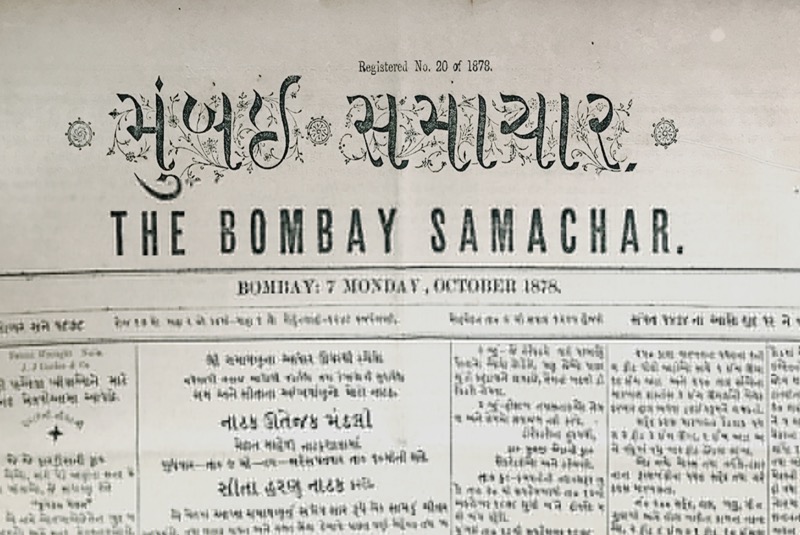
Encouraged by Governor Mountstuart Elphinstone’s support for vernacular education, Fardunji began studying English-language newspapers to understand European reporting and adapt its methods for Gujarati readers. On 10 June 1822, he issued a prospectus announcing a new weekly newspaper. Three weeks later, on 1 July, the first edition of Mumbai na Samachar appeared.

The response exceeded expectations. Within days the newspaper attracted around 150 subscribers, an impressive achievement for an entirely new Gujarati publication. Its readership soon extended beyond Bombay to Surat, Poona, Daman and Calcutta, encompassing Parsis, Hindus, Muslims and Europeans alike.

At a monthly subscription of two rupees, the paper became an indispensable source of commercial intelligence, shipping news, government notices and public affairs. Yet its significance lay not only in the information it carried but in the standards it established.

Fardunji viewed journalism as a vehicle for public service, not sensationalism. His editorials were measured rather than inflammatory, carefully reasoned rather than rhetorical. He criticised where necessary but avoided personal attacks, believing that public debate should illuminate rather than inflame.

While acknowledging the administrative achievements of British rule in comparison with some earlier regimes, he also insisted that Indians possessed an inherent right to a free press. Such arguments were striking at a time when public discourse remained tightly circumscribed. His newspaper sought to educate readers, encourage informed discussion and connect government with society without descending into partisanship.

That commitment extended beyond politics into social reform. Mumbai na Samachar carried articles promoting vaccination and modern medicine at a time when scientific advances were often greeted with suspicion. It discussed widow remarriage, women’s education and the abolition of harmful social practices, contributing to wider debates that would gather momentum throughout the nineteenth century. Fardunji recognised that journalism could do more than report events; it could expand the boundaries of public conversation.

Such independence inevitably invited controversy. A bitter dispute within the Parsi community over the religious calendar divided reformers and traditionalists, and Fardunji allowed both sides to present their arguments in the pages of his newspaper.

His effort to preserve editorial fairness pleased neither faction. Personal attacks and rumours followed, culminating in a damaging scandal in 1831 that undermined both his reputation and his business interests. Misfortune compounded misfortune. The following year he suffered catastrophic financial losses when a trading venture linked to China collapsed.

Stripped of his assets, including his press and newspaper, he relinquished Mumbai na Samachar in August 1832. The publication continued under new ownership and would eventually become a daily newspaper, but its founder’s chapter had come to an abrupt end.

Unable to rebuild his life in Bombay, Fardunji settled in the Portuguese enclave of Daman, where he practised oriental medicine until his death on 23 March 1847. It was a quieter existence than the one he had forged in Bombay, yet it scarcely diminished his legacy.

His greatest achievement had never been commercial success, which proved fleeting, but the institutions and ideas he left behind. The Gujarati printing press transformed access to knowledge. His translations broadened intellectual horizons. Above all, Mumbai na Samachar endured.

More than two centuries after its first issue appeared, the newspaper survives as Mumbai Samachar, making it Asia’s oldest continuously published newspaper. Its longevity is remarkable not merely because it has witnessed the rise and fall of empires, independence, industrialisation and the digital age, but because it still reflects the principles that shaped its founder’s vision: careful verification, measured judgment and respect for readers’ intelligence.

Fardunji Murzban did not live to see the influence of the institution he created, nor could he have imagined the India that would emerge long after his death. Yet the restless boy who once risked everything for an education ultimately gave his country something more enduring than personal success. He demonstrated that knowledge, once committed to print and shared freely, could outlive its author and continue speaking across centuries.

-30-

Copyright©Madras Courier, All Rights Reserved. You may share using our article tools. Please don't cut articles from madrascourier.com and redistribute by email, post to the web, mobile phone or social media.
Please send in your feed back and comments to [email protected]

0 replies on “Fardunji Murzban: The Runaway Boy Who Founded India’s Oldest Newspaper”