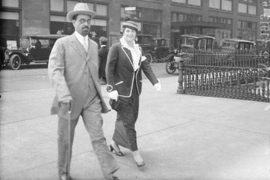

In 1941, two of the most gifted writers in the English language sat before radio microphones in Axis territory and spoke to the world. Both spoke for, or in, nations at war with their native countries. One was P.G. Wodehouse, an English comic novelist joking about his prison-camp experience in Germany. The other, Ezra Pound, was an expatriate American poet, ensconced in Mussolini’s Italy, condemning Roosevelt and lauding Hitler.
Both Wodehouse and Pound were to pay the price for those broadcasts for the rest of their lives. Their fates were different, but the shape of their stories is a case study in how genius and naivety can bring about ill-thought-through actions. And therein lie lessons, not just for those in the public eye, but also for an average person like you and me.
The Making Of Two Reputations
Both Wodehouse and Pound earned their literary immortality through sheer, obsessive craft. P.G. Wodehouse (1881-1975) spent decades honing linguistically engineered turns of phrase, similes, deflating asides, and feather-brained yet confident narrators. He brilliantly used plot apparatuses of mistaken identities, stolen cow creamers, and policemen’s helmets. By any commercial measure, when WWII broke out, he was one of the more successful writers alive.
The literary achievements of American Ezra Pound (1885-1972) were different – ranging from the 2-line poem In a Station of the Metro to The Cantos. The latter, a famously difficult long poem, began around 1915 and continued until 1962, bringing in Chinese characters, Renaissance references, Greek mythology, and, eventually, his own wartime obsessions. Perhaps Pound’s greatest influence was as a talent scout – he edited and championed T.S. Eliot’s The Waste Land and helped launch James Joyce’s career. It is said that without Pound’s interventions, the canon of twentieth-century English language literature would have been significantly different. As Hemingway famously said, for a writer, not being influenced by Pound was like “passing through a great blizzard and not feeling its cold.”
Restless By Choice
Wodehouse split his adult life between England, America, and France after stints as a bank clerk and as a Broadway lyricist. He finally settled down to a quiet retirement in New York State, where he became a US citizen in 1955.
Wodehouse never seemed interested in nations – his real country was a (partially make-believe) England of valets, country houses and perpetually broke young men in spats. This world, conjured by him, existed more on the page than it ever had in reality, even in 1920s and 1930s England.
Pound left America in 1908, frustrated with its conservatism, for London. He then went to Paris and finally to Italy in 1924, seeking a cause, not comfort. His restlessness was, perhaps, rooted in conviction. He became obsessed with monetary theory, usury, class war, and economic reform. In Mussolini’s ideas, he found what he believed was the antidote to the financial forces he blamed for war and cultural decay. By the 1930s, he believed himself to be a propaganda expert and, along with poetry, he was writing fringe economic tracts, and his views were bordering on fascism and anti-Semitism.
By the time World War II broke out in 1939, both men had done the work that would forever justify their literary reputations, which makes what followed all the more intriguing. Neither needed the broadcasts to matter. But they made them anyway.
The Broadcasts
In 1940, the invading Germans arrested Wodehouse in France, and he passed through a series of camps for over a year. He was released early, and the Germans evidently thought that good treatment of a celebrity might play well with still-neutral America. The Germans then put him up in a luxury hotel in Berlin (at his own cost, apparently) and steered him into broadcasting some accounts of his internment – which were to be specifically aimed at American audiences.
He said yes, mostly out of obligation, but also out of political naivety – in total ignorance of how the gesture might look back home. The talks were typical Wodehouse – light-hearted, self-deprecatory, and observational, describing prison life as an absurd experience. The broadcasts were entirely neutral – no praise of Nazism and no commentary on Britain. However, back home, a British subject speaking on German radio was regarded as deeply offensive, bordering on treachery, no matter what he said or didn’t say. Wodehouse was immediately denounced.
Pound’s broadcasts for Italian state radio were different. In the hundreds of radio speeches he delivered through most of World War II, he expounded on wildly speculative economic theories, praised Hitler and Mussolini, and peppered his commentary with anti-Semitic language. Unlike Wodehouse’s broadcasts, these were not naive or non-political; he delivered them with full awareness of what he was saying and to whom. He also wrote many anti-Semitic articles and often ended them with “Heil Hitler.”
The Repurcussions
British intelligence interviewed Wodehouse at length and concluded that he was merely silly and naive, not treasonous, and he was never charged. Though he was privately exonerated, the Government kept this hidden for years, leaving him with a sense of doubt and uncertainty. But the label stuck for the rest of his life, and he never returned to England, spending his last three decades in America, quietly wounded by a scandal that his own defenders argued had far more to do with wartime hysteria than with anything Wodehouse had actually said. Much later public opinion softened, and he was even given a knighthood – a few weeks before he died in 1975.
Pound’s fate was stranger. In 1945, he was arrested in Italy (kept in an outdoor steel cage for some time), later flown to the US and charged with treason – a capital offence, but then deemed insane. He then spent more than a decade at a psychiatric hospital in Washington, D.C.
While the insanity plea may have saved his life, it tarnished his reputation forever. He continued to write The Cantos from the hospital and was released in 1958, when he returned to Italy. He spent his last years largely in silence, retreating from public life and discourse. He told Allen Ginsberg that his worst mistake had been that “stupid, suburban prejudice of anti-Semitism.” He acknowledged that it tarnished his legacy and reputation. He became a figure both pitied and disliked.
Wodehouse was a man with no politics who was caught up in a political catastrophe through sheer inattention to the world outside his make-believe one. Pound’s tragedy was that, being a man of strong political convictions, he allowed those belief systems to turn into something more reprehensible – which cost him his moral standing. Wodehouse is loved, almost universally, his broadcasts generally ignored. Pound remains a complicated figure – a genius poet undone by overconfidence in his political and economic convictions.
These broadcasts of both Pound and Wodehouse invite some reflection, for those in the public eye as well as for private individuals.
Reflections For Those In The Public Eye
It is not just the message – platform and timing sometimes matter more than the message itself. Wodehouse’s jokes were harmless in isolation, but because they were broadcast from enemy radio during a world war, they seemed like treachery. In the public eye, where, when, and through whom you speak often shapes how a message lands, regardless of intent or content.
There is no excuse for toxicity—even genius does not offer immunity against toxic ideology. Pound was a brilliant editor and poetic innovator, yet his certainty that he understood global economics led him straight into fascism and anti-Semitism.
Public figures who fall in love with their own authority risk letting conviction turn into something monstrous and dangerous.
Keep an eye on the optics—ignorance of, or obliviousness to, optics is not defence against public outrage. Wodehouse was a master of his craft, but that mastery didn’t extend to political judgement—or lack thereof—and that proved career-damaging.
Public trust once lost takes time to regain. Wodehouse’s case reminds us that the court of public opinion doesn’t clear a name just because the court of law did. British intelligence cleared Wodehouse of treason, but the stigma outlived the verdict. Even today, his biographies sometimes carry the asterisk of these broadcasts.
What Their Stories Ask Of You And Me
Question and doubt your beliefs; strong convictions demand self-reflection, not just fervour. Pound’s downfall wasn’t a failure to think; it was too much certainty of the wrong kind. Convinced he held the one answer to society’s problems, he became easy prey for radicalisation and prejudice.
Escapism doesn’t always work; ignoring the wider world doesn’t stop it from reaching you. Wodehouse built his fiction in a world of country houses, plus-fours, and butlers, but that escapism didn’t shield him when history came knocking.
The public has a long memory; what you say (or post) takes on a life of its own depending on where it lands. Today, everyone has a microphone—social media, forums, comment sections. Reading one’s audience isn’t just a celebrity’s burden; it is everyone’s. Pound’s and Wodehouse’s wartime broadcasts remain blemishes on their reputations, proof that nothing said in public ever fully disappears. More so in today’s age of screenshots and unerasable posts.
Half-hearted regret isn’t redemption. Pound later waved off his anti-Semitism as a “suburban prejudice” but never truly owned what he’d done, and his legacy stayed tarnished for it. Real growth means confronting past harm head-on, not minimising it.
In the end, we can reflect on and learn from Wodehouse’s and Pound’s mistakes. Both incidents reiterate that history rarely asks permission before writing an epitaph; it listens to what was said, where it was said, and to whom.
-30-
Copyright©Madras Courier, All Rights Reserved. You may share using our article tools. Please don't cut articles from madrascourier.com and redistribute by email, post to the web, mobile phone or social media.Please send in your feed back and comments to editor@madrascourier.com