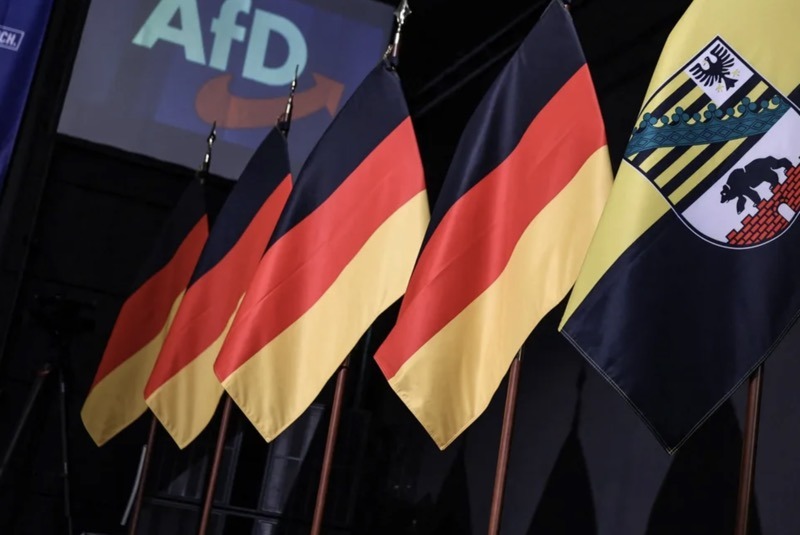
Alice Weidel has a new number to obsess over. On September 7, the co-leader of Alternative for Germany (AfD), Germany’s far-right party, declared that its next target was 40 per cent of the vote at the country’s next federal election, expected by 2029. The ambition might once have sounded fantastical. However, after the party’s performance in Saxony-Anhalt, it doesn’t sound improbable. The AfD won 43.8 per cent in the eastern state on September 6th, more than twice the 17.2 per cent secured by Chancellor Friedrich Merz’s Christian Democratic Union (CDU). It was the strongest result ever achieved by the AfD in a German state election and brought it within touching distance of governing a state for the first time in the Federal Republic’s post-war history.
For Ms Weidel, this was a “dream result.” For Mr Merz, it was a political earthquake. The chancellor said that the result had left his party “deeply shocked” and warned that the CDU could not simply return to “business as usual.” That is an understatement. The CDU’s result was its worst in Saxony-Anhalt since German reunification in 1990. The AfD, meanwhile, won 39 of the state parliament’s 83 seats, just three short of the 42 required for an outright majority. Turnout was unusually high, at 77.8 per cent, suggesting that the result was not simply the product of a disengaged electorate.
Saxony-Anhalt is not Germany. With about 2.1 million inhabitants, it is a small state whose economic and demographic problems are particularly acute. But that is precisely why the result matters. The eastern states have long provided fertile ground for the AfD, which has benefited from dissatisfaction with the economic legacy of reunification, population decline and a sense that political and economic power remains concentrated in the west. What is changing is the scale of the support. The AfD is no longer a protest party capable of embarrassing Germany’s established parties. It is becoming the largest political force in parts of the country, and it is beginning to contemplate what governing might look like.
Its candidate in Saxony-Anhalt, Ulrich Siegmund, a 35-year-old former fragrance salesman, helped give the campaign a more approachable face. Yet the programme was anything but moderate. The AfD promised a “remigration and deportation offensive” aimed at illegal migrants and attacked what it describes as the cultural alienation of Germany. It proposed changing school curricula to reduce the emphasis on the country’s Nazi past, introducing financial incentives to encourage larger families and expanding Russian-language teaching. The party also opposes German weapons deliveries to Ukraine and favours restoring energy and economic ties with Russia. These are not marginal adjustments to the German political consensus. They amount to a challenge to several of its central assumptions, from immigration policy to Germany’s role in Europe and its relationship with Moscow.
The appeal is nevertheless less mysterious than some of the rhetoric suggests. Saxony-Anhalt has struggled with an ageing and shrinking population, labour shortages and the uneven distribution of prosperity between eastern and western Germany. The AfD has been particularly effective at turning these structural problems into a political narrative. They present immigration as a threat to social cohesion; demographic decline as evidence that established politicians have failed families; economic stagnation as proof that reunification never delivered on its promises. Nostalgia for aspects of East German life, sometimes expressed through local symbols, reinforces the message that the old political class has little understanding of life in the east.
The CDU has struggled to answer this argument without strengthening it. Mr Merz came to power promising a more assertive conservatism and tighter control of migration, while also attempting to revive Germany’s economy and restore confidence in its governing institutions. Nonetheless, the AfD has continued to occupy the political space to his right. Ms Weidel now argues that the CDU and its Bavarian sister party, the Christian Social Union, cannot regain national dominance while the AfD continues to widen its lead in opinion polls. Her 40 per cent target is partly political theatre. However, it also serves a strategic purpose: to persuade AfD supporters that the party is no longer voting for protest, but for power.
The immediate obstacle is arithmetic. Winning an election is not the same thing as forming a government. The AfD has never governed one of Germany’s 16 states, and the country’s established parties have maintained a political “firewall,” refusing formal co-operation with it. That barrier remains intact in Saxony-Anhalt. The CDU has ruled out an alliance with the AfD, while the state’s political arithmetic leaves few comfortable alternatives. The left-wing Sahra Wagenknecht Alliance, or BSW, which has crossed the 5 per cent threshold needed for parliamentary representation, is more open to discussions. Its hostility to mass immigration and support for a less confrontational policy towards Russia give it some overlap with the AfD, although it remains ideologically distinct.
That leaves an intriguing possibility. If other parties refuse to form a coalition with the AfD but the BSW abstains in a vote to elect Mr Siegmund as state premier, the AfD could potentially take control without commanding an absolute majority. Such an arrangement would represent a historic breach in Germany’s post-war political order. Mr Siegmund has also suggested that individual CDU lawmakers might defect. Whether that happens is another matter. The established parties have spent years warning that co-operation with the AfD would legitimise a party they regard as extremist. The regional branch of the AfD in Saxony-Anhalt has been classified as a confirmed right-wing extremist organisation by the state’s domestic intelligence agency, a designation the party rejects.
For Mr Merz, the danger is therefore not that the AfD wins elections, but that the CDU becomes trapped between two incompatible strategies. It can attempt to imitate the AfD on migration and cultural issues, risking the loss of its distinction from the original. Or it can defend the political centre, accepting that the AfD may continue to absorb voters who believe the mainstream parties are unwilling to address their concerns. Neither option is attractive. The chancellor’s response after Saxony-Anhalt suggested that he understood the scale of the problem: “Giving up is not an option for me,” he said. But determination is not a strategy.
The economic dimension could make the political problem harder to address. Germany is emerging from several years of weak growth, while its manufacturing sector is adapting to higher energy costs, Chinese competition and the transition away from fossil fuels. The federal government has responded with large planned investments in infrastructure and defence, creating the possibility of a gradual recovery. But economic improvement may take longer to reach regions that have experienced decades of demographic decline. The AfD thrives in precisely that gap between national promises and local experience. Its success does not necessarily mean that voters have embraced every item in its programme; it may instead reflect the judgement that the established parties have failed to deliver.
Nor will Saxony-Anhalt be the last test this year. On September 20, voters in Berlin and Mecklenburg-Vorpommern will go to the polls. The AfD is performing strongly in both. In a September 4 poll, it was at 20 per cent in Berlin and 32 per cent in Mecklenburg-Vorpommern, while the CDU stood at 15 per cent and just 8 per cent respectively.
A series of strong AfD results would transform the interpretation of Saxony-Anhalt from an eastern German anomaly into evidence of a national trend.
However, Ms Weidel should beware of celebrating too soon. Forty per cent nationally is an enormous leap from even the AfD’s current strength, and Germany’s electoral system rewards parties that can turn votes into viable governing coalitions. The AfD can win a plurality without being able to govern. It can force the CDU to respond without replacing it. And it can become indispensable to political debate while remaining isolated from government.
That, however, may be cold comfort for Mr Merz. Germany’s political establishment spent years treating the AfD as a protest against the system rather than a plausible alternative within it. Saxony-Anhalt suggests that distinction is becoming harder to maintain. The party has now demonstrated that it can dominate a regional election, exploit the weaknesses of the mainstream right and come within a few seats of an outright majority. The next question is no longer whether the AfD can win. It is whether Germany’s other parties can persuade voters that winning and governing are different things. For Mr Merz, the answer will help determine not only his own political future, but the shape of Germany’s democracy for years to come.
-30-
Copyright©Madras Courier, All Rights Reserved. You may share using our article tools. Please don't cut articles from madrascourier.com and redistribute by email, post to the web, mobile phone or social media.Please send in your feed back and comments to [email protected]