Before Independence, India Won Gold in Hitler’s Berlin

Dhyan-Chand-Madras-Courier
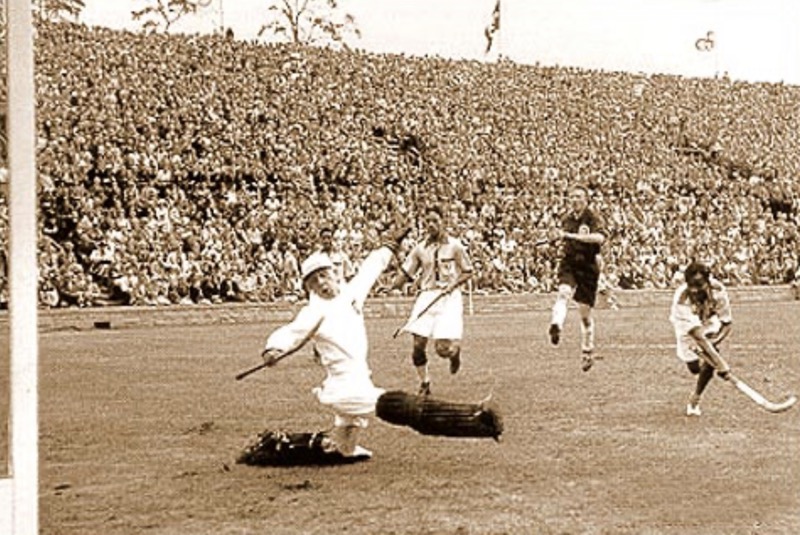
Dhyan Chand scoring a goal in 1936 Berlin: Wikipedia
Ninety years ago, Dhyan Chand led India to Olympic hockey glory in Berlin, eleven years before independence.

15 August 1936 was a remarkable day in Berlin. Ninety years ago—more than a decade before India became an independent country—the Indian hockey team, led by Dhyan Chand, played the final of the Berlin Olympics, which were marked by intense Nazi propaganda. They went on to defeat the host nation, Germany, 8–1, to win their third consecutive Olympic gold medal, following victories in Amsterdam in 1928 and in Los Angeles in 1932. At the centre of this remarkable victory was Major Dhyan Chand, the legend who would be immortalised as the Wizard of Hockey.

The date has significance. The final was originally scheduled for 14 August 1936, but inclement weather rendered the pitch unplayable; it was postponed to 15 August. This was exactly eleven years before India would become independent. The Tricolour was not yet the Indian flag. Yet the Dhyan Chand-led hockey team demonstrated confidence and excellence that transcended its status as a colonised country.

That India defeated Germany at that time was no ordinary achievement. The Berlin Olympics were the showcase of Hitler’s Germany and were intended to project Nazi achievements, discipline and racial prowess. Yet the remarkable teamwork of an Indian team from a colonised Asian country challenged that narrative decisively on the hockey field.

India had dominated its way to the final, defeating France 10–0 in the semi-final. Germany, however, had beaten India 4–1 in a warm-up match earlier. The German victory gave the hosts confidence, while the Indian team had a score to settle. In the final, Germany conceded only one goal in the first half. India then came to terms with the conditions and scored seven goals in the second half. Dhyan Chand scored three, Ali Dara two, and Roop Singh and Syed Jaffar one each. Carlyle Tapsell scored the eighth goal.

Given the warm-up loss to Germany and the wider ethos of the Berlin Games, where Germany sought to present itself as powerful and invincible, the final had a theatrical quality. The Indian team entered the match knowing that it had been beaten before and would have to play at its best against a German side that believed it could defeat India.

The final added to the mythology surrounding Dhyan Chand. He was injured in the first half, with reports suggesting that he lost a tooth after colliding with the German goalkeeper. Newspaper reports from the time indicate that in the second half he played barefoot to cope with the wet ground. The legend of Dhyan Chand that emerged from this final was enhanced by many stories that circulated afterwards. Perhaps those stories are less important than the lasting image they created: a relatively small, injured Dhyan Chand marshalling the ball with extraordinary precision on a wet pitch in Berlin.

Legend has it that Dhyan Chand scored six goals in the final, but the records show that he scored three. Dhyan Chand himself acknowledged this when the International Hockey Federation was updating its records. This makes India’s achievement that day more significant. It was not the work of one conjurer playing alone, but the product of a remarkably cohesive Indian eleven.

Dhyan Chand led a team that also reflected India’s diversity. Players from different communities and social backgrounds participated—including four Anglo-Indian players—and played as one team. Their success demonstrated that Indian hockey in 1936 was already a powerful manifestation of India’s pluralistic sporting culture, well before independence and the political divisions that would eventually divide the country.

The magnificence of that victory went beyond the playing field. India was not yet sovereign. The Government of India Act of 1935 introduced a limited measure of provincial autonomy, but India remained under British rule and lacked the political sovereignty to raise its own national flag. Yet in the Olympic hockey final, an Indian team defeated the host Germany, which had organised one of the most politically significant Olympic Games of the era.

The victory did not shake the colonial empire, but it was a memorable manifestation of Indian skill, discipline and dedicated teamwork that won global respect. It gave India international sporting visibility even before it became a sovereign nation.

Dhyan Chand’s life is equally interesting. He was not born to privilege. From humble beginnings, he built his reputation through disciplined practice and mastery of hockey. His genius was not merely his ability to score goals. It was his unbelievable ball control, fluid movement, anticipation and understanding of space. His hockey stick seemed to extend his imagination of the game.

His legend became so well established that spectators and rivals often suggested that his hockey stick contained a magnet. Such stories became part of the folklore surrounding Dhyan Chand because his skills were difficult to understand in ordinary terms.

The 1936 gold medal was Dhyan Chand’s last of three Olympic gold medals, following his victories in 1928 and 1932. He defined the first great era of Indian sporting achievement. The Olympic Games were not held in 1940 and 1944 because of the Second World War. When India returned to the Olympics in London in 1948, it won hockey gold again, but this time as an independent country and without Dhyan Chand. The Berlin Olympics therefore represented the peak of India’s pre-independence hockey era.

Eighty years later, in 2016, when I was Ambassador of India to Germany, I was reminded of this remarkable history and decided to celebrate it. On 15 August 2016, as we celebrated India’s 70th Independence Day, the Embassy of India in Berlin organised an exhibition on Major Dhyan Chand, the Hockey Wizard, to commemorate the 80th anniversary of that memorable victory in Berlin. I conceptualised the exhibition as a chance to bring Dhyan Chand’s history back to Berlin and introduce a new generation of Germans and Indians to this splendid chapter in the shared sporting history of India and Germany.

The exhibition had several poignant moments. The German establishment often found it difficult to identify a chief guest for India’s Independence Day celebrations as August was a holiday month. Given our emphasis on hockey that year, we invited German Olympians Natascha Keller and her brother Florian Keller to inaugurate the exhibition. Their grandfather, Erwin Keller, had played against Dhyan Chand in the 1936 Berlin final.

Natascha Keller had won an Olympic gold medal with the German women’s hockey team in 2004 and was the flag bearer for Germany at the 2012 Olympics. Her brother Florian had been part of Germany’s gold-medal-winning hockey team at the Beijing Olympics in 2008. This gave the occasion a remarkable Indo-German dimension: the grandchildren of a German player who had faced Dhyan Chand in the 1936 final were standing in Berlin, eighty years later, inaugurating an exhibition dedicated to the Indian player.

The siblings also saw photographs of their grandfather that they had never seen before. We had retrieved photographs from Indian and German sources for the exhibition. They went through the displays with great interest, reflecting on how hockey had acquired an importance far beyond the match itself.

The exhibition brought Dhyan Chand to life through objects related to his life. We displayed his spectacles, personal photographs, recordings of training sessions, his Olympic coat and tie, and German newspaper reports about the Berlin Games, particularly the hockey final. There were photographs of the 30-foot statue erected in his honour in Jhansi, his meetings with Indian national leaders, and the commemorative postage stamp issued in 1980.

I received considerable support from German archives, the Punjab Regiment of the Indian Army to which Dhyan Chand belonged, and his son, Olympian Ashok Kumar. The exhibition brought home to us that history is not recorded only in books, documents and monuments. Often, it survives in memories and personal objects. When diligently brought together, these can make history come alive in unexpected and powerful ways.

Today, 90 years after the Berlin Olympic hockey final, Dhyan Chand’s achievement is remembered with great awe. India won its third Olympic gold medal in hockey, but that victory symbolised something larger. A team could demonstrate excellence even when the country it represented lacked political sovereignty. It could exhibit confidence and national pride even before the Indian nation was politically born.

On 15 August 1936, when Dhyan Chand trod the Berlin field, India was still awaiting freedom. On that day, his exemplary play and that of his remarkably cohesive team brought the finest display of Indian teamwork to global attention. Ninety years later, that remains the magic of Dhyan Chand and the enduring significance of Berlin.

-30-

Copyright©Madras Courier, All Rights Reserved. You may share using our article tools. Please don't cut articles from madrascourier.com and redistribute by email, post to the web, mobile phone or social media.
Please send in your feed back and comments to [email protected]

0 replies on “Before Independence, India Won Gold in Hitler’s Berlin”