
Muthanga And The Criminalisation Of Adivasi Assertion

Muthanga-Madras-Courier
Dalit and adivasis who have been fighting for their rights, have not been given their due. Instead they have faced harassment and incarceration.

The Wayanad Principal Sessions Court has finally spoken on a case that has hung over Kerala’s conscience for more than two decades. M. Geethanandan, one of the state’s most consequential Dalit-Adivasi rights activists, has been acquitted of murder in the death of police constable K.V. Vinod during the police action at Muthanga on 19 February 2003. That the court found the murder charge unsustainable, after twenty-three years, is itself an indictment of how long the state took to arrive at what should have been evident much earlier. But in the same breath, Geethanandan and three others have been convicted in a related case and sentenced to five years’ rigorous imprisonment. It is difficult to read this outcome as anything other than what it is: the criminal justice system closing its books on Muthanga while the deeper wrong that produced Muthanga remains wide open.

For the state, Muthanga was simply a law-and-order episode. But it was the eruption of a crisis that Kerala’s successive governments had spent five decades manufacturing. As far back as 1975, the state legislature passed the Scheduled Tribes (Restriction on Transfer of Lands and Restoration of Alienated Lands) Act, promising to return land that had been alienated from Adivasi communities. It is one of independent India’s oldest unkept legislative promises. Every government that followed, regardless of political colour, found reasons to delay, dilute or abandon its implementation, evidently unwilling to confront the settler interests that had taken root on Adivasi land. Rules were drafted; little was restored. By the turn of the millennium, Kerala’s Adivasi communities — barely a little more than one per cent of the state’s population — were suffering starvation deaths even as the government debated procedure.

It took a 48-day agitation outside the Chief Minister’s residence in 2001, and C.K. Janu’s threat of a fast unto death, before the state moved at all. The resulting seven-point agreement promised land to the landless — a watered-down substitute for the restoration the 1975 Act had guaranteed, but a promise nonetheless. And then, true to form, the state broke it too. Within the first four months of a year set aside for implementation, barely one per cent of eligible families had received just over two per cent of the promised land. Adivasi families who had waited, negotiated and organised through every channel the democratic process offered were left with nothing to show for it but another broken commitment. Muthanga was what happened when that patience ran out. Families walked into the forest and began building homes on land they believed, with ample historical justification, was rightfully theirs. 

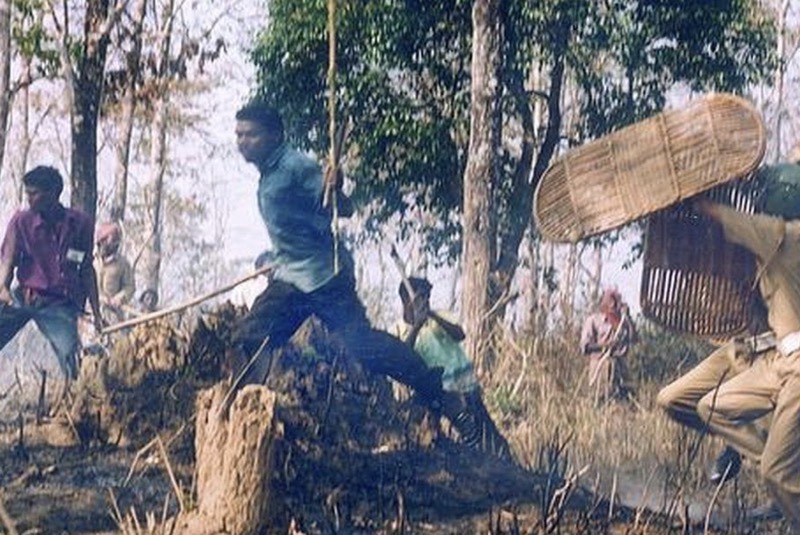
The state’s response was disproportionate to the point of brutality. An eighteen-hour police operation, media access sealed off, and by the time it ended, an Adivasi protester named Jogi and a police constable were both dead, with hundreds of Adivasis injured. A CBI inquiry that Adivasi organisations had hoped would establish accountability instead labelled the protesters “trespassers” — a verdict on the merits of the occupation delivered before any court had examined the merits of the violence used to end it. In the years since, it is the Adivasi side of that day’s ledger that has been pursued through the courts, while no comparable reckoning has ever been demanded of the state for the force it used, for Jogi’s death, or for the injuries visited on hundreds of unarmed people.

This is the pattern that the Muthanga verdict now extends. The tragedy of Muthanga cannot be reduced to a question of who is criminally liable for one constable’s death, however serious that question is in its own right. Framing it that way is precisely how a state absolves itself of the larger, harder question — why fifty years after promising to restore Adivasi land, it still has not done so, and why hundreds of families were driven to occupy forest in the first place. A murder trial can only ask who pulled a trigger or wielded a weapon. It cannot ask, and was never going to ask, why an entire community was forced into a position where confrontation with the state came to feel like the only recourse left.

That asymmetry is the real problem here. Geethanandan’s conviction, arriving in the same verdict as his acquittal on the murder charge, is a reminder that Kerala’s institutions have, for two decades, treated Adivasi political assertion as criminal conduct to be prosecuted rather than as a constitutional claim to be honoured. Land rights recognised in a 1975 statute, reaffirmed in a 2001 agreement, and reasserted through the occupation of Muthanga in 2003, have been met at every turn not with restoration but with delay, dilution, and eventually the machinery of criminal law turned against the very people who dared to insist that those promises be kept. No police officer has faced comparable consequence for the events of that day. No government has been held to account for fifty years of legislative failure. It is the Adivasis, and the activists who organised alongside them, who have carried the legal and personal cost of a crisis the state itself created. 

None of this is to dismiss the seriousness of a police officer’s death, or to pretend that violence, from whichever side, admits of easy justification. But a state that responds to five decades of its own broken promises by criminalising the people it dispossessed, while never seriously investigating the force used against them, has not delivered justice — it has merely closed a file. Democratic justice was never going to be assessed by a single verdict in a single courtroom. It will be judged by whether Kerala finally does what it promised in 1975, promised again in 2001, and has failed to do ever since: restore land, dignity, and equal citizenship to the Adivasi communities it dispossessed. Until that happens, Muthanga is not a closed chapter. It is an open wound with a court order stapled over it.

-30-

Copyright©Madras Courier, All Rights Reserved. You may share using our article tools. Please don't cut articles from madrascourier.com and redistribute by email, post to the web, mobile phone or social media.
Please send in your feed back and comments to [email protected]

0 replies on “Muthanga And The Criminalisation Of Adivasi Assertion”