
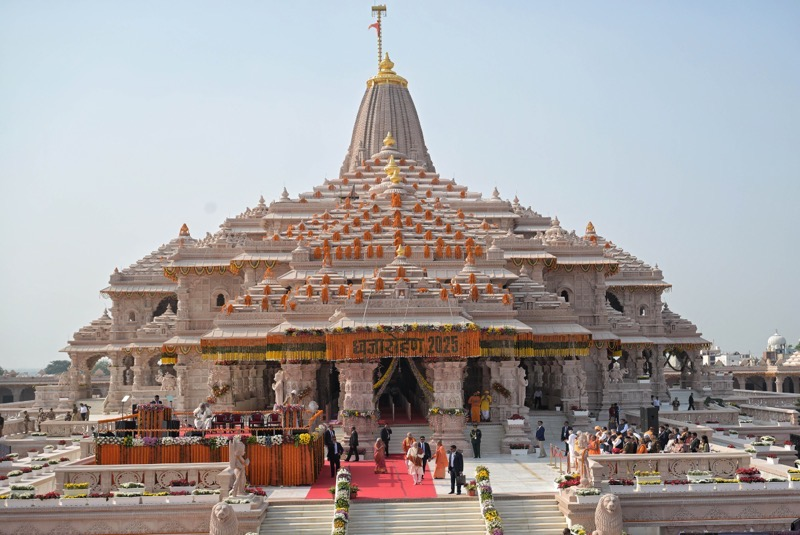
Whenever the Bharatiya Janata Party (BJP) finds itself under political pressure, it shifts the contest onto terrain where it enjoys its greatest advantage: religion, identity and the claim that its opponents are fundamentally hostile to Hindu interests. That instinct is once again on display following financial misappropriation of donations to the Ram Mandir in Ayodhya.
To scuttle uncomfortable questions about accountability, the party has sought to redefine the controversy. What began as an issue of governance is being recast as an attack on the Hindu faith.
The allegations strike at an institution unlike any other in contemporary Indian politics. The Ram Mandir is a project that is the culmination of the BJP’s defining ideology. Narendra Modi personally presided over both its foundation ceremony and its consecration before the 2024 general election, embedding the temple within the party’s narrative of civilisational restoration and political delivery.
Financial impropriety, fraud, and embezzlement of funds therefore raise awkward questions not only about those entrusted with administering the shrine but also about the political movement that invested so much of its legitimacy in its construction.
Instead of engaging those questions directly, the BJP has adopted a familiar strategy. Critics have been portrayed as “Ramdrohi”, traitors to Lord Ram, while Opposition leaders have been accused of maligning Hinduism itself. The effect is to shift attention away from allegations of fraud or administrative failure and to relocate the debate within the familiar terrain of religious identity. Accountability becomes secondary to the defence of faith.
The timing is politically significant. Uttar Pradesh is approaching another fiercely contested assembly election, and the BJP has already begun framing the political battlefield. During his first visit to Lucknow as the party’s national president, Nitin Nabin reaffirmed the BJP’s claim to be the authentic political heir of the Ram Janmabhoomi movement.
The BJP, the Rashtriya Swayamsevak Sangh and the Vishva Hindu Parishad, he argued, had sacrificed for the temple’s construction, whereas parties led by Rahul Gandhi, Akhilesh Yadav and Arvind Kejriwal had merely sought to derive political advantage from the present controversy. Questions surrounding Ayodhya, he suggested, were not legitimate demands for accountability but attempts to profit from a criminal incident.
Yogi Adityanath, alias Ajay Bhist, has carried that argument further. In a series of speeches across Uttar Pradesh, he has devoted little attention to the substance of the allegations. Instead, he has returned to themes that have long underpinned the BJP’s electoral success: namaaz, cow slaughter, Waqf properties, Mughal rulers, Kanwad Yatras and the historical treatment of Hindu religious institutions. The cumulative effect is unmistakable. Public discussion is redirected away from financial oversight at the country’s most politically significant temple and back towards the cultural and communal questions that have shaped Uttar Pradesh’s politics for decades.
Adityanath has accused the Congress and the Samajwadi Party of using allegations of corruption to ‘defame’ Ayodhya and Lord Ram. As “secular” parties, he argues, they lack the moral authority even to question what has happened because they have never genuinely respected Hindu belief. In this formulation, the controversy ceases to concern institutional accountability. It instead becomes another chapter in a longer story of purported hostility towards Hindu civilisation.
Yet this political framing leaves important questions unresolved. The Special Investigation Team established by the Uttar Pradesh government submitted a preliminary report, leading to a First Information Report and criminal proceedings against eight individuals. Those developments indicate that investigators considered the allegations sufficiently credible to warrant prosecution. They do not, however, resolve the broader issue of institutional responsibility.
The Ram Temple Trust exercises ultimate administrative authority over the temple. However, no action has been taken against the trust. The FIR was filed by a member of the trust instead of the investigating agency, despite the trust being central to the administration under scrutiny. Calls, including from figures within the saffron ecosystem, for an independent investigation by the Central Bureau of Investigation have so far gone unanswered. Nor has Mr Modi publicly addressed a controversy involving a project closely associated with his own political leadership.
Questions have also surrounded Champat Rai, the trust’s general secretary, who initially dismissed the allegations before withdrawing from public comment as scrutiny intensified. Whatever the outcome of the criminal investigation, the affair raises questions about transparency, oversight and governance within an institution presented as a national symbol rather than a religious trust.
Faced with those questions, the BJP has chosen to widen the political frame. Nabin invoked his father’s participation as a karsevak to reinforce the party’s moral claim over the Ram Janmabhoomi movement, while Adityanath has argued that the government’s swift creation of the Special Investigation Team demonstrates administrative efficiency rather than institutional weakness. Together, they seek to shift attention from the present administration’s conduct to the history of the movement that made the temple possible.
That transition is central to the BJP’s electoral strategy. Having reframed the controversy as another episode in the struggle over Hindu identity, the party has returned to themes that have defined its politics for decades. Adityanath has revived allegations that previous Samajwadi Party governments privileged Muslim institutions over Hindu ones, pointing to expenditure on Muslim graveyards while contrasting it with the BJP’s investment in temples and religious infrastructure.
He has revisited the 1990 police firing on karsevaks under Mulayam Singh Yadav’s government and revived disputes over the Congress-led United Progressive Alliance’s handling of the Ram Setu affidavit, presenting both episodes as evidence of a political tradition that dismissed or suppressed Hindu sentiment.
The same logic informs his treatment of contemporary controversies. Questions surrounding Waqf properties, cow slaughter, Kanwad Yatras and religious processions have been woven into a narrative in which the BJP presents itself as the defender of Hindu interests against an Opposition supposedly indifferent—or actively hostile—to them.
Adityanath has argued that parties criticising the administration of the Ram Mandir simultaneously oppose reforms to Waqf institutions while remaining silent about alleged encroachments on public land. Whether or not the issues are substantively connected is almost beside the point. Their political value lies in relocating public attention from the specifics of the investigation to a familiar argument about unequal secularism and historical grievance.
The chief minister has also returned repeatedly to the Mughal past, another enduring feature of the BJP’s political vocabulary. By contrasting Lord Ram and Lord Krishna with Babur and Aurangzeb, and by drawing attention to the slow construction of the mosque on the alternative site allotted under the Supreme Court’s 2019 judgment, he situates the present controversy within a much longer civilisational struggle. Such references shed little light on the allegations under investigation. Their purpose is to ensure that Ayodhya is discussed not as a question of governance but as a continuing symbol of Hindu resurgence.
This reframing extends even to the question of who may demand accountability. Adityanath has suggested that only genuine devotees of Lord Ram possess the moral standing to express outrage over the alleged theft. Opposition leaders are portrayed not as critics seeking transparency but as opportunists exploiting a criminal case to discredit both the temple and Hindu society. The implication is striking. Demands for administrative accountability are treated not as an ordinary feature of democratic scrutiny but as evidence of ideological hostility.
That approach reflects more than a communications strategy; it reveals the BJP’s electoral calculations. The 2024 Lok Sabha election demonstrated that the political dividends of the Ram Mandir are not inexhaustible. Despite inaugurating the temple only months before the polls, the BJP suffered significant losses in Uttar Pradesh, most symbolically in Faizabad, the constituency that includes Ayodhya. The party’s representation in the state fell sharply, suggesting that religious symbolism alone no longer guarantees electoral success. Local governance, economic concerns and caste alignments have reasserted themselves alongside questions of identity.
That setback makes the present controversy especially awkward. The Ram Mandir remains the BJP’s trump card and is one of its most powerful electoral symbols. Precisely because the party invested so much political capital in the temple, allegations concerning its administration cannot easily be dismissed as routine criminality. They invite scrutiny not only of individual wrongdoing but of the standards of transparency and institutional oversight governing a project repeatedly presented as a national achievement.
It is, therefore, unsurprising that the BJP has responded by broadening the political conversation. Rather than contesting every allegation on its merits, it has sought to absorb the controversy into the larger narrative that has sustained the party for more than three decades: that criticism of institutions associated with the Ram Janmabhoomi movement is inseparable from hostility towards Hindu faith. Within that framework, the dispute ceases to be about financial accountability and becomes another episode in the defence of Hindu civilisation against its political adversaries.
Whether that strategy succeeds will shape more than the coming assembly election. Ayodhya has long occupied a unique place in India’s political imagination, but its significance now cuts both ways. The temple remains an unparalleled source of symbolic legitimacy for the BJP, yet that same symbolism exposes the party to unusually exacting standards of public accountability. A shrine elevated into the centrepiece of a national political project cannot easily be insulated from questions about its governance.
The criminal investigation will ultimately determine the legal responsibility of those accused. The political questions, however, extend further. They concern whether institutions that claim exceptional moral authority are willing to submit to equally exceptional standards of transparency.
The BJP has chosen to answer those questions by returning to the language of faith, history and identity that has served it so effectively in the past. Whether voters remain persuaded that criticism of the Ram Mandir’s administration is indistinguishable from criticism of Hinduism itself may prove one of the defining political tests in Uttar Pradesh over the year ahead.
-30-
Copyright©Madras Courier, All Rights Reserved. You may share using our article tools. Please don't cut articles from madrascourier.com and redistribute by email, post to the web, mobile phone or social media.Please send in your feed back and comments to [email protected]