
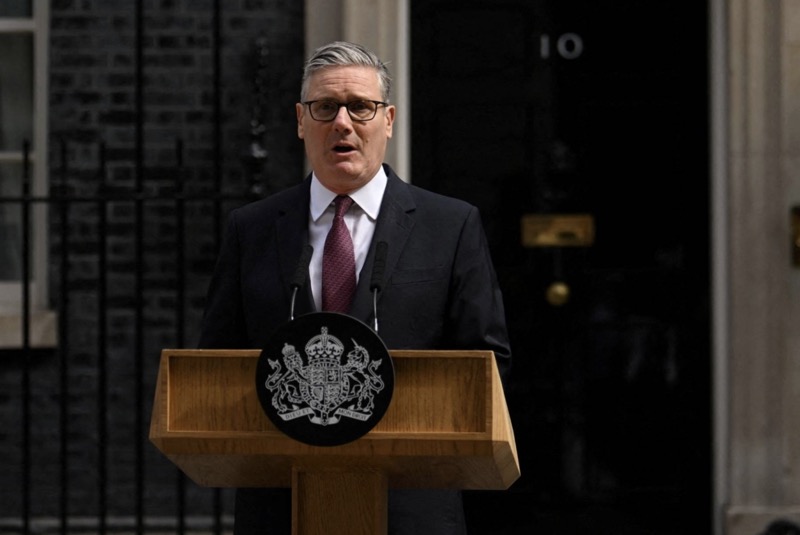
Keir Starmer’s resignation marks the end of a premiership. But it also marks Britain’s inability to ensure political stability. In the decade since the Brexit referendum, the country has churned through prime ministers with remarkable speed. David Cameron resigned after gambling the future of Britain on a referendum he expected to win. Theresa May inherited a crisis she could not resolve. Boris Johnson secured one of the largest Conservative majorities in modern history and still managed to leave office in disgrace. Liz Truss detonated her own government in less than two months. Rishi Sunak presided over the exhausted aftermath. Starmer, elected as the antidote to Conservative chaos, discovered that political exhaustion is contagious.
Six prime ministers in ten years is not simply a story about flawed leaders. It is a story about a political system struggling to govern a country whose citizens no longer agree on fundamental values. Beneath this rapid churn lies a deeper instability: Brexit never settled Britain’s arguments. It accelerated and reorganised them.
Ironically, Starmer arrived in office without ever truly being loved. Labour’s victory in 2024 was historic in parliamentary terms, but emotionally distant — perhaps cautious. The electorate had not fallen in love with Starmer; it had fallen out of love with the Conservatives. Today, Britain increasingly resembles a democracy in which governments are elected out of desperation and removed by disappointment. Electoral landslides conceal a remarkable absence of enthusiasm.
That absence created the political space for figures like Nigel Farage. Much of the commentary surrounding Farage remains trapped in an outdated debate. For nearly two decades, Farage has exercised a peculiar form of power: influence without responsibility. He has never governed. He has never managed a department. He has never had to reconcile campaign promises with fiscal realities. Yet he has repeatedly succeeded in persuading many British people to speak his language.
Prime ministers have come and gone. But Farage has remained. His competence lies not in winning power but in narrowing the range of political conversation. Immigration, national identity, borders, sovereignty, multiculturalism, and cultural grievance have become the gravitational centre of British politics. Even politicians who oppose Farage often find themselves responding to him, explaining themselves against his assumptions, debating on terrain he helped construct. In modern politics, controlling the agenda is often more important than controlling government. Farage seems to have mastered this art.
Farage did not create the conditions that made this possible. Those conditions were created over decades by governments of both major parties. Deindustrialisation hollowed out towns. Public infrastructure deteriorated. Social housing was neglected. Wealth was concentrated in fewer pockets. Regional inequalities deepened. The promise that globalisation would eventually lift all boats — that claim of ‘trickle down economics’ — began to sound absurd in communities where the ships had long sunk.
The political establishment offered management, while many voters demanded transformation. Into that vacuum stepped a series of populists, of whom Farage has been the most durable. His success rests on identifying genuine grievances while directing attention toward highly selective explanations. Housing shortages become immigration problems. NHS waiting lists become immigration problems. Wage stagnation becomes an immigration problem.
He has skilfully transformed the structural failures of economic policy into cultural disputes. This has proved politically effective because cultural explanations are emotionally convincing. They provide villains, offer clarity, and reduce complex systems to simple stories.
But Britain’s immigration debate is sustained by an extraordinary contradiction. The country has one of the most restrictive visa systems in the developed world, while simultaneously behaving as if migration occurs in a state of near-anarchy. Business sectors rely heavily on migrant labour. Universities depend upon international students. The NHS would struggle to function without overseas workers. Governments encourage migration when it serves economic needs and condemn it when it serves political needs.
The result is a perpetual cycle of outrage in which migrants are blamed for crises created elsewhere. Migrants did not create Britain’s housing crisis. It was created by decades of inadequate housebuilding. Migrants did not create the NHS crisis. It was created by chronic underinvestment and repeated attempts to run public services according to market logic. Economic insecurity was not imported in a suitcase. Political choices produced it.
Farage understands that none of this necessarily matters electorally. Politics is not merely about facts. It is about narratives. The story he tells is powerful as it offers coherence in an era of fragmentation. That coherence is now attracting audiences well beyond Britain.
One of the most intriguing developments in recent years has been Farage’s growing appeal among sections of Britain’s Indian diaspora. On the surface, the relationship appears paradoxical. A politician whose career was built on anti-immigration politics might seem an unlikely hero for migrant communities. But modern identity politics is rarely governed by such simple categories.
Farage is not trying to win over all British Indians. He is targeting a specific constituency: socially conservative, economically successful voters who place a high value on nationalism, traditional family structures, cultural hierarchy, and law-and-order politics. Such voters are not defined primarily by their experience as migrants but by their political values.
In this respect, Farage is borrowing from a strategy that has become common across the global right. Ethnicity becomes less important than ideological alignment. Nationalists seek alliances with minorities who share their social conservatism. The goal is not multicultural solidarity but the construction of new political coalitions around cultural values.
The phenomenon becomes easier to understand when viewed through the lens of contemporary Indian politics. Sections of Britain’s Indian diaspora have become increasingly influenced by the ideological currents associated with Hindu nationalism. The emotional attachment many diaspora voters feel towards Prime Minister Narendra Modi is not merely about India. It reflects broader political preferences: admiration for ‘strong’ leadership, scepticism toward liberal multiculturalism, hostility toward the political left, and concern about ‘demographic change.’ Farage has recognised an opportunity with Indian immigrants.
The enthusiastic coverage he receives from parts of India’s right-wing media ecosystem is therefore no accident. These media platforms see in Farage a familiar political figure. They recognise the language of ‘civilisational pride,’ ‘national sovereignty,’ ‘anti-elite populism,’ and ‘cultural grievance.’ They see a politician challenging liberal institutions and multicultural orthodoxies. Most importantly, they see validation for their claim that a global revolt against liberalism is underway.
The relationship is mutually beneficial. Farage gains visibility and legitimacy among diaspora audiences. The Indian right gains evidence that its worldview is not uniquely Indian but part of an international political movement stretching from Washington to London, from Budapest to New Delhi.
The symbolism matters. Donald Trump’s endorsement of Farage elevated him within the broader international populist network. Public support from Elon Musk, whose interventions in European politics have increasingly favoured anti-establishment and right-wing movements, further strengthened Farage’s image as part of a transnational insurgency against liberal elites. These endorsements do not automatically translate into votes. But they help situate Reform UK within a wider political ecosystem whose members increasingly learn from, celebrate, and amplify one another.
This is one reason why attempts to defeat Farage by debating immigration numbers alone are unlikely to succeed. His project is not fundamentally statistical. It is emotional and cultural. It offers belonging. It offers certainty. It offers a sense of national restoration.
Labour’s dilemma, therefore, extends far beyond finding a new leader. If the party responds by moving further onto Farage’s territory, it will merely reinforce his central argument that immigration and identity are the country’s defining problems. Every concession strengthens the frame.
The alternative would require something far more ambitious: reconnecting politics to material improvement, not through nostalgic promises or technocratic management, but through visible investment in housing, public transport, education, healthcare, green industry, and secure employment. The challenge is not simply defeating Farage. It is rendering Farage’s diagnosis less plausible.
That task is complicated by another reality exposed during the Truss premiership: the growing perception that democratic governments possess less economic freedom than voters imagine. Markets discipline governments. Bond traders acquire an influence that elected politicians lack. Grand promises collide with financial constraints. Citizens are repeatedly told that transformative change is impossible.
The danger is that this creates an opening for figures who insist that only cultural battles remain politically achievable.
Starmer’s resignation should therefore not be read as an isolated failure. It is another chapter in a decade-long story about political fragility in Britain. Prime ministers rise and fall, but the underlying crises remain. Economic insecurity, declining public trust, regional inequality, cultural fragmentation, and institutional exhaustion continue to define national life.
Farage’s growing traction is not evidence that these problems have been solved. It is evidence that they have not.
The real contest unfolding in Britain is not between Labour and Reform, nor between left and right. It is between competing explanations for the decline itself. One explanation blames migrants, minorities, and multiculturalism. The other points towards inequality, concentrated wealth, underfunded public services, and an economic model that has produced immense riches for some and stagnation for many.
The next Prime Minister will inherit that argument. Farage, whether he ever reaches Downing Street or not, intends to make sure it is fought on his terms. Britain’s future may depend on whether his opponents can persuade voters to see the country through a different lens.
-30-
Copyright©Madras Courier, All Rights Reserved. You may share using our article tools. Please don't cut articles from madrascourier.com and redistribute by email, post to the web, mobile phone or social media.Please send in your feed back and comments to editor@madrascourier.com