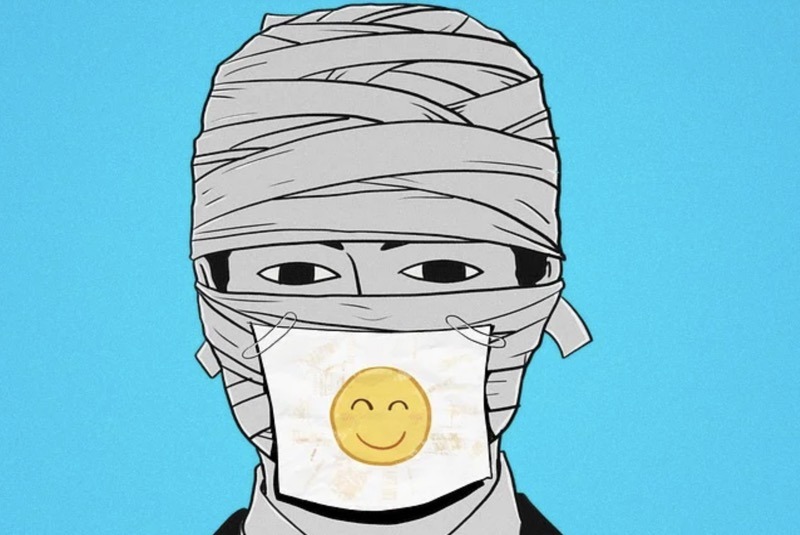
There is a deep problem with who can actually speak truth — write it, debate it, or express it through symbolic forms. To understand this problem fully, we must situate it in the Indian context, particularly against the backdrop of its current political condition, since the political institution seems far more domineering today than other powerful social institutions, even if those institutions are no less formidable in their own right.
Let us be clear about something elementary. Speaking or writing truth is, by its very nature, easier and far less costly than lying, conspiring, manipulating or scheming, for the latter demands a far greater expenditure of mental labour to sustain. More importantly, the fear of consequences that inevitably accompanies deception seizes further control of the heart and the mind. Both suffer under the weight of concealment.
So, when speaking the truth becomes difficult, and those who do so are celebrated as courageous, there is certainly something deeply and structurally wrong with the system. The point here is not to diagnose that wrong system in isolation, but to ask unsettling questions: how do those who do speak or write truth manage to do so? What emboldens them? What provides them with the agency to dare to say what is not inherently difficult to say?
One night last year, when I was alone and awake, I found my mind drifting toward thoughts that would be considered transgressive in the eyes of a powerful institution. Then I tried to redirect my thinking, but the mind, the night and the invisible architecture of the institution began to frighten me, then almost to throttle me. I was not immediately aware that the institution was haunting me even in my bed, even in the privacy of my own thoughts. I recriminated myself and sought something resembling penance. This is the lived texture of institutional power.
As Michel Foucault observed in Discipline and Punish, modern power does not merely punish the body from outside but colonises the inner life of the subject, making the surveilled individual their own jailer. The institutions are watching you always. Worse now than ever before. What was once easy and harmless to express becomes increasingly difficult and risky under the watchful gaze of these institutions.
Politics casts a hawk’s eye over the entire system, and nobody, or almost nobody, can escape the gaze entirely. Except for those the institution permits to dissent, or those the institution is somehow unable to suppress without endangering its own legitimacy. For its survival, every authoritarian or semi-authoritarian system must allow some voices of dissent, precisely to maintain the appearance of openness, while suppressing the vast majority. The question then becomes: who exactly constitutes this permitted minority?
As I was recently reading and listening to some prominent voices of dissent across newspapers, television, social media and YouTube in India, I found that these voices almost invariably emerge from certain positions that make it structurally possible for their bearers to speak. These positions are constructed over long periods of time and grant their occupants the agency to articulate what is obvious but incredibly dangerous for the majority to express. In fact, most of the majority is even afraid to listen to dissent openly. Many even pretend they do not understand or claim they cannot follow the substance of what is being said, when in reality the difficulty is not cognitive but institutional.
Several factors contribute to the creation of these rare positions. Some are personal, built individually over time through intelligence, skill, extraordinary performance and the slow accumulation of public recognition within the system. Some are created by the system itself, as in the case of opposition leaders in a political establishment who are structurally permitted, even required, to speak against the ruling power.
Some positions are created by more powerful foreign institutions, including international media organisations, foreign universities, global human rights bodies and international press freedom organisations, which provide a protective canopy that domestic institutions cannot easily tear down. And some positions are created by sudden ruptures within the system, moments of crisis or contradiction when the institutional grip momentarily loosens, and new voices briefly emerge.
Prominent figures across different categories illustrate this clearly. From the political system, names such as Rahul Gandhi, Mamata Banerjee, Akhilesh Yadav, Arvind Kejriwal and M.K. Stalin occupy positions that the system must structurally tolerate, for suppressing them entirely would expose the hollowness of its democratic claims. From journalism, figures like Ravish Kumar, Rajdeep Sardesai and Karan Thapar have built reputations so widely recognised that silencing them entirely would carry enormous reputational cost for the establishment. From the field of writing and intellectual life, Romila Thapar, Arundhati Roy, Ramachandra Guha and Pratap Bhanu Mehta command institutional credibility both domestically and internationally that makes complete suppression difficult, though certainly not impossible, as Roy’s charging under the UAPA in 2024 demonstrates. From the arts, Naseeruddin Shah, Anurag Kashyap and Prakash Raj have achieved cultural positions substantial enough to speak without being immediately erased. And from the digital world, figures like Dhruv Rathee, with over twenty million YouTube subscribers, have built platforms whose scale alone provides a form of protection.
These personalities have been praised for their courage in speaking what many believe is not difficult to say, but has been made systemically difficult to utter. When they speak it, the truth, which is relatively easy to uphold and express, becomes defamiliarised, not because only they understand it, but because others structurally cannot say it. Their articulation of the obvious performs the same operation that the literary theorist Viktor Shklovsky described as ostranenie, or defamiliarisation, the process by which art makes the ordinary appear extraordinary by removing it from the automatism of everyday perception.
The more ruthless and obstinate the system remains, the more the utterances of such positioned voices will be foregrounded, and they will remain perpetually, almost paradoxically, relevant. Antonio Gramsci, writing from his prison cell under Mussolini’s fascism, understood this dynamic well. In his Prison Notebooks, he argued that hegemony is never total, that a ruling class must always negotiate with organic intellectuals who articulate the lived contradictions of the system, even when it seeks to contain them.
Now, why is it that those occupying these positions can speak, while the majority who feel, understand and privately appreciate these truths cannot openly express similar views, even in their own raw and elemental ways, especially in this age of technology and social media that would seem to democratise expression? A commoner without social, economic or institutional protection cannot publicly and emphatically repudiate the ruling media narrative without real and immediate personal consequences. Job loss, social ostracism, legal harassment under broad and vaguely worded laws, and digital mob violence are all available as instruments of suppression.
India’s use of the Unlawful Activities Prevention Act, or UAPA, against students, journalists and activists illustrates how the state can deploy the language of national security to criminalise dissent. According to Human Rights Watch’s 2026 World Report, several activists, including students, languished in jail without charge under this counterterrorism law. Similarly, Arundhati Roy or Rahul Gandhi hold positions from which they can speak what many others know but cannot write or say. Their position, not their unique moral virtue, is what makes speech possible.
And suppressing that position entirely is difficult for the system precisely because it needs the appearance of permitting dissent for its own survival and international legitimacy. As the political philosopher Hannah Arendt argued in The Origins of Totalitarianism, even the most authoritarian systems require a residual theatre of legality to justify themselves to the world.
It is worth noting that these positions are not simply handed to their occupants. They are largely earned over time, through sustained labour within the very system that simultaneously seeks to contain them. This is part of what makes the entire arrangement so elegant in its cruelty. The system does not merely suppress from the outside. It shapes the very conditions under which recognition, reputation and platform are accumulated, ensuring that those who accumulate them have already, in various ways, demonstrated their capacity to operate within its limits. Pierre Bourdieu’s concept of cultural capital is instructive here. Those who possess sufficient cultural, social and symbolic capital are permitted a degree of dissent, precisely because their very participation in the system’s credentialing processes has already partially domesticated their radicalism.
Viewed from a sufficient distance, the entire arrangement begins to resemble an elaborate and darkly comic performance. The system complicates truth and common sense until they become so entangled in layers of fear, institutional pressure and social penalty that they are almost impossible to articulate. Then those who attempt to untangle what was always obvious, by mouth or written word or art, are celebrated as exceptional and brave.
In this way, the majority of commoners, who could in principle be the most powerful force for truth simply by virtue of their numbers, remain almost always at the receiving end of a system that will not emancipate them, for that emancipation would threaten its own survival. As Paulo Freire wrote in Pedagogy of the Oppressed, the oppressed often internalise the image of the oppressor to such a degree that liberation itself begins to feel dangerous. The system does not merely silence the majority. It teaches the majority to silence themselves.
-30-
Copyright©Madras Courier, All Rights Reserved. You may share using our article tools. Please don't cut articles from madrascourier.com and redistribute by email, post to the web, mobile phone or social media.Please send in your feed back and comments to [email protected]