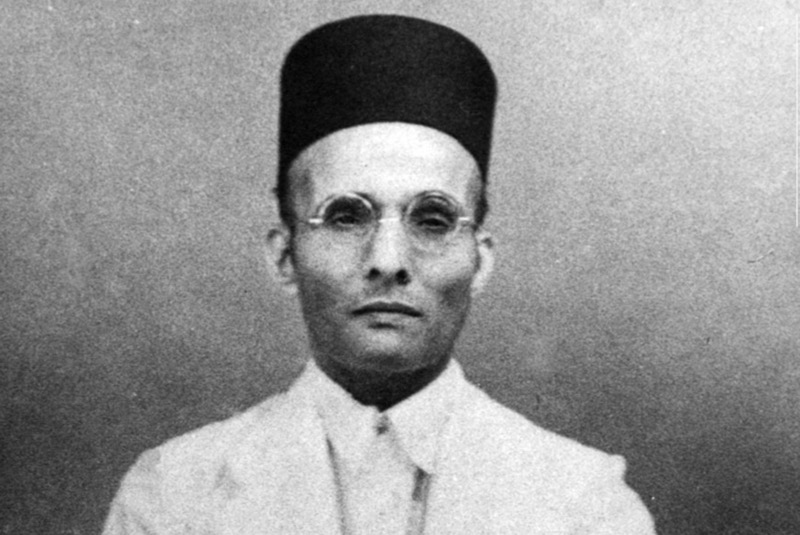
At a time of impassioned debate on Sanatana Dharma between members of the RSS and others, and when some Hindu temples have confined entry to declared adherents of the faith, it is instructive to look at the views of VD Savarkar — the godfather of the BJP and its mentors in the RSS — on ‘the eternal faith.’
Today, most people think Savarkar was committed to Sanatana Dharma. Interestingly, that was not the case.
Savarkar had deep knowledge of Sruti-Smriti literature as well as the scriptures of other religions. In his copious outpourings during his lengthy incarcerations by the British-Indian government, he makes clear his scepticism of various aspects of the Sanatana Dharma.
In her deeply researched book entitled ‘Savarkar and the Making of Hindutva,’ the scholar Janaki Bakhle studies his essays, poems and books — largely written in Marathi — to present a clear exposition of Savarkar’s standpoint on what are today considered to be core tenets of Sanatana Dharma, namely the caste system, food prohibitions, cow worship, and temple entry.
In an essay titled ‘What is the True Eternal Faith?,’ Savarkar lampoons and satirises beliefs embedded in the Sanatana Dharma, and dares adherents to challenge his erudition. He primarily argues that Sanatana Dharma was not ritualism, caste barriers, food proscriptions, temple protection or deification of the cow.
Priding himself on being a rationalist and pragmatist, he argued that, while he respected the literature of Sanatana Dharma, it should be sifted for its utility in the present age. He mocked those who claimed that everything new and useful had its seed in the Srutis: “As soon as coal-fired trains get going, they start hearing the sounds of railway engines in the Vedas”, and, he predicted, they will expound about the existence of planes in the distant Hindu past.
He highlighted the illogic and contradictions surrounding the four-fold caste system (chaturvarnya) as laid out in the Purushasukta of the Rg Veda: how could the four varnas arise from a single entity; did not ‘untouchables’ constitute an obvious fifth caste; was caste purity even possible?
Ridiculing the proliferation of castes based on occupational distinctions, he wrote: “When some milkmen started making butter from cold milk, they became a caste separate from those who made butter from warm milk….. Among the meat-eating people, the group of fish-eating Brahmans became a separate caste, the group of chicken-eating Brahmans became another caste, and goat-eaters became another one.”
Decrying the idea of touch pollution, Savarkar asked: “What kind of God can be polluted by simply being worshipped?” God “is not one who is polluted by the touch of someone impure; by his own touch, he purifies the impure.” He pointed out the absurd belief that someone like Dr Ambedkar, whom he held in high regard, was regarded as a polluting element.
Savarkar viewed caste, like he did most issues, primarily through the prism of Hindu nationalism. He believed that caste artificially divided Hindus and created schisms among them, keeping them from putting up a united front against the “main enemy, the Muslim.” Untouchability, he argued, provided fertile ground for recruitment into other faiths, thereby further weakening the Hindu community.
Savarkar spoke out in favour of intermarriage across castes, the education of women, and interdining. However, Savarkar was primarily driven by his mission to unify and strengthen Hindus against Muslims.
In a piece titled ‘The Locus of Religion: Faith is the Heart, not the Stomach,’ he wonders why Hindu tummies are unable to digest food cooked by others: “the notion that if Hindus dine with Christians or Muslims, they will be polluted is crazy!,” he wrote. He was comfortable with inter-dining, taking the cue from his mentor, Balgangadhar Tilak, who believed that Hinduism was not so weak that merely consuming others’ food would diminish the faith.
From an early age, Savarkar saw himself as an agent of Hindu social reform. When he was not yet twenty, he wrote an emotive poem in which he decried child marriage and argued for the remarriage of widows. In 1933, he gave a series of lectures on the Manusmriti, debunking popular beliefs and pointing out absurdities and contradictions.
He asserted that there was nothing in the Manusmriti against marriage between castes, remarriage, or vegetarianism. Indeed, he claimed that scripture enjoined mourners to partake of the flesh of various animals to satiate the spirits of ancestors.
Attacking Hindu prejudice, Savarkar argued that the cow is a useful animal, “but not our mother, and definitely not a god.” He laughed at those who “filled their cupped hands with cow urine and sprinkled it all over a temple but if a pure and wise previous-untouchable like Dr. Ambedkar were to give them Ganga water…..they believe they have been polluted”. He goes on to say that “to worship any such animal is to insult humanity.
Savarkar presented himself as a progressive, worldly, rationalist. His philosophy involved no theology, no priesthood, no single text, no rituals. His guiding principle was nationalism — what has been described as “a territorial or cartographic fundamentalism”.
By turning the figure of the nation into a goddess, Savarkar opportunistically ensured that worship of “Bharat Mata.” In doing so, as Bakhle says, he “fulfilled both a secular and sacred function,” providing spiritual sustenance to believers for all activities construed as nationalistic and patriotic.
And so, Savarkar came to be known as the chief prophet of spiritual nationalism, encompassing the territory of Bharat as the ‘punyabhumi’ (sacred land) and ‘pitrubhumi’ (fatherland) of its inhabitants. While his views on nationhood have become the guiding principle of India’s national policy today, his views on the need to discard illogical aspects of Sanatana Dharma have been completely ignored.
-30-
Copyright©Madras Courier, All Rights Reserved. You may share using our article tools. Please don't cut articles from madrascourier.com and redistribute by email, post to the web, mobile phone or social media.Please send in your feed back and comments to editor@madrascourier.com