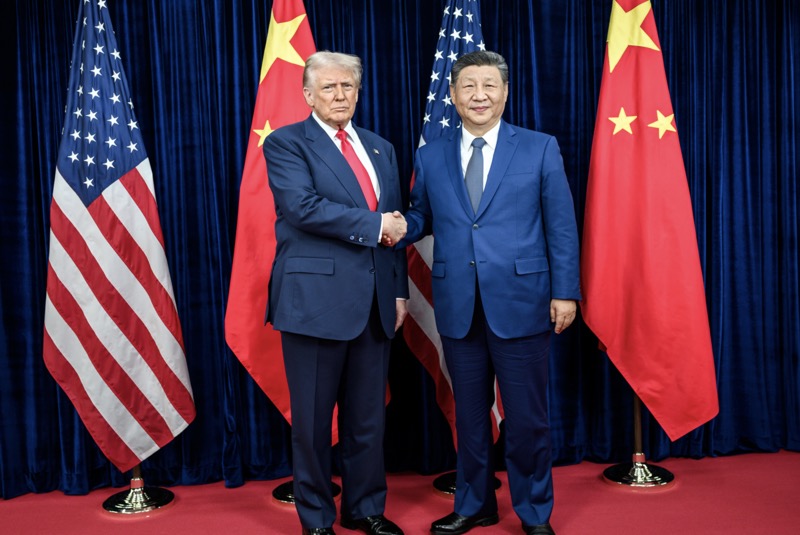
The meeting between Donald Trump and Xi Jinping in Beijing is, in many respects, a negotiation over the operating system of the twenty-first century. In the last decade, the world has come to accept that the United States and China are rival power centres competing on major issues: trade, artificial intelligence, energy, military power, supply chains, semiconductors, finance, and even the rules governing speech and information.
The relationship between Washington and Beijing has reached a peculiar phase; both countries are economically and strategically intertwined, but they are distrustful enough to cooperate. It’s a contradiction that defines the instability of modern geopolitics.
The summit comes after years of economic confrontation, tariff escalation, and technological restrictions that rattled global markets and fractured the world economy. Even now, the relationship is in a “trade truce.” However, both sides have rolled back some tariffs and export controls after realising that the spiral of retaliation was economically unsustainable.
This meeting, however, is not about tariffs. The deeper question is whether the United States and China can coexist within the same global order.
For Trump, the meeting is transactional. He has always viewed foreign policy through the language of leverage, imbalance, and deals. Reports suggest he will arrive with corporate executives to seek expanded access for American companies, agricultural purchases, and agreements on technology and investment. His administration is interested in “managed trade”—a system in which Washington and Beijing negotiate directly over what goods flow where, which industries receive protection, and which technologies remain restricted.
It represents a profound shift away from the post-Cold War assumption that free markets alone would organise global commerce. The old model depended on the belief that economic integration would gradually soften political rivalry. Instead, integration intensified it.
China became richer without becoming politically Western. America became more dependent on Chinese manufacturing while simultaneously growing fearful of Chinese power. The result is a world economy that increasingly resembles an armed truce.
Xi has a different objective: stability without surrender.
China’s leadership does not expect friendship with Washington. It wants predictability. Beijing hopes to slow the momentum toward economic decoupling, preserve access to advanced technologies, and prevent the United States from tightening alliances around China’s perimeter. Most of all, Xi wants to ensure that competition does not drift into open conflict over Taiwan.
Taiwan produces the majority of the world’s advanced semiconductors, including the chips essential for artificial intelligence systems, smartphones, military systems, and global communications networks. A military crisis in the Taiwan Strait would trigger a global economic seizure.
Beijing wants Washington to soften its rhetoric, reduce military signalling, and explicitly reaffirm elements of the “One China” framework. Taiwan, meanwhile, fears becoming a bargaining chip in a U.S.-China tug-of-war.
The United States increasingly frames global politics as a contest between democratic openness and authoritarian control. China frames it as a contest between Western dominance and multipolar sovereignty. Neither side merely seeks advantage; both seek validation of their political model.
Artificial intelligence sharpens that competition dramatically.
AI is expected to occupy a central place in discussions between the two governments. This matters because AI is rapidly becoming the infrastructure beneath military planning, economic productivity, surveillance, finance, scientific research, and the media.
The United States still leads in frontier AI models and advanced semiconductor design. China possesses enormous manufacturing capacity, vast data ecosystems, and a state willing to direct industrial policy on an extraordinary scale.
Both countries understand that whoever dominates AI will wield enormous strategic influence over the coming decades.
Yet there is a paradox at the centre of the AI race. The same technology that intensifies competition also increases the need for cooperation.
An uncontrolled AI arms race between two of the world’s largest powers could become catastrophically destabilising. Military systems increasingly rely on machine learning; Cyber capabilities are accelerating; Disinformation tools are becoming more sophisticated; Even financial systems are becoming more vulnerable to algorithmic disruption.
Some analysts now compare the moment to the early nuclear era: two powers racing toward transformative capability before fully understanding the consequences. This explains why the summit matters even if it produces no dramatic breakthrough.
The world is searching for evidence that Washington and Beijing can still establish guardrails — mechanisms that prevent rivalry from becoming systemic chaos. Reports that both sides may establish permanent trade and investment forums suggest an attempt to institutionalise competition rather than eliminate it. That may sound modest. In reality, it could prove historically significant.
The alternative is a world drifting toward permanent fragmentation.
Already, countries across Europe, Asia, Africa, and Latin America increasingly feel pressured to navigate between American and Chinese systems — American security guarantees on one side, Chinese trade and industrial investment on the other. Supply chains are reorganising. Technology ecosystems are splitting. Financial networks are becoming politicised.
The fear among many middle powers is not necessarily that either Washington or Beijing will “win.” It is that the rivalry itself will become the organising principle of global life. There is another reason this summit matters: both leaders now govern from positions shaped by insecurity rather than confidence.
Trump returned to office, arguing that globalisation weakened American industry and hollowed out the middle class. Xi governs a China facing slowing growth, demographic decline, mounting debt pressures, and growing international suspicion. Both leaders increasingly rely on nationalism as political glue.
That creates incentives for confrontation.
Yet both understand the costs of instability. China still depends heavily on global markets. The United States still depends on Chinese manufacturing and critical minerals. Recent disputes over rare earth exports demonstrated how vulnerable modern economies remain to supply disruptions.
In an earlier era, rival superpowers could often separate economically while competing militarily. Today’s rivalry is more complicated because the competitors remain deeply intertwined. America and China are adversaries who cannot fully disengage without harming themselves and the wider world. That interdependence may ultimately be the only thing preventing catastrophe.
But the question is whether political leadership can transform that condition into a durable framework for coexistence. Not whether soybean purchases increase. Not whether tariffs fall by five or ten per cent. Not whether corporate executives secure new market access. The larger issue is whether the world’s two most powerful countries can still recognise limits.
Can they compete without forcing every other nation into submission? Can they build technological supremacy without dismantling global stability? Can they pursue national ambition without drifting toward military collision?
For decades, globalisation encouraged the fantasy that economics could replace geopolitics. Today, that illusion is over. Power has returned to the centre. The Trump-Xi summit is important because it will reveal what kind of power politics now governs the world: disciplined rivalry or unmanaged escalation.
The answer will shape not only the future of the United States and China, but the future of the century.
-30-
Copyright©Madras Courier, All Rights Reserved. You may share using our article tools. Please don't cut articles from madrascourier.com and redistribute by email, post to the web, mobile phone or social media.Please send in your feed back and comments to [email protected]