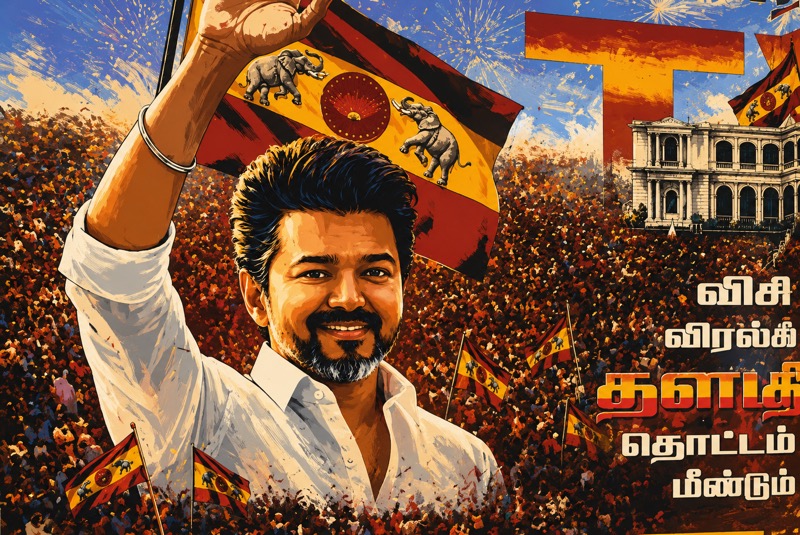
The spectacular victory of Joseph Chandrasekhar Vijay caught the nation unawares. Except for the Axis My India exit poll, no one could foresee such a massive victory for the Tamilaga Vettri Kazhagam (TVK), formed barely two years ago. The media is calling it a non-Dravidian party just because the word ‘Dravida’ is missing from the name.
The two well-established Dravidian parties, the DMK and the AIADMK, have been soundly trounced by TVK, a just-born outfit with no pronounced programme of action in the political arena. The manifesto of a political party is much more than the promises it makes during the elections. The manifesto delineates the party’s vision for a society across culture, agriculture, education, industry, healthcare, gender justice, social justice, and more. Though little is known of TVK’s stance on these subjects, the people, particularly the Gen Z, voted overwhelmingly in favour of TVK, led by Joseph Chandrasekhar Vijay, a leading film star of Tamil cinema.
In the euphoria of an unexpected electoral triumph, everyone assumed that a young and energetic persona is going to lead the run to St. Fort George, in Chennai, little realising that TVK fell slightly short of the required majority to form a Government. It won 108 seats, further reducing it to 107, as Vijay won from two constituencies but can cast only one vote in the Assembly. In a House of 234, a simple majority would mean 117 plus 1, based on the fifty per cent plus one formula, the minimum required numbers to constitute a simple majority.
This euphoria was based on several precedents in government formation in India, following the general elections to the Parliament and the Assemblies. The public mood is ‘never mind the shortfall of a dozen seats for a simple majority which can easily be made up’. The TVK chief himself was not sure of a mechanism to bridge the 12-seat gap to form the government. The mandate was clearly in favour of TVK and very much against the other two alliances.
When Vijay approached the Governor seeking an invitation to form the government, the Governor took a stand that shocked everyone. The Governor asked for a letter containing the signatures of the 118 MLAs pledging support to TVK. This stand is unheard of for several reasons. The Governor’s stand amounts to asking for proof of a majority in the drawing room of the Raj Bhavan rather than on the floor of the House. It is the latter that is the legitimate forum to prove the majority. Let us examine the scenario from a constitutional perspective and from the perspective of constitutional conventions.
Article 163 of the Constitution states that there shall be a Council of Ministers with the Chief Minister at the head to aid and advise the Governor in the exercise of his functions, except in so far as he is by or under this Constitution required to exercise his functions… Article 164 says: The Chief Minister shall be appointed by the Governor, and the Governor shall appoint the other Ministers on the advice of the Chief Minister, and the Ministers shall hold office during the pleasure of the Governor. The Constitution does not address the procedure to be followed by the Governor in government formation. A Constitution should not be seen as a manual, but as broad guidelines of governance. However, several constitutional conventions guide the Governor in forming the government. Let us see them.
When a political party gets a clear majority, that is, fifty per cent of the total strength of the House plus one, the newly elected MLAs usually elect one amongst them as the leader of the legislature party. The leader so elected or his representatives approach the Governor with a resolution of the election, whereupon the Governor invites the leader to form a government. The Constitution provides for the election of a non-legislator as the leader of the legislative party; that is, a person can become a Chief Minister or a Minister without being a legislator, but such a person must become a legislator within a period of six months from the day of his appointment as the Chief Minister or a Minister. Of course, this is not very relevant here.
What happens when no political party gets a clear majority following a general election to Parliament or an Assembly? It is here that constitutional conventions guide the nation. When no party gets a clear majority, that situation is described as a ‘Hung House’ by the media. In the Westminster system we follow, the Executive, that is the Government, emanates from the Legislature, and it is accountable to the Legislature for all its acts of commission and omission. In other words, the Government holds office during the pleasure of the Legislature. The pleasure of the Legislature means having a majority in the House.
In the Westminster system, governance must be carried out in accordance with laws passed by the Legislature. The policies and programmes being implemented by the Government have to pass the test of legislative scrutiny. Money cannot be drawn without the approval of the Legislature, and the approval of the Legislature cannot be obtained if the party in power does not command a majority in the House.
That being so, how is a government formed after general elections if no party gets a majority? This is the question that is confronting Tamil Nadu today. Every question has an answer, but every answer produces its own questions. That is the law of nature. We have the comfort of constitutional conventions to tide us over a crisis such as the one prevailing in Tamil Nadu today.
No party got a clear majority. In such a scenario, the single largest party is offered the first opportunity to form the government. The Governor is required to hold consultations with the leader of the single largest party to ascertain whether that party is in a position to form the government. If the single-largest party is too far short of a simple majority, inviting that party to form the government can lead to large-scale political defections. It is against the constitutional spirit.
It is also possible that the largest party may not come forward to form the government if, in its view, securing a majority is difficult. In this particular instance, the single largest party is only slightly short of a simple majority, which can be made up with the support of other parties.
Nothing is permanent in politics, as also in life. There are examples of stable governments collapsing. Examples include the NTR government in the state of Andhra Pradesh in 1983, and the PV Narasimha Rao Government at the Centre in 1996, surviving in the Legislature.
Nobody, not even the Tamil Nadu Governor, can be sure of what would happen tomorrow. Like in mathematics, life is a matter of assumption. Not everything is written in the Constitution. What we follow, but that is not written in the Constitution, is how a constitutional convention emerges. For example, nowhere in the Constitution of India does it say that a person should not be appointed as the Governor of his own state. But it has emerged as a convention, practised over the years without opposition.
What the Governor of Tamil Nadu is doing is violating such a convention. He is not recognising the convention that, when no party gets a majority in the elections, the single largest party within reach of a simple majority is allowed to form a government, with the condition that the majority be proved on the floor of the House within a certain time limit.
Now, TVK is short of 12 MLAs. By insisting on proof of 118 MLAs supporting the single largest party, he is making his stand contradictory. From where can TVK obtain 12 MLAs’ signatures overnight? Once a government is formed, reconciliation among political parties is possible, and realignment is always possible. If the single largest party is unable to prove its majority on the floor of the House, it will bow out, and, again, the Governor is required by convention to explore the possibilities of government formation by other parties or a combination of parties.
The President of India has done this exercise on various occasions, and so have the governors of various States. By steadfastly insisting on the support of 118 legislators, the Governor’s action leads to encouraging defections, while the Constitution seeks to prevent it!
In a democracy, there should be an elected government to govern. It is only under extraordinary circumstances that a non-elected entity is entrusted with the task of governance. One such circumstance is when no party is in a position to form a stable government. Another circumstance is when there is a constitutional collapse in the state.
Except for these two unusual and extraordinary circumstances, there ought to be an elected government in place. That is what the Constitution ordains and gives the Legislature the power to decide the fate of a government.
In this instance, the Governor is not even convening the Legislature, which is a constitutional requirement. The Assembly must be convened; a senior legislator is appointed as the pro tem Speaker to administer the oath of office to the members, and only the newly elected representatives become the MLAs. Till they take the oath, they are not MLAs in the legal sense of the term.
The Governor’s insistence on the signatures of 118 supporting MLAs is unsustainable. Firstly, how is he going to ascertain whether the signatures are genuine or fake? When a newly elected representative takes the oath, he is required to sign in the official register of the Assembly, and it is that signature which is authentic for all official purposes. When there is no authenticating source, how will the Governor verify a signature? What happens when a member signs the letter of support and subsequently retracts his position? MLAs are known to change sides overnight. Here is an encouragement to do that from the Raj Bhavan! It amounts to doing what one is supposed to stop! If the fence itself eats the crop, who is going to protect it?
The issue of hung assemblies was studied by the Sarkaria Commission as early as 1983 and later by the Puncchi Commission in 2007. The Sarkaria Commission came out with certain broad guidelines to be followed by Governors while dealing with hung Assemblies:
First Preference: A pre-poll alliance with a majority. This is not possible in the present case, with neither alliance anywhere near the mark, not having crossed even 100 seats.
Second Preference: The single largest party, even without a majority. This assumes significance in the present context because there is a party that emerged as the single largest party, with a seat tally slightly short of a simple majority. This option allows parties to reconsider their choices, as nobody wants a fresh election within weeks of a general election.
Smaller parties are more likely to offer support as their stakes are limited and they have nothing to lose. Even the bigger parties may remain silent or abstain on crucial occasions to avoid a fresh election soon after a general election. Holding fresh elections is a huge burden on the exchequer and keeps governance in abeyance until the process is over.
In 2018, BJP leader Yediyurappa was invited to form the Government in neighbouring Karnataka as the single-largest party. However, the BJP was short of 9 seats to a simple majority. It is difficult to understand what was right in 2018 in Karnataka has become wrong in Tamil Nadu in 2026.
Instead of exercising the second option suggested by Sarkaria, the Governor’s insistence on a clear majority in a hung House is a contradiction in terms. If there is a clear majority, it is not called a hung House, and there is no magic wand with the TVK to get the signatures of a dozen MLAs in a jiffy.
Keeping the leader of the single largest party on tenterhooks is contrary to the constitutional spirit. It amounts to a violation of well-established constitutional conventions. By nature, conventions are not written, but they derive their strength from being followed time and again. The second option of Sarkaria is clearly applicable in the current situation.
There is no doubt that the government’s stability must be maintained. However, that should not be a decisive factor, because it is not the Governor’s duty to ensure the stability of the Government. That is the responsibility of those who run the Government. The Tamil Nadu Governor will go down in history as someone with dubious constitutional credentials, even if he changes his mind and eventually allows the TVK leader. Such behaviour from the Governor puts an avoidable strain on the federal nature of the polity.
Here, the political naivete of the TVK leader is obvious. Having fought the elections, opposing the BJP on ideological grounds, to expect a smooth ride from the Raj Bhavan to Fort St. George without a clear majority is difficult to understand. The election results were out by the afternoon of 4 May, and his team should have opened a window of dialogue with smaller parties to garner support. Casually going to the Raj Bhavan with a paper in hand speaks of a lack of political acumen and protocol niceties. It is time someone gave the leader an orientation.
Lastly, one thing appears clear to any discerning observer in the Chennai drama. The Lok Kalyan Marg seems to be sending a subtle communication through the Lok Bhavan to the Lok Nayakan that merely emerging as the single largest party is not enough to have a party without the blessings of the party that won a single seat! So much for the mother of democracy!
-30-
Copyright©Madras Courier, All Rights Reserved. You may share using our article tools. Please don't cut articles from madrascourier.com and redistribute by email, post to the web, mobile phone or social media.Please send in your feed back and comments to [email protected]