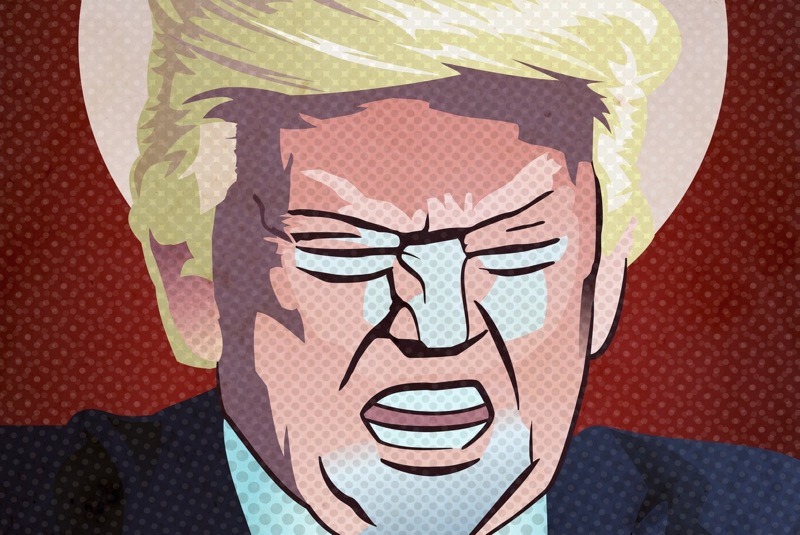
On Easter Sunday, Donald Trump logged onto social media and wrote an expletive-filled post. “Tuesday will be Power Plant Day, and Bridge Day, all wrapped up in one, in Iran. There will be nothing like it!!!,” he wrote, adding, “Open the Fuckin’ Strait, you crazy bastards, or you’ll be living in Hell – JUST WATCH! Praise be to Allah. President DONALD J. TRUMP.”
His profane, unpresidential rhetoric startled even seasoned observers. Many American politicians, embarrassed by his post, said that Trump was an “unhinged madman.” Others asked, “Dear Americans, what have you done to yourself? How could you elect this man as your President?”
Trump’s post was bellicose, laced with expletives that blurred the line between statecraft and impulse. Critics, including some within the United States (some from his own party), urged him to “dial back” the language. The message did not exist in isolation. It was part of a pattern in which presidential communication, once filtered through layers of caution, now sounded like cheap, vulgar and incendiary comments of a street thug.
The United States has long projected power as much through military and economic might as through dignity and rhetorical flourish. Even in moments of crisis, language served as ballast, a means of reassuring allies and signalling restraint to adversaries.
Trump’s style has inverted that expectation. His public statements, particularly on digital platforms, often don’t read like diplomatic communiqués. Instead, they sound like rants of a bitter man who is sick in the head. Cumulatively, they are corroding America’s credibility, built over decades, that American words carry a degree of reliability, even when contested.
That erosion is clearly visible in America’s war on Iran. The war, initiated without prior consultation with European allies, has exposed fissures. Privately, diplomats describe a sense of dislocation: a superpower acts like a thug, and its allies recalibrate in real time.
In public, the language is more restrained, but the message is unmistakable. Spain, under Prime Minister Pedro Sánchez, rejected America’s “unilateral military action,” and explicitly denied the United States the use of key military bases for operations against Iran. The decision marked a departure from the cooperation that has historically defined transatlantic security arrangements.
Austria went further, invoking its neutrality to deny U.S. access to its airspace for missions connected to the conflict. Spain’s refusal was grounded in alliance law and political principle; Austria’s, in constitutional identity. Together, they suggested a willingness among European states to impose limits on American power, even at the risk of diplomatic retaliation.
In turn, Trump responded to Spain’s stance with threats of economic punishment, including the possibility of cutting off trade; it is a move that European officials privately described as ‘coercive’ and ‘counterproductive.’
The rupture is not confined to policy disagreements. It extends into the realm of tone, where Trump’s rhetoric has increasingly alienated leaders who might otherwise seek common ground. In Norway, Prime Minister Jonas Gahr Støre has suggested that respect for American leadership is no longer a given. Meaning, it is subject to erosion by conduct.
Though couched in diplomatic language, his sentiment reflects a recalibration across Northern Europe, where political culture places a premium on restraint and consensus. Trump’s approach—combative, personalised, and profane—sits uneasily within that framework.
France, historically an ally and a counterweight to American power, has responded with a mixture of pragmatism and distance. President Emmanuel Macron has emphasised European unity and strategic autonomy, framing the crisis as an opportunity for the continent to assert its own diplomatic voice.
In practical terms, this meant coordinating with Germany and other EU states to manage the fallout from the Iran conflict, even as Paris maintains selective cooperation with Washington on areas of overlapping interest. The posture is not outright opposition; it is not uncritical support; it is a deliberate, calculated hedging against unpredictability.
In London, the reaction has been cautious. Prime Minister Keir Starmer has indicated that the conflict with Iran is not in Britain’s national interest and has declined to commit to direct involvement. His statement carries particular weight given the United Kingdom’s historical role as America’s closest military partner. To step back, even rhetorically, is to signal that the “special relationship” is no longer immune to strain. British officials, speaking off the record, describe a dilemma: how to maintain diplomatic relations with Washington while avoiding entanglement in a conflict that lacks broad international support.
Across the continent, similar calculations are underway. Germany has publicly backed Spain in its dispute with the United States, emphasising European unity amid external pressure. Italy and the Netherlands have focused on defensive measures, deploying assets to protect regional stability without endorsing the broader strategic direction of the conflict. Even countries that remain sympathetic to American aims have called for de-escalation, wary of being drawn into a war whose objectives remain ambiguous.
These responses signal a significant shift in posture. For decades, European scepticism of American policy coexisted with an underlying confidence in American leadership. Disagreements were frequent over Iraq, trade, and climate policy, but they unfolded within a framework of mutual expectation. The United States might act forcefully, but it would remain within the conventions of diplomacy. That framework is now under strain.
Trump’s defenders argue that his style reflects a break from what they see as the ‘complacency of the past.’ By speaking bluntly and acting decisively, they contend, he has forced allies to confront realities they might otherwise ignore. Indeed, European leaders have, in recent years, accelerated efforts to build independent defence capabilities and to coordinate foreign policy closely within the EU. But the same developments can be read differently: not as a response to American leadership, but as a hedge against its absence.
Trump’s rants and comments have certainly been a wake-up call for the Europeans. His use of social media as a primary instrument of statecraft has altered the tempo and texture of international relations. Messages that once would have been conveyed through diplomatic channels now appear instantly, often without context or clarification. The result is an informational whiplash in which allies interpret statements that may or may not reflect settled policy. Over time, this has contributed to a perception that American positions are provisional, subject to revision at the speed of a post.
This perception has tangible consequences. In crises, credibility functions as a currency, enabling states to coordinate actions and to signal intentions with a degree of confidence. When that credibility is in doubt, coordination becomes difficult, and the risk of miscalculation increases.
European resistance to U.S. requests—whether denying access to their bases, restricting airspace, or declining to participate—is not only a policy disagreement but also an expression of uncertainty. If the United States cannot be relied upon to maintain a consistent course, then the incentives to align with it diminish.
Ironically, the United States remains the central actor in the international system. Its military capabilities and economic influence remain superior. But power is not merely a matter of resources. It is also a function of perception, of others’ willingness to follow or at least to accommodate. The current moment suggests that this willingness is no longer assured. It must be earned, and, once lost, it is not easily restored.
America’s crisis of credibility is as much a rupture as a recalibration, a process that will transform into a new equilibrium. The question is what that equilibrium will look like, and whether it will preserve the centrality of American leadership.
In the meantime, the image of a president issuing expletive-laden warnings from a digital platform lingers, emblematic of a broader transformation. Such language is not unprecedented in politics; it now occupies a place once reserved for carefully measured words.
The shift alters not only how the United States speaks but how it is heard. In capitals across Europe, from Madrid to Oslo, the response has been a mixture of disbelief, calculation, and, increasingly, distance. The credibility that once flowed almost automatically now arrives, if at all, in diminished measure.
-30-
Copyright©Madras Courier, All Rights Reserved. You may share using our article tools. Please don't cut articles from madrascourier.com and redistribute by email, post to the web, mobile phone or social media.Please send in your feed back and comments to editor@madrascourier.com