Human history is not linear progress but a repetitive oscillation between savagery and a thin, delicate civilisation. It cannot settle at any fixed point of virtue. Wars, from the Peloponnesian to Gaza, reveal this pattern: a sudden plunge into organised brutality, followed by a laborious, often hypocritical reconstruction of order, then another descent. As Reinhold Niebuhr argued in Moral Man and Immoral Society (1932), groups are more ruthless than individuals because collective fear and honour override restraint.
Evil, contra liberal optimism, is not an absence but a fiercer, more infectious force, proportionally harder to undo. Hannah Arendt, covering the Eichmann trial, warned of the “banality of evil,” but here Nietzsche offers a darker counterpoint: evil is not always banal. It can be the assertive strength of a will to power, what he called the Ubermensch’s becoming, not a Nazi caricature, but the dangerous capacity to shatter old tables of law. In the Iran-America-Israel triangle, this Nietzschean lens becomes unavoidable: each side believes the other is the beast, and each mobilises its own power as a higher form of necessity. The question William Golding leaves us with is not who wins, but whether the beast is ever truly external.
War, then, is one reflection of this seemingly inevitable drive to dominate, an evil that does not care who it crushes, weaponising modesty, morality, education, religion, civilisation, technology, and nearly every social fact as instruments of control. This is precisely what we witness in the ongoing Iran-America-Israel war.
Neither is it new, nor does it operate on a single axis; rather, it unfolds at the intersection of multiple overlapping systems of power. Here, Kimberle Crenshaw’s concept of intersectionality (originally framed around race and gender) becomes unexpectedly useful, for wars are fought not along a single line of enmity but at the crossroads of many.
Consider Antonio Gramsci’s hegemony, where the powerful enforce their rule as “common sense” to manufacture the consent of the powerless, a logic visible when both Tel Aviv and Washington frame their violence as inevitable, even righteous. Consider Theodor Adorno and Max Horkheimer’s dialectic of enlightenment: reason, progress, science, and technology, otherwise meant to liberate, turn into instruments of domination, as precision drones, AI-targeting systems, and cyberwarfare become enlightenment’s dark twins. Consider Michel Foucault’s biopower, by which social institutions produce docile bodies, seen in Iran’s morality police and Israel’s administrative detention, where populations are managed, disciplined, and rendered politically inert. Consider Giorgio Agamben’s state of exception, where order is suspended in the name of crisis to create a zone where the voiceless are forced into “bare life” (homo sacer) stripped of legal protection, like Gaza since 2007, and intermittently the West Bank, being a textbook case.
Consider Pierre Bourdieu’s cultural capital and symbolic violence: the dominant class’s manners, language, and success are made to sound like merit, while the subaltern’s inability to belong is recast as incompetence, meaning an Iranian or a Palestinian refugee does not lack intelligence but rather the right kind of capital. Consider C. Wright Mills’s power elite, where the political, military, and corporate domains are fused; in Washington, the revolving door between the Pentagon, defence contractors like Lockheed Martin and Raytheon, and lobbying groups such as AIPAC ensures that war becomes profitable continuity rather than an aberration.
Consider Guy Debord’s society of the spectacle, where the powerful decide what the poor should desire, see, and consume, with media images of “precision strikes” or “martyrs” replacing the messy reality of dismembered children. Consider Louis Althusser’s ideological state apparatuses, through which schools, media, mosques, synagogues, and even family structures interpellate individuals into obedient subjects, an Israeli conscript, an Iranian Basij volunteer, and an American drone operator, all hailed by their respective apparatuses as natural, necessary, and good.
Consider Edward Said’s orientalism, by which entire peoples are historically cast as barbaric, irrational, and backward: Iran as part of the “axis of evil,” Palestinians as “unreasonably violent,” Israelis as “colonial crusaders,” each side orientalising the other. Consider Michael Hardt and Antonio Negri’s empire, where power today is not a single state but an interconnected system of corporations, financial networks, military alliances, and NGOs, meaning the US-Israel-Iran conflict is not three actors but a lattice of supply chains, cyber commands, Gulf money, Russian and Chinese hedging, and UN impotence.
And finally, consider Tidiane Kasse and others’ concept of global apartheid, where all these institutions cohere into a world system of class and racial supremacy, such that an Iranian nuclear scientist and a Gazan child live under entirely different sets of rules, different valuations of life. This war, therefore, is not Samuel Huntington’s clash of civilizations; it is a clash of intersections, a brutal laboratory where every theorist above finds fresh evidence, and where the beast Golding warned us about turns out not to be any single nation, but the architecture of domination itself.
The Iran-America-Israel war, like the Russia-Ukraine war, like any war, is a reflection of the inherent evil that civilisations have attempted to control through the dominance of what they call good, or order. Yet all the intersecting factors enumerated above show that evil is never finally controlled; its sway is almost always fiercer and more brutal in effect than the good, much like the symbolic contestation of will and desire between Ralph and Jack in Golding’s Lord of the Flies, where the latter’s savage charisma steadily overwhelms the former’s delicate assemblies.
It is natural, of course, for humans to generate ideologies and narratives regarding differences that lead to war. However but it is equally natural, as Reinhold Niebuhr reminds us, that evil is inherent to the human condition, not a mere aberration or false consciousness to be educated away. Wars have countless disadvantages, obvious to all who have been witnessing them unfold in real time across Gaza, the West Bank, Lebanon, Iran, Israel, and the Red Sea. The purpose here, however, is not to rehearse those obvious costs but to focus on a more insidious process: how the ongoing, unrestrained character of this war, conducted almost at the will of war-hungry powerful elites, could slowly normalise killing, brutality, devastation, desolation, uncertainty, and the very meaninglessness of being across entire nations now directly affected by it.
When drone strikes become routine, when hostage videos become algorithmic content, when children’s deaths are reduced to statistical updates between sports highlights, something fundamental shifts in the human psyche. As Judith Butler has argued in Frames of War (2009), certain lives are rendered grievable while others are not; this war extends that logic into a permanent global theatre where brutality is no longer an exception requiring justification but a default state requiring no justification at all. And that, perhaps, is the deepest evil of all: not the first killing, but the point at which we stop being surprised by the thousandth.
Watching the war from thousands of miles away, from the roaring skies, the din and plume of missiles and air strikes raging as if everything and everyone down on earth were merely flies to wanton boys, we may feel safe, merely sharing our fear and sympathies from behind screens and news alerts. Yet this feeling of distant safety hides a deeper, drearier truth: the war is slowly becoming a normal part of our lives.
The behemoth of war prowls everywhere at will, which truly terrifies, but the very way it has been raging across the world, from Ukraine to Gaza, from the Red Sea to Iran’s interior, ensures that it can prowl anywhere, and soon. The problem is that as this normalcy deepens, as brutality becomes ambient rather than exceptional, it will grow genuinely difficult for anyone to stop it.
Tomorrow, when we (now watching from a safe distance) become the target of this same behemoth, when our children are massacred, our lives lost like flies to wanton boys, our infrastructure devastated, blasts and bombs rattling everything we have built, others will be watching from some other safe distance, shaking their heads, posting their sympathies, and doing nothing to stop it.
As Susan Sontag warned in Regarding the Pain of Others (2003), proximity to suffering does not guarantee action; often it merely produces a surplus of images that numb rather than mobilise. The Israeli historian Yuval Noah Harari has noted that the greatest danger of our era is not any single weapon but the habituation to catastrophe, the slow erosion of the instinct to say “never again.” When war becomes routine, so does indifference. And indifference, as Elie Wiesel famously reminded us, is not the opposite of action but the silent accomplice of evil. The beast, after all, does not need to devour everyone at once; it only needs us to stop being surprised when it devours someone else.
The very act of repeatedly watching the war creates a sense of the banality of the spectacle, and the normalisation of brutality and bone-chilling macabre can also become banal and thereby normal. When human suffering means nothing to this hegemonic global apartheid, then humans themselves will slowly normalise their own ensuing helplessness in the face of brutality inflicted upon other fellow humans.
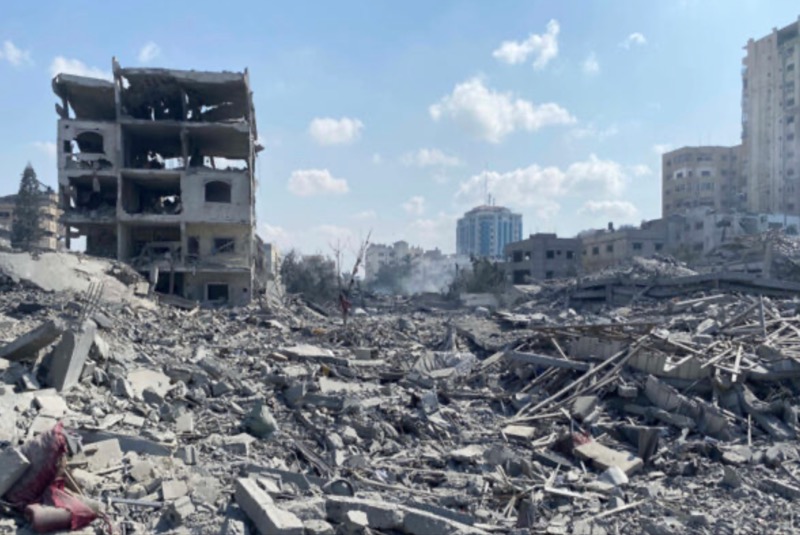
Watching a video of the levelling of a building, a university, a school, or any infrastructure, along with the ensuing deaths and devastation, every single day on your phone makes it look like just another video of a fictional spectacle: ordinary and boring. So boring that the very next day you want to see something else. It no longer shocks you, not even the death of a leader, not the blasting of heritage sites, not hundreds of children who are just like your own children. Simply put, devastation is normalised.
This is precisely what Guy Debord diagnosed in The Society of the Spectacle (1967): when lived experience is replaced by represented experience, even atrocity becomes a consumable image, stripped of its power to demand a response. And Hannah Arendt, watching the trial of Adolf Eichmann in Jerusalem, coined the phrase “the banality of evil” precisely to capture how monstrous acts could be committed by utterly ordinary men who had stopped thinking about what they were doing or seeing.
Today, we are not Eichmann’s judges; we are his audience. We scroll past a demolished Gaza school, then a recipe video, then a murdered child, then an advertisement for sneakers, and the algorithm learns nothing from the whiplash. The French philosopher Paul Virilio, in War and Cinema (1989), argued that we now experience war primarily as a logistics of perception: the real battlefield is not where bombs fall but where images land. If that is true, then the greatest victory of the war-hungry powerful is not territorial but psychological. They have made us bore ourselves into submission. And when the day comes that the behemoth arrives at our own doorstep, we may find that we have forgotten how to be outraged, because outrage, like everything else, has been flattened into content.
Another thing that the ongoing Iran-America-Israel war cannot justify, even by invoking the tired claim that “everything is fair in war,” is the deliberate or reckless damage of infrastructure and civilian sites that no legitimate military objective can excuse. When a rich and influential person loses a duel to a poor common man, his ego is wounded; revenge always follows by attacking the powerless where he is most helpless, his home, his family, his relations, almost everything that forces him to surrender.
When this same logic plays out in war, nothing can justify the heartlessness of the cowardice hiding behind the so-called brave. Is it not shameful to kill a poor child merely to force his father to surrender? Is it not a confession of moral bankruptcy when a nuclear-armed state or a heavily funded military alliance bombs a hospital, a school, a water treatment plant, or a residential tower, and then calls it “collateral damage”?
The just-war tradition, from Augustine to Aquinas to contemporary theorists like Michael Walzer in Just and Unjust Wars (1977), has long held the principle of distinction, combatants must distinguish between military targets and non-combatants, and the latter must never be directly intended as targets. Yet what we witness daily in Gaza, the West Bank, southern Lebanon, and strikes inside Iran is the systematic erosion of that principle, replaced by what Walzer himself has called “supreme emergency” rhetoric, a dangerous doctrine that allows any atrocity if the threat is framed as existential.
The Israeli historian Ilan Pappe has described this as “incremental genocide” through infrastructure destruction. But the moral calculus remains lopsided: the powerful always have more sophisticated language to excuse their violence, and the powerless always die in higher numbers. As the Kenyan writer and activist Ngugi wa Thiong’o once observed, the empire speaks in the language of the law, but it writes its orders in blood. To bomb a child is not strategy; it is the tantrum of a bully who lost a duel and cannot bear the humiliation. And to normalise that bombing, to scroll past it, to call it “complex” or “unavoidable,” is to become complicit in the very cowardice we claim to condemn.
In the ongoing war, see what the powerful braggarts are doing. The UNESCO-listed Golestan Palace, sometimes called the “Versailles of Persia,” is not merely a monument or an architectural wonder; it is a museum, a reservoir of the memories of generations, of civilisations. When its Hall of Mirrors (Talar-e-Ayaneh) was shattered by debris from a March 2026 airstrike, the damage was not collateral; it was symbolic. The Iranian artisans who first developed the art of ayaneh-kari in the sixteenth century took broken Venetian mirrors and turned them into dazzling mosaics of light, transforming accident into beauty. Now those same mirrors lie in shards across the palace floor, and officials say restoration will take at least fifteen years.
But the blasting of this palace, or the seventeenth-century Chehel Sotoun palace in Isfahan, with its twenty wooden columns reflected in the long pool to create the illusion of forty, or the Masjed-e Jame, Iran’s oldest Friday mosque, whose turquoise tiles have crashed to the ground, or the universities where over thirty have been directly attacked and where professors and students have been killed, none of this is something war can justify as “just,” because winning wars cannot win you anything more precious than these sites of artistic and cultural wealth.
UNESCO has repeatedly warned that cultural property is protected under international law, notably the 1954 Hague Convention, and has provided all parties with the geographical coordinates of heritage sites in advance. That these warnings were ignored tells us everything about the contemporary architecture of impunity. As the architectural critic Robert Bevan writes in The Destruction of Memory, “war is about killing cultures, identities and memories as much as it is about killing people and occupying territory”. And the Iranian scholar Mojtaba Najafi, watching his country’s heritage burn, put it even more poignantly: “For me, ancient monuments are as important as human lives, because they connect me to my past. Their destruction means my memory is being demolished.” The powerful braggarts, it seems, have learned nothing from the Taliban at Bamiyan or ISIS at Palmyra, or perhaps they have learned everything: that to erase a people’s memory is to erase the people themselves, slowly, one shattered mirror at a time.
Moreover, the repair or reconstruction of these sites can never retrieve the reservoir of memories and associations that people have with tradition, architecture, and values. Once a mosque that held seven centuries of whispered prayers is reduced to rubble, rebuilding it in glass and steel does not restore the sound of those prayers; it only restores the building’s shape. This creates a civilizational disconnect: a rupture not merely in stone but in the lived, inherited sense of who we are and where we belong.
As the Polish-born British sociologist Zygmunt Bauman argued in Liquid Modernity (2000), we live in an age where all that is solid melts into air, but war accelerates that melting into a weapon: erase the past, and the future becomes a floating, rootless terror. This is the plunge into savagery that Golding warned us about. This is where Ralph’s painstaking efforts to establish order (the conch, the assemblies, the signal fire, the delicate rule of reason) turn bootless, because Jack’s hunger for dominance begins to speak louder, first in whispers of “freedom” and then in screams of power.
The conch, once shattered, cannot be glued back together; nor can a civilization that has normalized the bombing of its own memory. And so we are left with the beast. Perhaps it was only ever us, our inability to stop the stronger from devouring the weaker, our addiction to spectacles of vengeance, our slow, comfortable drift into the banal acceptance of atrocity. But perhaps, too, Golding left us one small hope: that recognition of the beast inside is the first step toward restraining it. The question, as the bombs continue to fall over Golestan’s broken mirrors and Gaza’s flattened classrooms, is whether that recognition has come too late or whether it will come at all.
-30-
Copyright©Madras Courier, All Rights Reserved. You may share using our article tools. Please don't cut articles from madrascourier.com and redistribute by email, post to the web, mobile phone or social media.Please send in your feed back and comments to editor@madrascourier.com