The significance of the BRICS grouping has resurfaced, this time as a prospect for bringing peace to the ongoing war in Iran. This year, India is leading the BRICS rotating presidency, and it must play a vital role in promoting diplomacy and stand in solidarity with Iran, one of India’s oldest diplomatic friends.
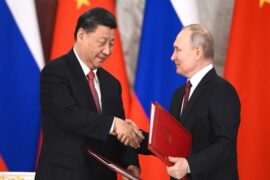
While the BRICS (originally Brazil, Russia, India, China, and South Africa) is not exactly a political or strategic grouping, several commonalities bind them. The United States is attempting to write off BRICS as an internally divided bloc that is structurally incapable of producing collective action in this conflict. Incidentally, all of the BRICS countries have been negatively impacted not only by the conflict but also by Trump’s Tariffs.
In fact, President Trump has been consistent and unequivocal in his criticism of BRICS, even calling its policies‘Anti-American.’ The key reason is in the potential that BRICS offers. As a grouping, BRICS covers 40 per cent of Global GDP and 26 per cent of Trade. More importantly, it has challenged the US’s hegemony over global financial institutions. One of the core pain points is the growing ‘de-dollarisation’ of trade, especially energy trade. Trump’s response was to impose additional tariffs on BRICS nations.
India assumed the BRICS presidency on 01 January 2026. The agenda for its term is to ‘strengthen economic and institutional resilience in a “humanity-first” approach.’ Further, India has stated a goal of promoting a ‘people-centric agenda’ to navigate global geopolitical tensions and foster equitable development. Incidentally, Iran is a member of BRICS since 2024, as are Saudi Arabia, the UAE, and Egypt.
India, as Chair, must take the lead to mitigate the conflict and its economic impact.
Historically, India, a proponent of non-alignment, has condemned global hegemons for brazen, unilateral use of force against sovereign nations. It had a consistent policy of calling out the perpetrators. This time it is different; it is neither the era of non-alignment nor, strictly speaking, a matter of ‘strategic autonomy.’
During the Cold War, India’s diplomacy in the Korean War (1950-1953), Indochina (1950s to 1970s), and the Suez Crisis (1956) brought temporary and negotiated peace, if not a lasting one. It was possible as New Delhi, then, was non-aligned, and the leaders took a principled, moral high ground on the use of force. Jawaharlal Nehru, as the Prime Minister and External Affairs Minister, had deployed and overseen Indian diplomats on these peace efforts. He would even apprise the Indian Parliament directly of developments on the ‘International Situation’. Political leadership, initiative, and accountability were evident.
India has consistently spoken on behalf of the Global South. In 1961, the Government of India brought together several stakeholders contesting Western imperialism and colonialism. It promoted South-South cooperation through events such as the ‘Seminar on Portuguese Colonial Possessions’ and the ‘Afro-Asian Conference for Economic Cooperation’ in December. India also organised the Seventh Non-Aligned Movement Summit in 1983, which showcased the camaraderie between Prime Minister Indira Gandhi and Fidel Castro. These were not just ‘show and tell’ symbols. Instead, they sent a strong message to the powers of the day, underscoring India’s centrality in aggregating support for those who need it.
We are currently in an anarchic international system that is driven by erratic, egotistical leaders who brandish military strength and do as they please, without any regard for international law. America, under Trump’s presidency, is going berserk across political, economic, and diplomatic fronts, leaving little incentive for parleys and peace. This provides room for the resurgence of multilateral fora such as BRICS to negotiate for peace. The BRICS nations together account for 49.5 per cent of the world’s population. BRICS may not have the legal mandate, but it has the economic clout to push for peace.
India and Iran, beyond the civilisational ties and energy security, also have a strategic dimension to their bilateral relations. Previously, both countries had conceived two key strategic infrastructure projects: a gas pipeline from Iran to India via Pakistan and the Chabahar port. Iran has the second-largest gas reserves globally, after Russia, and these projects would have strengthened India’s energy security.
The Modi government, in its first term (2014-2019), was keen to build strong relations with Iran. The Prime Minister visited Iran in 2016 and was willing to invest USD 15 billion in Iran’s energy infrastructure, railway, and transport corridors. These initiatives were shelved due to Western pressure, economic sanctions on Iran, and the Modi Government’s changing priorities. India reduced its oil imports from Iran after Donald Trump became President in 2017. Bilateral trade with Iran dwindled from USD 17 Billion in 2018 to USD 1.6 billion in 2025.
On 21 March 2026, during a bilateral call with PM Modi, Iranian President Masoud Pezeshkian called upon the BRICS bloc to play an independent role in halting aggression against Iran. He had previously urged the same on 12 March in their first call together. The Prime Minister also spoke with Gulf leaders, including the President of the UAE, the Amir of Qatar, and the Crown Prince of Saudi Arabia.
PM Modi, addressing the Lower House of the Indian Parliament on 23 March, reiterated the role of diplomacy and dialogue in resolving the conflict. He reaffirmed India’s unwavering commitment to humanity and peace. However, despite tall claims, so far, India has not even issued a statement condemning the United States and Israel for their brazen attack on Iran.
New Delhi is walking a tightrope, trying not to alienate old friends Iran or antagonise recent strategic partners. Among India’s defence imports, Israel ranks third at 15 per cent, and the United States fourth at 9.6 per cent. At the same time, India imports 60 per cent of its LPG supplies, of which 90 per cent is routed through the Strait of Hormuz. Juxtaposing reliance on defence imports with India’s dependence on global energy imports creates a difficult paradox.
India’s challenge is to secure its energy supplies, which it has been diversifying significantly, and to defend its strategic partnerships. The most promising way to do that is through multilaterals such as BRICS.
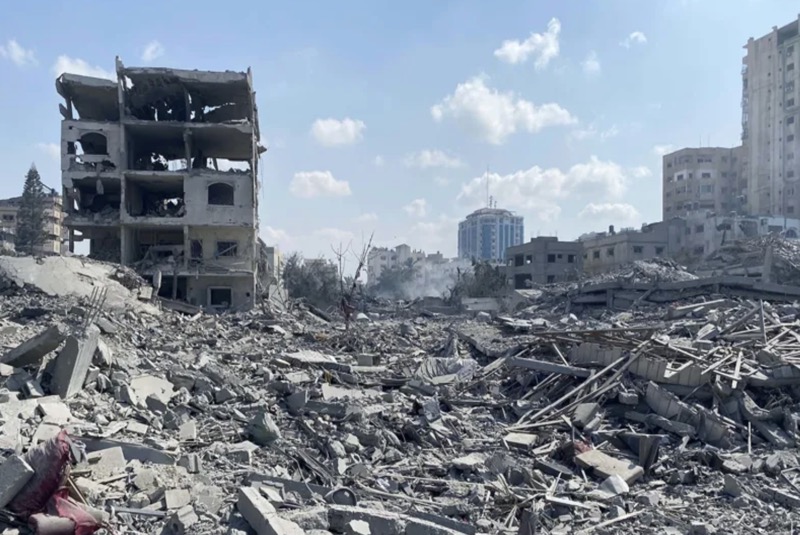
The United States and Israel have launched this unprovoked war on Iran, without regard for international law, in the middle of a negotiation process. It is a ‘discretionary war.’ Every country and the common people across the world are feeling the economic ramifications of the war. More importantly, given the human-centric agenda of BRICS 2026, India has an opportunity to stand in support of fellow member countries. Not only Iran, but also the UAE and Saudi Arabia.
BRICS meetings provide for physical and diplomatic spaces for the afflicted parties to deliberate on their grievances. During the Cold War, India leveraged its diplomacy to mediate, negotiate, and broker truces in several conflicts. Today, BRICS provides a platform to diffuse this tense situation.
India’s strategic autonomy and diplomacy have come into question in the past two years. India’s foreign policy has consistently stood for peace. It has been independent and sovereign. But in recent years, Indian foreign policy has committed a series of blunders. It is about time to reclaim that status, and the BRICS forum is the appropriate stage to showcase that.
-30-
Copyright©Madras Courier, All Rights Reserved. You may share using our article tools. Please don't cut articles from madrascourier.com and redistribute by email, post to the web, mobile phone or social media.Please send in your feed back and comments to editor@madrascourier.com