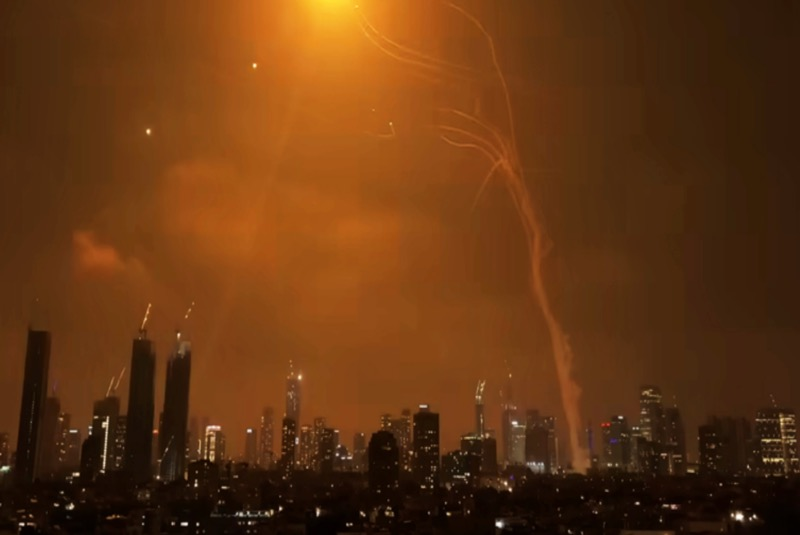
The attack on Iran by Israel and the U.S.—or rather more accurately, by prime minister Netanyahu and president Trump—is best explained by Chanakya who wrote about Matsya Nyaya (Law of the Fishes, with the big fish eating the small one with total impunity) and by Thucydides who laid down the law that “the strong do what they can and the weak must suffer what they must.” Incidentally, Thucydides wrote in the fifth century B.C. and Chanakya in the next century. Has Homo Sapiens Sapiens, or rather Homo Politicus, radically changed over the millennia? Hardly.
Most wars, if not all, are avoidable, as there is hardly any inter-state dispute that diplomacy cannot resolve through an intelligent process of give and take, unless there are powerful actors on one side or the other who want war, often mistakenly believing they can win it. Some political leaders have been naïve enough to believe they can start a ‘limited war,’ forgetting that once a war starts, it does not end unless all the belligerents want it to. As Winston Churchill wrote”
Never, never, never believe any war will be smooth and easy, or that anyone who embarks on that strange voyage can measure the tides and hurricanes he will encounter. The Statesman who yields to war fever must realise that once the signal is given, he is no longer the master of policy but the slave of unforeseeable and uncontrollable events…
An important point about the unfolding tragedy, often missed by pundits and the media in the West and India, is that Trump attacked, even though his representatives were conducting diplomatic negotiations with Iran, facilitated by Oman. He gave the green light to Netanyahu in June last year, even while the talks with Iran were still on. The lesson to learn is that diplomatic negotiations with the Trump administration can be a farce or a charade.
The Omani Foreign Minister, Sayyid Badr bin Hamad Albusaidi, who mediated, with exceptional aplomb, the negotiations between Steve Witkoff and Jared Kushner and the Iranian Foreign Minister, Abbas Araghchi, was in Washington meeting with Vice President Vance hours before Israel struck. Albusaidi made it clear that the negotiations were going well and that an agreement would be signed soon.
What was the agreement arrived at when the talks were concluded on 26 February? We have to go by what has been revealed by the Omani Foreign Minister Albusaidi, who said that Iran had agreed to zero enrichment, zero stockpiling of nuclear material, and to down-blend the uranium with it so that it cannot be used for making a bomb.
There is no good reason to doubt the veracity of what the Foreign Minister of Oman said. We also know that a team of Iranian experts was to go to Vienna for technical talks. It follows that Trump was in a position to declare victory by correctly claiming that his deal was infinitely better than Obama’s 2015 deal that permitted enrichment.
Why didn’t Trump choose that option?
Professor John Mearsheimer’s explanation is that Netanyahu prevailed on Trump, and Trump has “boxed himself into a corner” and walked into a war that he cannot win. But if he backs down, “he risks being criticised by Israel and its U.S. lobby back home.”
Mearsheimer’s explanation is credible. However, is there anything more to it? We know that the ghost of Epstein is haunting the corridors of power in Washington and that the Democrats are demanding the full release of the file, hoping that they can find material to implicate Trump, before the midterms in November, when they plan to get a majority in both houses so that Trump can be impeached.
It is possible that Epstein was an agent of Mossad, which might have the full file. Additionally, Mossad might have the technical competence to delete parts of the file without leaving any trace of such deletion. If so, Netanyahu might have a chokehold on Trump, and that might explain why the master dealer did not take the chance to claim he got a deal better than Obama’s, and that too without a war, through smart diplomacy.
The above is only a hypothesis. Hopefully, when the fog of war lifts and more documents are made available, it will be substantiated. But it is worth being put forward as a possible explanation.
There is one more possible explanation for the timing of the war. The Mossad had been monitoring the movements of Ayatollah Ali Khamenei and his top aides for months for carrying out decapitation, a favourite item on Israel’s war menu. In the present case, the Ayatollah was holding a meeting with his top aides, unaware of the risk. Netanyahu wanted to strike, as Israel’s policy is to strike at the earliest opportunity.
It is to be noted that even as the talks with Iran were progressing, Secretary of State Marco Rubio had been repeatedly saying that the ‘radical Shia clerics’ cannot be trusted. In other words, Trump kept open the option of military action, which he ultimately resorted to – the Epic Fury joining with Netanyahu’s “Roaring Lion.”
It is not advisable to attempt an account of the war as it gets outdated in no time. But a few observations can be made:
Anyone in Washington or Tel Aviv who expected Iran to surrender after the Supreme Leader and forty-odd commanders were killed has to admit that he was wrong.
Iran had repeatedly warned that any attack on it would develop into a regional war. By attacking the foreign military bases, airports and hotels in the GCC, Iran has provoked its Arab neighbours, to the delight of Israel.
The GCC has threatened to retaliate militarily, and a limited retaliation has begun with Qatar’s jets shooting down Iran’s old third-generation planes. Saudi Arabia’s Aramco has been hit, affecting production. Similarly, Qatar’s LNG plant has stopped work after a hit.
Washington has advised its nationals to leave the area, implying that the war is not going to end soon and that they might be in peril if they do not move out. This advice came after the U.S. Embassy in Saudi Arabia was hit by drones. Till now, six U.S. servicemen have been killed and many more injured. Trump has warned there will be more casualties.
The Strait of Hormuz, through which twenty per cent or more of hydrocarbon exports pass, has been practically blocked. The gas price in Europe has gone up by fifty per cent.
The war has plunged financial markets into turmoil for a second day. The FTSE 100 index lost 280 points. Japan’s Nikkei is down by 3.1 per cent and South Korea’s by 7.2 per cent. The IMF (International Monetary Fund) has stated that the war has worsened the ‘already uncertain’ global environment.
Let us examine the international community’s response to the war. President Putin has characterised Khamenei’s killing as “a cynical violation of morality and International Law.” China has also condemned it. The EU’s High Representative and Vice President for Foreign Affairs has said the killing gave her ‘hope and fear.’ The BRICS and SCO have been silent. In short, the Global South has been intimidated by Trump.
Let us look at India. There has been no condemnation or even criticism of the killing of Khamenei. Prime Minister Modi was in Israel, where he referred to ‘the Palestine issue’ and declared that India stood with Israel at the Knesset, saying, “India stands, firmly, with full conviction, in this moment and beyond.” (Italics added.) Does it follow that Netanyahu had shared his decision to attack Iran? We do not know.
When Modi landed at Ben Gurion International Airport, eight super tankers were used for mid-air refuelling, and two unmarked 747 aircraft were probably used to transport embassy personnel. We may assume the PM’s party has taken note of all this. Modi has spoken to his GCC counterparts, but not to Iran.
The Opposition has pointed out that there is a 180-degree change from India’s traditional position. The Palestinian Embassy in New Delhi is much older than the Israeli Embassy.
Washington has already backtracked from ‘regime change’. There is considerable confusion in this regard. ‘Regime change’was done in Iraq after the U.S. military occupied it. The ‘nation-building’ experiment in Iraq was a study in failure.
Will the U.S. and Israel send ground troops to Iran? Trump and Netanyahu have not ruled it out. In my view, they are rather unlikely to send ground troops. Given Iran’s geography, the 93 million population, the culture and history of Iran, any plan to occupy that vast country will fail at an enormous cost in casualties. However, just because it would be foolish to do something does not mean a given political leader will never do it. Isn’t history a long list of folly, as Barbara Tuchman reminds us in her book The March of Folly: From Troy to Vietnam (1984). Tuchman wrote:
A phenomenon noticeable throughout history, regardless of place or period, is the pursuit by governments of policies contrary to their interest.
What should outrage the global citizen is that such policies kill fellow human beings. As the Proverbs says, where there is no vision, people perish. My judgment at this moment is that Trump will be compelled to declare ‘victory’ and end the war to the chagrin of Netanyahu.
Probably, Netanyahu wants to destabilise Iran with the Kurds, the Baluchis, and Arabs rising in revolt against Iran, such that Israel emerges as the uncontested hegemon in the region, where, except for Iran, others have either recognised Israel or do not bother much about Israel’s annexation plans for the Occupied Territories.
-30-
Copyright©Madras Courier, All Rights Reserved. You may share using our article tools. Please don't cut articles from madrascourier.com and redistribute by email, post to the web, mobile phone or social media.Please send in your feed back and comments to [email protected]