Christianity is a religion centred on the resurrection of Jesus Christ. If Christ had not risen from the dead, He would have remained just another man who claimed to be the Messiah. Without the resurrection, Christianity would not exist as we know it today; it would simply fade into the backdrop of Judaism. This event, more than any other, makes the Christian faith distinct and gives it enduring power and influence. Ergo, resurrection is not just a theological idea. It is the foundation on which Christianity is built.
However, the Ahmadiyya Movement has sought to challenge this doctrine. Founded in the late nineteenth century by Mirza Ghulam Ahmad of Qadian, it represents a distinct interpretation of Islamic thought that stands in opposition to both traditional Islam and Christianity. In its most provocative claim, the Ahmadiyya sect suggests that Jesus did not die on the cross, as Christians believe, but rather survived the crucifixion, and eventually died a natural death in India. This assertion, radical as it is, shifts the narrative of Jesus’ life and death—a story at the heart of Christian and Islamic faiths. For Christians, the resurrection is central; for Ahmadiyya Muslims, it is the natural death of Jesus that carries weight.
The Ahmadiyya Movement arose during the British Raj in India, a time of political and social upheaval. Its teachings, which blend Islamic beliefs with the assertion of Jesus’ survival and death outside of Palestine, were seen as a direct challenge not only to Christian orthodoxy but also to the mainstream Muslim community. The sect’s beliefs—particularly their claim that Jesus died in Kashmir—have sparked fierce debate between Muslims and Ahmadiyyas, with some Islamic scholars denouncing the movement as heretical.
In Pakistan, where the majority of Ahmadiyya Muslims reside, the sect has faced violent persecution. The Pakistani government officially deems the Ahmadiyya community non-Muslim, a designation that has subjected them to systemic discrimination, violence, and legal oppression.
At the heart of this theological conflict is the interpretation of key verses in the Quran. Some of these verses, according to Mirza Ghulam Ahmad and his followers, suggest that Jesus did not ascend to heaven, but died a natural death. This interpretation is at odds with mainstream Islamic views, where Jesus is considered a prophet who was raised to heaven, and it sharply contrasts with Christian belief in His divine nature and resurrection.
In mainstream Islam, Jesus is seen as a revered prophet, a messenger of God who foretold the coming of the Prophet Muhammad. However, they do not attribute divinity to Him. The Ahmadiyya Movement, however, diverges from this traditional Muslim perspective by affirming that Jesus was indeed the Messiah, but not in the way Christians understand it. While Christians await the Second Coming of Jesus, Ahmadiyyas believe that the Second Coming has already occurred, embodied in Mirza Ghulam Ahmad. Ahmad claimed to be the Mahdi, the promised redeemer of Islam, and the second coming of Jesus, who had returned not as a divine figure, but as a reformer of faith.
Mirza Ghulam Ahmad’s teachings represent an effort to synthesise elements from various religious traditions, drawing on the wisdom of figures such as Lao Tzu, Moses, Krishna, and Guru Nanak. He argued that these figures, despite belonging to different faiths, all pointed to the ultimate truth of Islam. His vision was of a world where religion and state would be separate, a view that distinguished the Ahmadiyya community from many other Islamic movements.
While many Muslims hold on to a political understanding of Islam—one where the faith is inseparable from governance—the Ahmadiyya Movement calls for the separation of religion and political power, a perspective more in line with modern democratic ideals. This view, combined with their beliefs regarding Jesus, created a significant schism within the broader Muslim world.
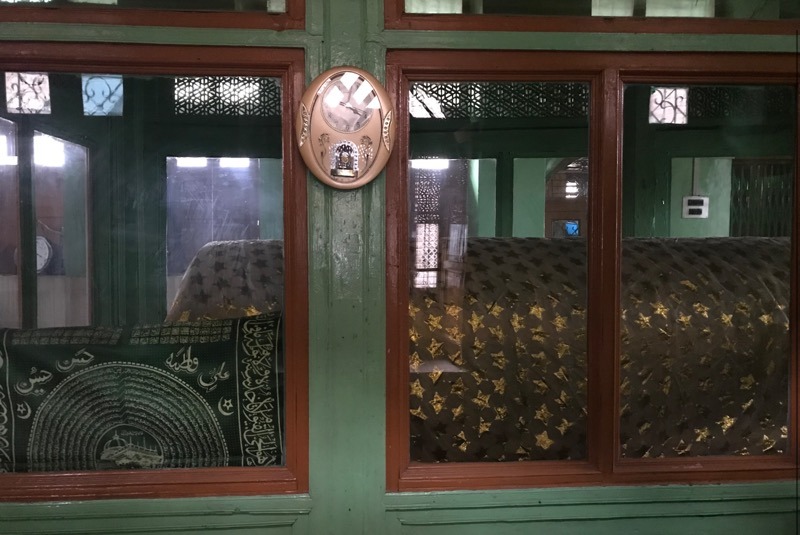
The most controversial of the Ahmadiyya claims, however, is the assertion that Jesus did not die on the cross, but instead survived the crucifixion and travelled to Kashmir, where he lived out the rest of his days. The Roza Bal shrine in Srinagar, Kashmir, has become a focal point of this belief.
Before Mirza Ghulam Ahmad’s assertion, the shrine was a modest, lesser-known site. But Ahmad’s proclamation that this was the place where Jesus had died and was buried brought international attention to it. The Ahmadiyya sect believes that Jesus, after surviving the crucifixion, made his way to India, where he sought refuge among the descendants of the lost tribes of Israel, who had supposedly migrated to Kashmir centuries earlier. According to their interpretation, Jesus lived to an old age in Kashmir, spreading his message of peace and love, and ultimately died a natural death.
One piece of evidence that Ahmad cited to support this theory was a rock carving at the Roza Bal shrine, which he claimed depicted the feet of a man resembling Jesus as he was nailed to the cross. The carving, depicting the feet of a figure known as Yuzasaf, a name Ahmad interpreted as “son of Joseph,” was presented as further evidence of Jesus’ presence in Kashmir.
Ahmad argued that the name “Yuzasaf” could be broken down into “Yuza” (Jesus) and “Asaf” (Joseph), thus linking the figure to Jesus Christ. For Ahmadis, this carving, along with other references to Jesus in Kashmiri tradition, serves as compelling proof that the Messiah had come to Kashmir.
The story of Jesus in Kashmir is not without its controversies. As the Roza Bal shrine gained more prominence, foreign tourists and curious seekers began flocking to the site. Among them was a woman named Suzan Olson, who claimed to be a descendant of Jesus and sought DNA evidence to prove that the tomb belonged to Him.
Olson even attempted to dig at the shrine, a move that sparked communal tensions in the region. Local authorities, wary of the potential for unrest, filed an FIR against her, and tensions between various religious communities flared. This episode reflects the sensitive and volatile nature of the discussion surrounding the shrine and the claim that Jesus was buried in Kashmir.
Despite these tensions, the shrine has become an increasingly popular destination for tourists, including those from the Ahmadiyya community. The influx of visitors has brought economic benefits to the region, providing much-needed revenue for the local economy. In this sense, the Roza Bal shrine has become not only a religious symbol but also a symbol of the complex interplay between faith, history, and identity in contemporary Kashmir.
While the claim that Jesus died in Kashmir remains a deeply controversial issue, the shrine stands as a testament to the power of belief and the enduring quest for answers to some of history’s most enigmatic questions. It remains a place of pilgrimage, a place where the threads of faith, history, and culture converge in the winding alleys of Srinagar.
In the end, the story of the Roza Bal shrine and the Ahmadiyya Movement highlights the complex ways in which religious ideas evolve and intersect with political and social realities. The belief that Jesus died in Kashmir is a provocative reimagining of the life and death of one of history’s most influential figures.
For the Ahmadiyya community, it is a way to reconcile their understanding of Jesus with their broader vision of Islam. For others, it is a challenge to their deeply held religious convictions. But regardless of one’s stance, the story of Jesus in Kashmir is a fascinating chapter in the ongoing dialogue between faith, history, and the search for truth.
-30-
Copyright©Madras Courier, All Rights Reserved. You may share using our article tools. Please don't cut articles from madrascourier.com and redistribute by email, post to the web, mobile phone or social media.Please send in your feed back and comments to [email protected]