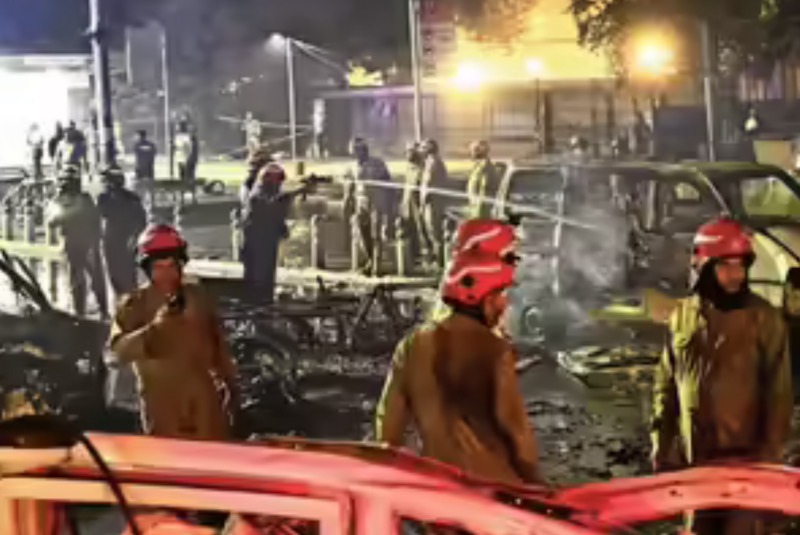
On the evening of November 10, 2025, a Hyundai i20 slowly idled at the traffic signal near the ʻRed Fort Metro’ entrance. Then, the car detonated in a thunderous blast that shattered windows, engulfed vehicles in flames, and killed at least eight people. The explosion, at a location steeped in symbolism, jolted India.
Hours earlier, the Jammu & Kashmir Police announced the dismantling of what it described as an “inter-state and transnational terror module,” operating across Jammu & Kashmir, Haryana and Uttar Pradesh. The operation led to the arrests of doctors, academics, and others alleged to be part of a “white-collar terror ecosystem” linked to the banned jihadist organisations Jaish‑e‑Mohammad (JeM) and Ansar Ghazwat‑ul‑Hind (AGuH).
The convergence of a car bombing in India’s seat of power and a professional-class terror module raises urgent questions: How did a network of doctors, university staff and medical colleges become entwined with a decades-old insurgency? And how does this tie into the global reach of JeM?
In what appears to be a new configuration of extremist tactics, several doctors are now in police custody. Dr Muzammil Shakeel, teaching at the medical college of Al Falah University in Faridabad, is alleged to have stored roughly 2,900 kg of explosive-making material, including ammonium nitrate and electronic detonators, in rooms near the campus.
Dr Adeel Ahmad Rather, from South Kashmir, and another Kashmiri medical professional, have also been arrested in the same probe. Worse, investigators say, a female doctor, Dr Shaheen Shahid (also referred to as Sayeed), hailing from Uttar Pradesh and associated with Al Falah, has been arrested for allegedly heading a recruitment and operations network within India for JeM’s newly announced women’s wing, known as Jamaat‑ul‑Mominat.
The significance of Al Falah University cannot be overstated. Located in Dhauj, Faridabad, the university operates a medical college and a 650-bed hospital, both of which are managed by a charitable trust. Its campus has now become the focal point for counter-terror investigations: the men arrested teach there, the woman arrested worked there, and the explosive cache was found in housing tied to the campus. The idea of a terror module embedded in a university environment disrupts conventional assumptions about where militancy begins and thrives.
Dr Shaheen’s case is especially indicative of a shift in the nature of radicalisation. According to official sources, she was tasked under JeM’s directive to form and lead the India arm of Jamaat-ul-Mominat, a women’s wing helmed by Sadiya Azhar, sister of JeM founder Masood Azhar. Her recruitment role suggests the group is no longer content to rely solely on male operatives in remote terrain. Instead, the network is reaching into professional, urban, female-populated spaces—lecture halls, hospital bays, commuter towns.
Meanwhile, the car that exploded outside the Red Fort appears to connect to this broader module. Police investigations trace its ownership through multiple transfers: initially sold in Uttar Pradesh, then to a Pulwama resident, and finally linked to Dr Umar Nabi, a doctor from south Kashmir who is suspected to have been driving the vehicle at the time of the explosion.
The early narrative suggests a panic-driven detonation rather than a precisely choreographed attack, following arrests of his associates. But even in that uncertainty lies a chilling truth: the capacity and intent to strike urban India were present.
While Indian security agencies have yet to attribute the blast to JeM formally, the evidence aligns closely with the group’s modus operandi, and investigators are pursuing that line vigorously. The module uncovered in Faridabad included encrypted communication channels for indoctrination, recruitment, fund movement and logistics, activity described by the J&K police as part of a “white-collar terror ecosystem.” What is new is how that ecosystem spans legitimate professions, academic institutions and urban locales, blurring the boundary between everyday life and militant infrastructure.
To understand this moment fully, one must revisit the organisational root. Masood Azhar founded JeM following his release in 1999 from Indian custody, in exchange for hostages on the IC-814 hijacking. From its base in Bahawalpur, Pakistan, JeM has long waged attacks in Indian-administered Kashmir and beyond. The group took responsibility for the 2001 Indian Parliament attack, the 2016 Pathankot air base attack, and the 2019 Pulwama suicide strike. Azhar was designated a “global terrorist” by the United Nations Security Council’s 1267 Committee on May 1, 2019.
That designation speaks to JeM’s global reach. Although its principal theatre has been Kashmir, its ideology, fundraising and recruitment networks have extended far beyond. Among the more documented links: British-Pakistani jihadists such as Ahmed Omar Saeed Sheikh — once associated with JeM and later convicted in the murder of Wall Street Journal reporter Daniel Pearl — operated in Europe and South Asia.
JeM’s fundraising operations have adopted cryptocurrency, mobile-wallet donations and shell charities to channel money internationally. The global diaspora of radicalised South Asian Muslims, connected via social media, becomes a vector of JeM’s ideology and resource flow.
The implication is stark: what is unfolding in Faridabad and Delhi is not merely domestic terror but part of a transnational architecture of jihad. A doctor in Haryana communicating with operatives in Pakistan; a university in Delhi’s periphery serves as a staging ground for explosives logistics; women recruited through clandestine networks mobilise rural India for global jihad. The explosion near the Red Fort, then, is a manifestation of global jihad’s localised node.
For Indian security agencies and policy-makers, the challenge has evolved. No longer is the focus solely on militant camps hidden in mountains; now it must also encompass lecture theatres, hospital wards, academic conferences and encrypted chat groups.
The line between the radical and the ordinary has shifted. It may be the scholar, the specialist, or the commuter who becomes the operative. The arrests at Al Falah University, the construction of the women’s wing, Jamaat-ul-Mominat, and the car-blast near a national symbol suggest we have crossed into a new phase of insurgency.
In the hours after the blast, India’s home minister reaffirmed that all angles were being examined; the Defence Minister declared that those responsible “would not be spared.” But the deeper reckoning lies in understanding how a Pakistan-based organisation, registered in the UN as a global terror group, has reached into India’s professional classes and urban institutions. The question is no longer simply one of deterrence at the border, but rather resilience in everyday life.
If the investigation succeeds in exposing every link—the funding flows, the recruitment pathways, the academic covers, the digital channels—then perhaps the network can be dismantled. But if it fails, then the blast at the Red Fort may prove to be a prelude, not an anomaly.
The terrain of terror has shifted from valleys to campuses, from remote outposts to universities and metro stations. And unless India’s security architecture and its social understanding shift with it, the next bomb may not come from a forest, but from a faculty lounge.
-30-
Copyright©Madras Courier, All Rights Reserved. You may share using our article tools. Please don't cut articles from madrascourier.com and redistribute by email, post to the web, mobile phone or social media.Please send in your feed back and comments to [email protected]