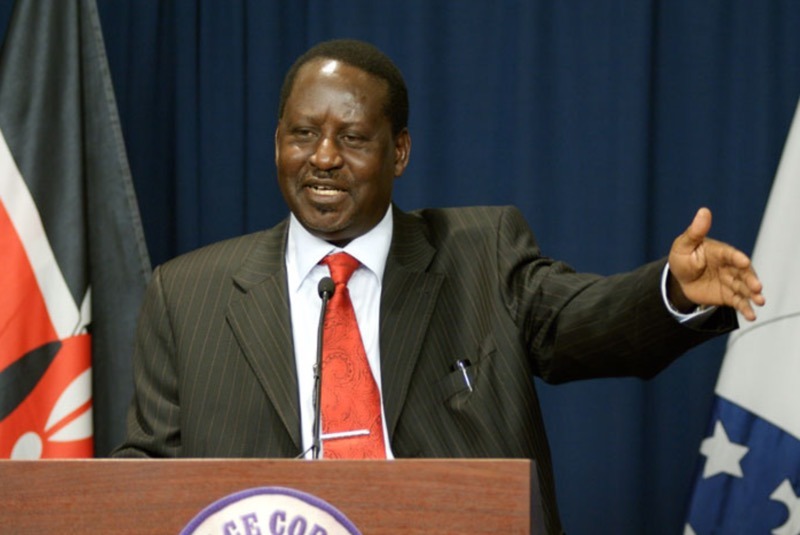
Raila Odinga (80) passed away while walking at an ayurvedic institution in Kerala. His remarkable life concluded unexpectedly while receiving treatment in India, a place he admired.
A five-time presidential contender who never ascended to Kenya’s highest office, Raila’s legacy is not found in electoral victories but in the democratic transformation of Kenya that he helped engineer, often at immense personal cost. I met Raila in 1996, when he had come forth to marshal some opposition stream into a political party. This was feasible since Moi introduced multiparty politics in 1992. Raila met me to seek investors for his languishing molasses plant in Western Kenya. That did not succeed, but his political activity increased.
His life was one of defiance, reinvention, and contradiction. Moreover, he had an enduring belief in the power of international solidarity. Nowhere was this more evident than in his deep respect for India, a country whose democratic ethos, anti-colonial history, and development trajectory mirrored many of the ideals Raila spent a lifetime championing in Africa.
Born into a politically active family — the son of Jaramogi Oginga Odinga, Kenya’s first vice president and a leading anti-colonial figure — Raila was no stranger to resistance. He entered politics not as an opportunist but as a freedom fighter, paying the ultimate price for challenging dictatorship.
Arrested after the failed 1982 coup attempt against President Daniel Arap Moi, he spent six years in detention without trial. He was tortured, subjected to mock executions and blindfolded isolation, but emerged unbroken.
Throughout this personal and political torment, Raila drew inspiration from other post-colonial democracies that had walked the difficult path of liberation. India, in particular, stood out to him as a model of resilience. In an interview, he remarked that “India’s democracy, despite its size and diversity, has weathered the storms of division and remained intact. That is the promise I want for Kenya.”
India’s history, from Gandhi’s nonviolent resistance to its post-colonial democratic experimentation, had deep parallels with Kenya’s journey. Raila saw India’s successful linkage of democracy and development as a beacon for African nations, often mentioning it in his speeches. He visited India multiple times, not only for medical reasons but also for high-level engagements, learning exchanges, and diplomatic outreach.
The Indian Connection: More Than Medicine
That Raila died in India is not incidental. He had long chosen the country for medical care, a testament to his trust in its healthcare system and the warm relations he cultivated with successive Indian administrations. But it was also symbolic of his deeper connection to the Indian people.
In 2009, while serving as Prime Minister (in a power-sharing government, where this post was created for him), Raila was instrumental in expanding diplomatic and trade relations between Nairobi and New Delhi. He pushed for enhanced educational exchanges, technology partnerships, and investment flows. His government helped facilitate scholarships for Kenyan students to study in Indian universities and negotiated business deals that benefited both nations.
He often spoke fondly of the Indian community in Kenya, a vital economic and cultural force, and credited their resilience and industriousness as central to Kenya’s development. “The Indian community has been part of the Kenyan story,” he said during the 2010 Diwali celebrations in Nairobi. “They remind us of what unity in diversity truly means.”
The Reluctant Insider
Raila’s political career is marked by dramatic paradoxes. A dissident turned prime minister, a reformist who made peace with the establishment he once fought, and a man who never won the presidency yet changed the presidency. His impact on Kenya’s democratic process is unrivalled. From fighting for multi-party democracy in the 1990s to triggering sweeping electoral reforms in the 2000s, Raila turned loss into leverage.
After the violent fallout of the 2007 elections, Raila accepted a power-sharing deal and became Prime Minister under President Mwai Kibaki. That uneasy partnership brought temporary peace and institutional reform but also revealed his pragmatic streak. He was never shy about compromising with power if it meant advancing the democratic project. Though a Luo from Western Kenya, he often competed or cooperated with Kikuyu Presidents.
In 2018, another contested election led to the now-famous “handshake” between Raila and President Uhuru Kenyatta, halting months of protest. That gesture, and the Building Bridges Initiative (BBI) that followed, won him praise as a statesman but criticism from his base for blurring opposition lines.
His final political act, a surprise alliance with President William Ruto in March 2025, was baffling and historic. It underscored a lifetime pattern: Raila would rather be at the negotiating table shaping the country’s future than shouting from the sidelines.
Beyond Borders: Pan-African Vision
From 2018 to 2023, Raila served as the African Union’s High Representative for Infrastructure Development, a role in which he championed regional connectivity and trade. His vision was of a continent united not only by roads and railways but by common purpose.
That vision, again, was shaped partly by India’s rise. He admired India’s role in the Global South, advocating for a multipolar world order and leading initiatives like the International Solar Alliance. Raila often cited India’s achievements in education, technology, and grassroots democracy as proof that developing nations could chart their own course without Western tutelage.
Though unsuccessful in 2025, his bid to chair the African Union Commission reflected this Pan-African ambition. He wanted Africa to speak with one voice, just as India had done in global platforms like BRICS and G20. Truly, the AUC Chairperson has said ‘He inspired generations of leaders, including myself, and citizens alike through his courage, resilience, and unwavering belief in the power of dialogue and democratic institutions.”
The Final Chapter: An End in India
Raila’s death in India adds poetic weight to his story. A life spent fighting for democracy ended in a nation whose democratic traditions he so admired. He died not in exile or silence, but as a respected elder statesman whose influence had long transcended borders and partisanship.
Kenya mourns not just a man, but a movement.
His Orange Democratic Movement (ODM) now faces the herculean task of surviving without its charismatic founder. The party’s lack of succession planning could trigger internal implosions or create new formations, further fragmenting the opposition.
Yet, even in his absence, Raila Odinga’s legacy endures — in every vote cast, protest allowed, and power-sharing deal negotiated. His life’s arc, from torture chambers to international diplomacy, is a chronicle of sacrifice, resilience, and unfinished dreams.
And somewhere in the cacophony of Kenya’s evolving democracy, one can still hear his voice, echoing with the conviction of a man who lost every election, but won the soul of a nation.
-30-
Copyright©Madras Courier, All Rights Reserved. You may share using our article tools. Please don't cut articles from madrascourier.com and redistribute by email, post to the web, mobile phone or social media.Please send in your feed back and comments to editor@madrascourier.com