The RSS’s Legacy Of Exclusion & The Battle For India’s Constitutional Values

RSS-Madras-Courier
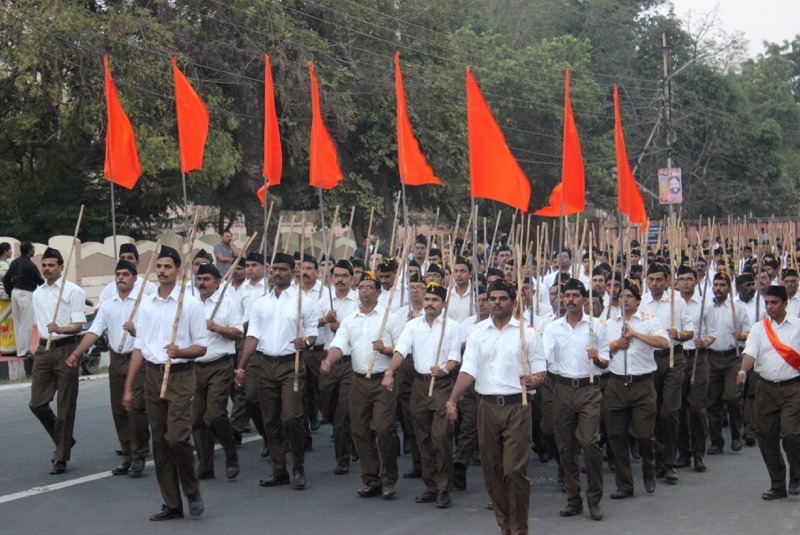
Representational image: Public domain/Wikipedia.
As the RSS celebrates a century of influence, the question that looms large is whether India’s commitment to secularism & pluralism can withstand the pressures of an increasingly exclusionary and majoritarian political climate.

The Rashtriya Swayamsevak Sangh (RSS), a Hindu nationalist organisation founded in 1925, recently marked its centenary. In recent decades, it grabbed power and moved into the centre stage, becoming a dominant force in Indian politics, primarily through its affiliations with the Bharatiya Janata Party (BJP), which has governed India for much of the last two decades.

The BJP’s close ties to the RSS have been a source of both power and controversy, particularly as the BJP has celebrated key figures in the RSS’s ideological pantheon. Among these figures are men whose legacy is entwined with an extremist, perverted version of Hindu nationalism that stands in stark contrast to the democratic values enshrined in the Indian Constitution.

For those familiar with the RSS’s founding principles, it is no surprise that the BJP has publicly honoured figures such as V.D. Savarkar, Shyama Prasad Mukherjee, and M.S. Golwalkar, three men who shaped the ideological backbone of the organisation. Their birthdays have been celebrated as national holidays, and their philosophies have been subtly, and at times explicitly, woven into the fabric of India’s political discourse. However, what is far more troubling is how the government has validated these controversial figures and their deeply exclusionary and extremist views.

At the heart of the RSS’s ideology is Hindutva, a vision of India where the Hindu identity, narrowly defined, reigns supreme. This concept, first articulated by Savarkar in the 1920s, asserts that India is a land exclusively for Hindus, a view that explicitly marginalises religious minorities—particularly Muslims and Christians.

Savarkar’s ideological heirs, like Golwalkar, took this doctrine even further. Golwalkar himself was often likened to fascist thinkers such as Hitler, particularly due to his endorsement of the idea of racial superiority. The RSS’s rejection of India’s secular, pluralistic Constitution has been a persistent thread throughout its history.

As the BJP acts as the RSS’s political arm, the tension between its ideological vision and the principles of the Indian state has grown more pronounced. The BJP’s champions of Hindutva—Savarkar, Golwalkar, and their ilk—offer a vision of India where religious and cultural homogeneity are paramount, and the political establishment’s embrace of this vision sends a message that the government’s commitment to secularism is waning.

Golwalkar’s vision of Hindu devotion, as outlined in his book Bunch of Thoughts, is chilling in its exclusivity and extremism. “Hindu society, whole and integrated, should forever be the single point of devotion for all of us,” he wrote, urging that no other consideration, be it caste, sect, language, or region, should interfere with this singular devotion.

His call for a “homogenous society,” in which the identity of the majority religious group is elevated as the ultimate form of devotion, is deeply troubling in a democratic society. When the ruling party backs these views, they embolden those who subscribe to them, empowering them to police society, impose their beliefs on others, and silence those who disagree. The validation of such rhetoric by the state has profound implications, not just for the political landscape but for the very nature of public discourse and social harmony.

The societal impact of such ideas is even more troubling. As Golwalkar’s call for a homogenous Hindu identity is amplified by the BJP’s policies, the consequences have been stark. The rise of vigilante groups, fuelled by a sense of ideological righteousness, has led to an alarming increase in violent atrocities against religious minorities, Dalits, and other marginalised groups.

These vigilantes, often acting with impunity, have found protection within the broader political establishment, which has refused to hold them accountable. In practice, this means that the legal protections guaranteed to citizens—especially those in historically oppressed communities—are systematically undermined. The erosion of these protections is not a minor issue; it is a direct assault on the foundational democratic principles of equality, justice, and the rule of law.

The glorification of figures like Golwalkar, whose views were explicitly shaped by a belief in racial superiority, further exacerbates these dangers. Golwalkar’s endorsement of the idea of an “Aryan” identity, a superior race, draws troubling parallels with the Nazi ideology. His emphasis on racial purity and his disdain for minorities mirrors the toxic thinking that led to some of history’s most horrific atrocities.

When the BJP, the political arm of this ideological movement, celebrates Golwalkar’s life and writings, it is not simply honouring a historical figure; it is endorsing a worldview that has the potential to divide the nation along increasingly dangerous lines. This ideological shift—an embrace of religious and cultural homogeneity—signals a pivot away from the pluralism that has long been at the heart of India’s national identity.

Golwalkar’s bigotry, however, was not confined to his views on race alone. In his writings, he took aim at Muslims, whom he saw as a threat to the Hindu identity of the nation. In Bunch of Thoughts, Golwalkar described Muslims as “invaders” whose hostility toward Hindu culture was “deep-rooted” and unchangeable.

His simplistic, one-dimensional view of India’s Muslims, which portrays them as perpetual enemies of Hinduism, has become a central tenet of the RSS’s rhetoric. The language of confrontation and division has seeped into the discourse of the BJP, leading to an atmosphere of fear, suspicion, and violence toward Muslims, even as they constitute one of India’s largest religious communities. This distortion of history and culture only deepens divisions, creating an “us vs. them” mentality that is both politically convenient and morally bankrupt.

The RSS’s treatment of India’s Muslim and Christian communities is symptomatic of a broader intolerance that threatens the nation’s social fabric. Golwalkar’s suggestion that Muslims should “return” to Hinduism, based solely on the religious identity of their forefathers, represents a fundamental denial of individual religious freedom.

His view directly contradicts the constitutional right to religious liberty enshrined in Article 25, which guarantees every citizen the right to practice, profess, and propagate their faith without interference. The idea that Muslims or Christians are, by virtue of their ancestry, obligated to return to Hinduism is not only legally indefensible but deeply dangerous in a country where religious pluralism has been a cornerstone of national identity since independence. This push to homogenise India’s religious identity risks turning the country into a place where personal faith and belief are dictated by the state, rather than an individual’s conscience.

As the BJP continues to advance the RSS’s agenda, celebrating figures like Golwalkar and promoting their views through policy and rhetoric, the question remains whether India can retain its democratic and secular character. The rise of Hindutva and the increasing legitimacy granted to its ideas pose a grave challenge to the pluralistic vision of India enshrined in its Constitution.

The question is not simply about political power or ideological supremacy, but about the soul of India. Can India, with its rich history of cultural and religious diversity, continue to thrive as a democracy that respects the rights and freedoms of all its citizens? Or will it succumb to the forces that seek to divide and conquer, turning the nation into a place where identity is defined not by the individual, but by the collective beliefs of a majority?

This is India’s great challenge as it enters the next chapter of its history. As the RSS celebrates a century of influence, the question that looms large is whether India’s commitment to secularism and pluralism can withstand the pressures of an increasingly exclusionary and majoritarian political climate.

The stakes could not be higher. India’s future and its place in the world as a beacon of democracy rest on its ability to uphold the values of equality, justice, and respect for diversity—values that have been under threat but are still worth defending for the sake of the nation’s future and the dignity of its people.

-30-

Copyright©Madras Courier, All Rights Reserved. You may share using our article tools. Please don't cut articles from madrascourier.com and redistribute by email, post to the web, mobile phone or social media.
Please send in your feed back and comments to [email protected]

0 replies on “The RSS’s Legacy Of Exclusion & The Battle For India’s Constitutional Values”