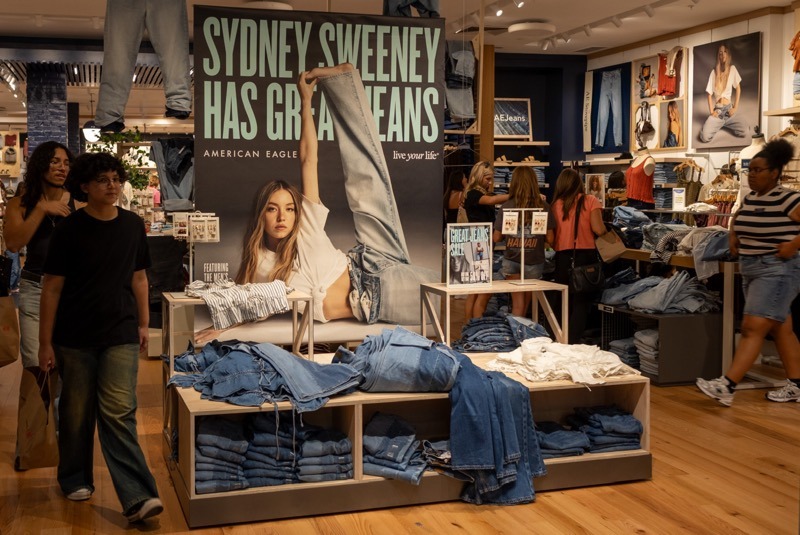
On 23 July 2025, a clothing company released an ad featuring young actress Sydney Sweeney. The company, which had been operating at a financial loss, ostensibly aimed to attract young female customers by showcasing Sweeney, who is known for her fair skin, blonde hair, and blue eyes. The tagline:
Sydney Sweeney Has Great Jeans.
This campaign played on the homophones “genes” and “jeans.” In the ad, Sweeney says, “Genes are passed from parents to offspring, determining characteristics like hair color, personality, and even eye color.” As the camera moves from her denim jeans and jacket to her face and eyes, she adds, “My genes (jeans) are blue,” implying that her eye colour is genetically inherited. The advertisement cleverly used this wordplay to link fashionable denim with inherited physical traits, aiming to convey literal and metaphorical “good jeans.”
Initially, the ad went viral on social media platforms like TikTok, Instagram, and YouTube, quickly gaining widespread attention. However, the reaction was not entirely positive. Many netizens questioned the need to reference genetic inheritance in a jeans advertisement. Why, they asked, did the line “my jeans are blue” focus on her eye colour rather than the clothing itself?
These questions sparked a wave of backlash, with online discourse escalating rapidly. Critics accused the advertisers of flirting with eugenicist ideas, and soon, allegations of white supremacist undertones and even Nazism began circulating.
Within days, amid the intensifying controversy, the company pulled the advertisement. Nonetheless, during this brief window, the company’s share prices (NYSE: AEO) surged by 24 per cent—its most significant rise since 2000. The ad’s marketing success drew comparisons to Brooke Shields’ Calvin Klein commercials from the 1980s, and Sweeney’s featured jeans quickly sold out in stores.
Despite the advertisement’s removal, public discussion continued. Sweeney herself remained silent, neither commenting nor issuing a statement on the matter. Meanwhile, political reactions poured in. On August 4, President Donald Trump tweeted: “Sydney Sweeney, a registered Republican, this is her hottest ad.” Soon after, Vice President JD Vance praised Sweeney as an “all-American beauty.”
Conservative media outlets like Fox News quickly aligned with the campaign and offered their support. Journalistic investigations soon confirmed that Sweeney had indeed registered as a Republican in Florida on 14 June 2024 — very conveniently, just one month before the ad’s release.
Adding fuel to the fire, photos from Sweeney’s mother’s birthday party surfaced, showing guests wearing MAGA hats. In response, Trump publicly reaffirmed his endorsement of the advertisement.
Trump’s support, however, must be seen in the broader context of his political strategy. His rhetoric has long revolved around appealing to white identity politics — and by amplifying manufactured anxieties about declining white social dominance.
Trump has repeatedly portrayed the Black Lives Matter movement as anarchic while defending participants in the Charlottesville “Unite the Right” rally. The Republican Party, under his leadership, has often been viewed as the voice of white Americans who feel threatened by demographic changes. That Sweeney — a registered Republican — featured in a controversial ad with racist undertones, and that this ad was publicly defended by both the President and Vice President of the United States, is far from incidental.
The White House spokesperson Steven Cheung dismissed the criticism, labelling it “cancel culture run amok.”According to Cheung and other right-wing commentators, the backlash reflected excessive “woke” extremism, where even minor missteps are met with disproportionate outrage. They argued that the public had overinterpreted the ad and unfairly targeted both Sweeney and the clothing brand.
Yet, many critics see the situation differently. The ad’s messaging—linking blue eyes and genetic inheritance to “good jeans”—echoed disturbing eugenicist language. The phrase “good jeans” may seem benign in modern fashion marketing, often used to complement attractiveness, but its historical undertones are far more sinister.
Beneath this seemingly playful wordplay lies the legacy of eugenics: a discredited ideology that sought to engineer “better” humans through selective breeding.
Eugenics, which originated in the nineteenth century and gained traction in the early twentieth century, was promoted under the guise of scientific progress. In practice, it fueled racism, ableism, and systemic discrimination.
The ideology was used to justify forced sterilisations, social exclusion, and ultimately contributed to the genocidal policies of Nazi Germany. Although widely condemned today, the language and assumptions of eugenics still surface in subtle ways—especially when beauty and desirability are linked to specific, often Eurocentric, traits.
Understanding Trump’s support for the advertisement requires examining his broader policies and political agenda. Since January, his administration has declared a national emergency at the U.S.–Mexico border, blocked entry to asylum seekers, initiated mass immigration raids, and pushed for self-deportation policies.
Furthermore, efforts to dismantle diversity, equity, and inclusion (DEI) initiatives have sparked alarm among civil rights advocates. Trump’s rally speeches often invoke themes of genetic purity and national decline. Last October, he referred to undocumented immigrants as having “bad genes,” and claimed they were “poisoning the blood of our country”—language that chillingly echoes Adolf Hitler’s Mein Kampf.
Such rhetoric resonates with a growing segment of the Republican base. A University of Massachusetts poll in October 2024 found that two-thirds of Republican voters supported Trump’s geneticist language. Public figures like Tucker Carlson and Elon Musk have also promoted the Great Replacement Theory — an ideology positing that immigrants are demographically and culturally replacing white Americans. The Republican Party amplified this theory during the 2024 campaign, accusing Democrats of importing voters through immigration. Against this backdrop, American politics continues to slide into darker territory.
The lingering shadow of eugenics in modern media and advertising remains troubling. Traits like beauty, purity, and attractiveness are still culturally associated with “good genes,” despite the discrediting of eugenics as a scientific field. While the phrase may now seem innocuous, it carries a dangerous legacy of social engineering, forced sterilisation, and systemic injustice. The eugenics movement cloaked bigotry in scientific legitimacy, promoted racism, misogyny, ableism, and the ideology of racial superiority.
Even today, when terms like “good genes” appear in ads or political speeches, it’s crucial to understand their historical weight. Science must serve equality and human dignity—not discrimination or exclusion. The history of eugenics stands as a stark warning. The blue jeans advertisement is not just a fashion misstep. It is a contemporary echo of a long and horrifying past.
-30-
Copyright©Madras Courier, All Rights Reserved. You may share using our article tools. Please don't cut articles from madrascourier.com and redistribute by email, post to the web, mobile phone or social media.Please send in your feed back and comments to [email protected]