How White Victimhood & ‘White Rage’ Fuel MAGA Politics

Maga-politics-madras-courier
Representational image: Public domain.
Without a willingness to confront uncomfortable realities surrounding the myth of white victimhood, the United States risks remaining colour-blind.

Amadou Diallo, a black immigrant from Guinea, was standing on his apartment building stoop in the Bronx, shortly after midnight, when he was confronted by four NYPD police officers of the Street Crime Unit (SCU). As Diallo reached for his wallet to present identification, the officers indiscriminately fired at him 41 times, of which 19 bullets struck and ravaged his body. His death sparked a nationwide outrage over police brutality, racial profiling, and the phenomenon of “Contagious Fire”.

The following year, in 2000, a predominantly white jury acquitted the police officers of all charges, including manslaughter and homicide. In a country with a sordid history of apartheid and racial violence, it warrants reflection and logical supposition: What might the judicial outcome have been if the roles were reversed – if an unarmed white man had been shot and killed unprovoked by four Black officers under similar circumstances?

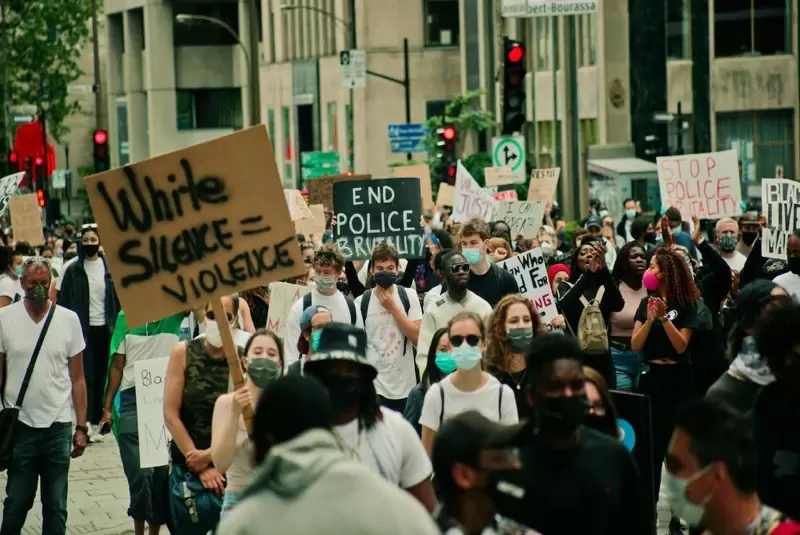
The fatal shooting of Michael Brown, an African American teenager, by a white police officer in Ferguson, Missouri, on August 9, 2014, ignited widespread protests and civil riots. All mainstream news channels, including CNN, MSNBC and Fox News, were live-streaming a burning Ferguson – the arson, pillaging, besieging and besmirching of the town by black protestors – and condemning the violence as unleashing of “Black Rage.”

In truth, the tragedies of Amadou Diallo and Michael Brown reflect what Carol Anderson, a renowned professor at Emory University, describes as “White Rage.” In her book, “White Rage: The Unspoken Truth of Our Racial Divide,” Anderson argues that these acts of violence and the subsequent partisan judicial outcomes are expressions of deeply rooted, systemic anger and resistance within white America, rather than simply isolated incidents of racial tension.

White rage is a culmination of white victimhood. Its historic roots could be traced back to the American Civil War. The victory gained by the Abolitionists of the North didn’t quite ameliorate the plight of the enslaved black population across the United States. The Confederates of the South bemoaned the economic loss of chattel slavery and connived for a sociopolitical backlash against the Blacks, who erroneously believed they were emancipated.

The legislatures in the Southern states created the Black Codes and Jim Crow laws to reinstate white supremacy by segregating blacks in public places, limiting their voting rights, legitimising indentured labour with zero mobility, and thereby undermining every tenet of democracy. The sweeping white resentment across the southern states ferociously fought to neutralise the 13th, 14th and 15th amendments. They even welcomed the 1876 Supreme Court’s ruling in the United States vs Cruikshank case by undercutting a law aimed at defusing the terror of the Ku Klux Klan.

The landmark Brown vs The Board of Education ruling of 1954 was another pivotal moment in Black history, paving the way for racial integration in public schools and ruling the unconstitutionality of segregated schools for white and coloured children. But the black children were greeted by white mobs with bricks blocking school entrances in an escalation of white rage.

Disillusionment among Black Americans intensified in 1956 when 19 senators and 82 representatives signed the Southern Manifesto, challenging the Brown decision. In response, governors in southern states such as Alabama, Arkansas, Virginia, and Georgia formulated an “interposition” doctrine, asserting that any federal law could be invalidated if a state opposed it.

To further resist racial integration, these states enacted laws specifically designed to withhold funding from schools that complied with the Brown decision. As a result, desegregated schools were forced to close. At the same time, white students continued their education in racially exclusive private academies—actions that openly defied federal law and were subsidised by taxpayer dollars.

White intolerance against Blacks and people of colour has historically stemmed from the fear that privileges enjoyed by the white population will erode with the social upliftment of marginalised groups. This enduring prejudice underpins the concept of white victimhood, which asserts that whites are an exclusive biological race, racially superior to other ethnic and racial groups, but also are becoming highly vulnerable and exposed to the risk of losing their distinct hierarchical advantages. Such ideas are the foundation for ultra-racial ideologies that fuel white nationalism.

The drive to maintain a distinct White, European cultural identity leads to demands for preferential treatment, the creation of segregated and gated communities, and advocacy for legal protections that safeguard these constructed privileges. White victimhood thus becomes a rationale for social and political movements intended to preserve existing power structures and resist changes that might endanger the status quo.

The election and re-election of President Obama profoundly intensified anxieties among ultra-conservative white Republicans, who viewed his presidency as a tangible sign of a shifting racial landscape. For many, the idea that Obama—a descendant of people once subjected to chattel slavery—could ascend to the most powerful office in the world was deeply unsettling.

Voter suppression and mandatory photo ID laws emerged as a response to perceived post-racial optimism in the US. When these laws were passed, 25 per cent of Black Americans lacked government-issued photo IDs, compared to 8 per cent of White Americans, making it harder for Black voters to access ballots. Consequently, an estimated six million Black Americans could lose their voting rights as a result, according to a joint report by the NAACP Legal Defence and Education Fund and the NAACP.

The rise of Donald Trump — a divisive figure with dubious business credentials and poor political expertise — can be attributed mainly to the intensification of white grievance. Trump positioned himself as the antithesis of Barack Obama, standing in stark opposition to Obama’s secular, non-racial, progressive, and inclusive vision for America.

For the Republican Party, which had increasingly shifted toward a fanatical, far-right stance, Trump emerged as a saviour. He rallied supporters under the slogan “Make America Great Again,” promising a return to a bygone era defined by unbridled white dominance and unhinged privileges. The MAGA movement became a rallying cry for white racial revanchism, systematically undermining the aspirations of marginalised communities and seeking to dismantle the progress and hope that had begun to take root towards a post-racial United States.

Trump’s white supremacist rants have often mirrored historical patterns of bigotry and xenophobia. His claims that immigrants are “poisoning the blood of the country” draw disturbing parallels to the hate-filled language found in Hitler’s autobiography, Mein Kampf.

Derogatory remarks and dehumanising language became a common feature of Trump’s public discourse. In 2018, he referred to Haitian and African immigrants as people coming from “shithole” countries. Again, during his 2024 campaign trail, he derided illegal immigrants as “animals.” Both statements have sparked international outrage and further highlighted the underlying prejudice in his views.

Trump repeatedly cast undocumented immigrants as the source of rising crime rates in the United States. He leveraged this narrative to advocate for stringent immigration measures and to appeal to his white voter base. In contrast, he extended refugee status to white Afrikaners from South Africa, citing rural crime and farm deaths as justification—issues that, in fact, affect all groups within the country, not just whites.

Donald Trump’s political overtures are primarily driven by self-promotion rather than lofty ideological convictions. He employs inflammatory language, as seen in his characterisation of Latino immigrants from Mexico as “rapists.” Trump has also associated with known white supremacists, such as Nick Fuentes—a Holocaust denier—demonstrating a willingness to align himself with white extremist figures for political gain. To appease Christian Zionists, he bombs Iranian nuclear facilities, supplies arms and aid to Israel, and fetes Benjamin Netanyahu — against whom the International Criminal Court has issued an arrest warrant — as a war hero for waging an inhuman war against women, children, and civilians of Gaza.

The underlying motive behind these actions is the deliberate courting of a neo-Confederate white Christian American voter base, a group increasingly anxious about perceived threats to their economic and social standing. This anxiety is often articulated through the “Great Replacement” theory, which fuels fears of job loss and diminishing prospects due to the influence of Jews, Communists, immigrants, and liberals. Echoing the convictions of white extremists who believe in the supremacy of their race, Trump’s diatribe is predictably against Black, Hispanic, and Asian communities, reinforcing divisive narratives and deepening existing societal fractures.

The assertion that immigrants, Black, and Hispanic individuals negatively impact employment opportunities for white workers lacks empirical evidence. Data from 2000 to 2022 indicate that the unemployment rate among Black Americans has consistently exceeded that of White high school dropouts, and across five college major categories, Black graduates experience double the unemployment rates of their White counterparts.

A major source of White grievance is the loss of manufacturing in the Rust Belt. This was largely due to the large-scale financialisation of the US economy, which led to the outsourcing of manufacturing — first to Mexican “Maquiladoras,” then to the Far East and ultimately to China. The malefactor was the greed for short-term profits by hawkish US corporations, not immigrants and people of colour.

Similarly, claims regarding the negative impacts of immigrant labour lack credibility. Data indicate that, in 2023, the unemployment rate for U.S.-born workers reached a record low of 3.6%. The labour force participation rate among prime-age (25-54) U.S.-born individuals was 81.4 per cent, up from 80.7 per cent in 2019, with the prime-age Labour Force Participation Rate (LFPR) reaching a historic peak of 83.9 per cent. The United States has greatly benefited from immigrant talent, notably through the H1-B visa program, which allows employers to recruit highly skilled professionals globally, thereby enhancing competitiveness and innovation beyond what could be achieved by relying solely on native labour.

Projections from the Congressional Budget Office (CBO) estimate that the recent surge of immigrants will add $8.9 trillion or 3.2 per cent of GDP in the next decade. Additionally, the National Bureau of Economic Researchhas established that immigrants are 80 per cent more likely to become entrepreneurs than native-born workers.

The repercussions of white rage as a consequence of white victimhood are not exhibited through overt demonstrations on the streets, encountering water cannons and rubber bullets. However, it is expressed more subtly through the militarisation of police, legislative manoeuvres in Congress and discriminatory judicial practices.

This quiet but profound opposition to racial equity forms the foundation of the controversial “Critical Race Theory” (CRT). CRT posits that racism is not merely the result of individual acts, but is woven into the fabric of social institutions—including the criminal justice system, education, labour markets, housing, and healthcare. The compelling argument is that if social institutions are laced with racism, it can exist without racists.

By embedding discriminatory practices within systemic frameworks, these institutional mechanisms effectively safeguard the status quo, ensuring that the longstanding advantages associated with whiteness are maintained even as America’s social landscape evolves. The American sociologist W.E.B. Dubois called these enduring social and psychological privileges “the wages of whiteness.”

Those who espouse the narrative of white victimhood are often individuals who view 100 per cent white representation as an inherent right; when this dominance diminishes even marginally to 98 per cent, they perceive it as a grave injustice and a sign of discrimination.

In the United States, the topic of racism and the legacy of slavery—often referred to as “the original sin”—remains deeply uncomfortable and contentious within white communities. Discussions are frequently met with defensiveness that centres on individual experiences rather than acknowledging broader societal patterns.

Most white individuals express that they were raised to be non-racist, point to having people of colour within their families, reference marching in the Civil Rights Movement of the 1960s, or cite participation in initiatives such as “Teach for America” as evidence of their commitment to racial equality.

Robin DiAngelo, in her book White Fragility: Why It’s So Hard for White People to Talk About Racism, describes this defensiveness as “White Fragility.” Hesitancy to engage with criticism or collective responsibility impedes constructive dialogue on racial inequity.

However, such defensiveness and reliance on personal narratives and individual accomplishments have not resolved the issue of racial inequity in American society. Without a willingness among white Americans to confront the uncomfortable realities surrounding the myth of white victimhood and resultant white rage, the United States risks remaining deceitfully colour-blind—unable to move toward a society that is truly colour-free.

-30-

Copyright©Madras Courier, All Rights Reserved. You may share using our article tools. Please don't cut articles from madrascourier.com and redistribute by email, post to the web, mobile phone or social media.
Please send in your feed back and comments to [email protected]

0 replies on “How White Victimhood & ‘White Rage’ Fuel MAGA Politics”